
Pentair IntelliFlo3 1.5 HP vs. 3.0 HP: Which Size Do You Need?
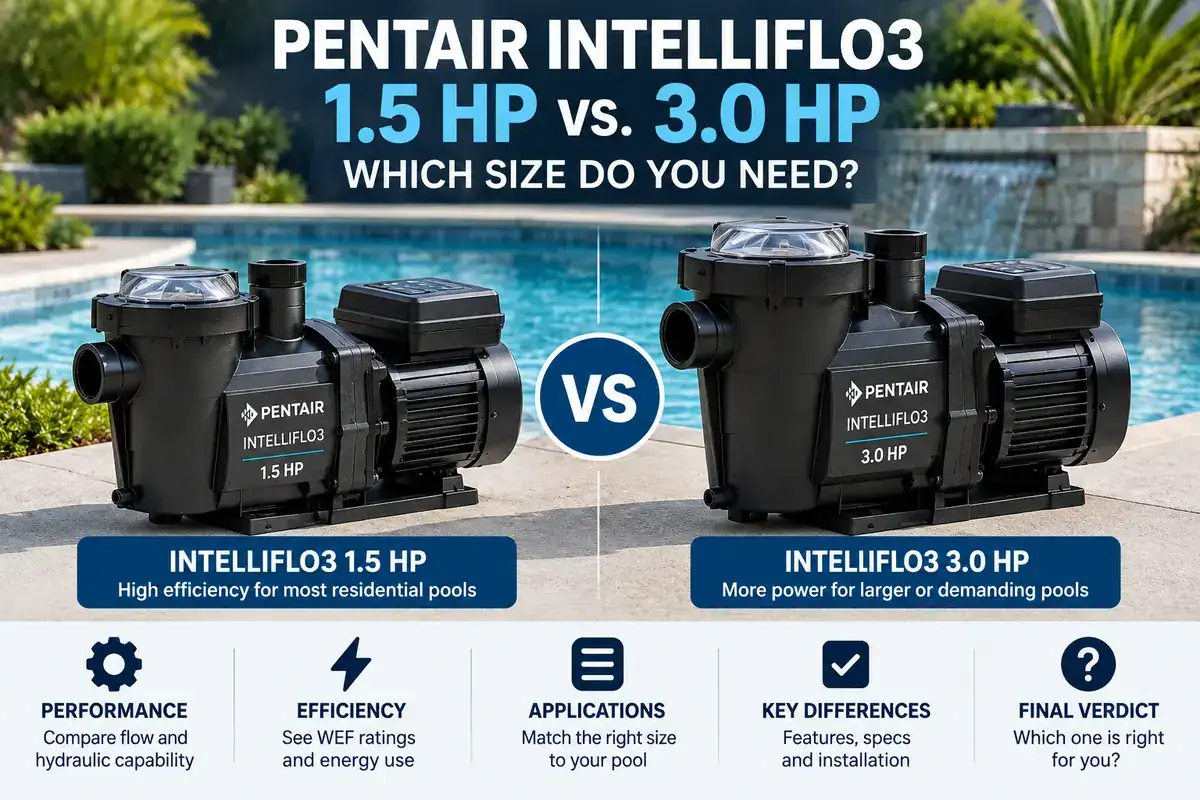
Pentair offers the IntelliFlo3 Variable Speed & Flow pump in both 1.5 and 3.0 total-horsepower versions. While the 3.0 HP model provides greater hydraulic capability, bigger is not automatically better. The right choice depends on your pool's required flow, plumbing, attached equipment, voltage, and peak-demand features such as spas and waterfalls.
Quick Answer: IntelliFlo3 1.5 HP vs. 3.0 HP
The Pentair IntelliFlo3 1.5 HP and 3.0 HP are variable-speed-and-flow pumps designed for different hydraulic requirements. The 1.5 HP model can serve many conventional residential pools, while the 3.0 HP model provides additional capacity for systems with greater flow demands.
The deciding factor is not pool gallons or horsepower alone. It is whether the pump can deliver the required gallons per minute (GPM) against the resistance of your actual plumbing and equipment.
Electrical service also matters. The 1.5 HP model supports both 115-volt and 208–230-volt configurations, while the 3.0 HP model requires 208–230 volts.
IntelliFlo3 1.5 HP vs. 3.0 HP at a Glance
| Specification | IntelliFlo3 1.5 HP | IntelliFlo3 3.0 HP |
|---|---|---|
| Total horsepower | 1.5 THP | 3.0 THP |
| Published WEF | 9.4 | 7.1 |
| Voltage | 115 V or 208–230 V | 208–230 V |
| Full-load amps | 12 A at 115 V; 6.4–5.9 A at 208–230 V | 12.4–11.2 A |
| Port configurations | 1.5" × 1.5" or 2" × 2" | 2" × 2", 2.5" × 2.5" or optional 3" × 3" |
| Listed weight | 48 lb | 55 lb |
| Hydraulic application | Systems whose required flow is within the smaller model's performance range | Systems requiring additional hydraulic capacity |
These are the model specifications used for this comparison. Confirm the current Pentair documentation for the exact model and configuration before purchasing, particularly when electrical requirements or plumbing connections are critical.
For a broader explanation of pump sizing, flow, efficiency and variable-speed operation, see our Complete Guide to Pool Pumps.
The Biggest Difference Is Hydraulic Capacity
The primary reason to move from the 1.5 HP IntelliFlo3 to the 3.0 HP model is that the pool system requires more hydraulic performance.
A pool pump must produce sufficient flow while overcoming resistance from plumbing, filters, heaters, valves, fittings and other equipment.
Two pools with the same water volume can have very different hydraulic requirements.
Example: Two Pools With Different Equipment
Consider two hypothetical 18,000-gallon pools.
| System Feature | Pool A | Pool B |
|---|---|---|
| Pool volume | 18,000 gallons | 18,000 gallons |
| Plumbing | Relatively short, straightforward runs | Longer runs with additional equipment |
| Spa | None | Attached spa with jets |
| Water features | None | Waterfall and deck jets |
| Peak flow requirement | Determined primarily by pool circulation and connected equipment | May be substantially higher during spa or water-feature operation |
Pool A may have modest hydraulic requirements despite its water volume. Pool B may require considerably more pump capacity when certain features operate.
The correct comparison uses each system's required flow and total dynamic head (TDH), followed by the manufacturer's pump performance curves.
When the IntelliFlo3 1.5 HP Makes Sense
The 1.5 HP IntelliFlo3 is worth evaluating for residential pools without unusually demanding hydraulic requirements.
Applications to investigate include:
- Conventional residential swimming pools.
- Pool-only circulation systems.
- Systems with moderate required flow.
- Compatible installations using 1.5-inch or 2-inch plumbing.
- Replacement installations where 115-volt capability is useful.
- Systems without substantial high-flow requirements.
The essential question is whether the smaller pump can produce the required GPM at the system's actual resistance.
If it meets all required operating conditions, the additional horsepower of the larger model may not provide a practical benefit.
Example: A Pool With Modest Circulation Requirements
An 18,000-gallon pool has a theoretical average flow requirement of 37.5 GPM for an eight-hour turnover:
18,000 ÷ (8 × 60) = 37.5 GPM
This establishes a circulation reference, not a final pump specification.
The next step is to determine whether the pump can deliver the necessary flow at the system's actual TDH while meeting the requirements of the filter, heater and any other connected equipment.
If the 1.5 HP model satisfies every required operating condition, the pool may not need the additional capacity of the 3.0 HP version.
Shopping for the 1.5 HP model? The Amazon link below is for the Pentair IntelliFlo3 VSF 1.5 HP, model 011065. Verify that the exact model matches your electrical, plumbing, automation and hydraulic requirements before purchasing.
Check IntelliFlo3 1.5 HP Price on Amazon
When the IntelliFlo3 3.0 HP Makes Sense
The 3.0 HP IntelliFlo3 provides additional hydraulic capacity for systems with greater flow requirements.
Applications that may require evaluation of the larger model include:
- Pool-and-spa combinations.
- High-flow spa jets.
- Waterfalls and other water features.
- Negative-edge pools.
- Long plumbing runs.
- Larger-diameter plumbing systems.
- Systems with higher peak-flow requirements.
- Equipment configurations with substantial hydraulic demands.
The additional capacity can allow the pump to meet higher peak demands while still operating at reduced speed during normal filtration.
However, the presence of a spa, heater or water feature does not automatically establish that the 3.0 HP model is necessary. The required flow and system resistance must still be calculated.
Does a Bigger Pool Automatically Need the 3.0 HP?
No. Pool volume matters when determining circulation requirements, but gallons alone should not determine pump horsepower.
A large pool with efficient plumbing and modest equipment requirements can sometimes have lower hydraulic demands than a smaller pool with restrictive plumbing, a raised spa, multiple water features and complicated equipment.
Compare Required Flow, Not Just Pool Gallons
Theoretical average circulation flow can be calculated using:
Pool Volume ÷ Circulation Time in Minutes = Average GPM
| Pool Volume | 8-Hour Circulation | 10-Hour Circulation |
|---|---|---|
| 10,000 gallons | 20.8 GPM | 16.7 GPM |
| 15,000 gallons | 31.3 GPM | 25 GPM |
| 20,000 gallons | 41.7 GPM | 33.3 GPM |
| 25,000 gallons | 52.1 GPM | 41.7 GPM |
| 30,000 gallons | 62.5 GPM | 50 GPM |
These figures represent theoretical average flow for one turnover during the stated period. They do not account for actual system resistance, peak equipment demands or site-specific circulation requirements.
Our How to Size a Variable-Speed Pool Pump guide explains the factors to consider before selecting pump capacity.
What the WEF Ratings Mean
The specifications used for this comparison list a Weighted Energy Factor (WEF) of 9.4 for the 1.5 HP IntelliFlo3 and 7.1 for the 3.0 HP model.
WEF is the Department of Energy efficiency metric used for covered dedicated-purpose pool pumps. It measures water moved relative to electrical energy consumed under the applicable standardized test procedure.
A higher WEF indicates greater efficiency under that test procedure, but it does not establish which pump will consume less electricity in every real-world installation.
Why WEF Is Not the Only Efficiency Consideration
The two IntelliFlo3 models have different hydraulic capabilities.
If a pool requires flow that the 1.5 HP model cannot provide at the system's operating head, the smaller model's higher WEF does not make it a suitable substitute.
Likewise, buying the 3.0 HP model does not automatically mean the pump must operate at high speed throughout the day.
Actual energy consumption depends on the operating flow, system resistance, pump efficiency and programmed runtime.
Will the 1.5 HP Use Less Electricity?
Not necessarily in every operating situation.
Variable-speed pumps can operate across a range of speeds. Actual electricity consumption depends on how the pump is programmed and how much flow the pool requires.
A properly sized pump operating at an appropriate reduced speed can be efficient. Operating either model at unnecessarily high speed can increase energy consumption.
Example: Why Runtime and Power Both Matter
Consider two hypothetical pump schedules. These are illustrative electrical measurements, not published IntelliFlo3 performance figures.
| Operating Schedule | Average Electrical Draw | Runtime | Daily Energy |
|---|---|---|---|
| Schedule A | 300 watts | 12 hours | 3.6 kWh |
| Schedule B | 900 watts | 6 hours | 5.4 kWh |
Daily electricity use is calculated as:
Power (kW) × Runtime (hours) = Energy (kWh)
At a hypothetical electricity rate of $0.18 per kWh:
- Schedule A costs approximately $0.65 per day.
- Schedule B costs approximately $0.97 per day.
These examples illustrate how different operating schedules affect energy consumption. They do not establish the performance or operating cost of either IntelliFlo3 model.
The goal is to select a pump that meets peak requirements while allowing efficient reduced-speed operation during normal circulation.
For a closer look at energy use, see How Much Does a Variable-Speed Pool Pump Cost to Run?.
Voltage Is an Important Difference
The electrical requirements can be particularly important for replacement installations.
The specifications used for this comparison list the 1.5 HP IntelliFlo3 for 115-volt or 208–230-volt operation.
The 3.0 HP IntelliFlo3 requires 208–230 volts.
| Existing Electrical Supply | What to Verify |
|---|---|
| 115 V | Whether the exact 1.5 HP configuration is compatible and the circuit meets its requirements. |
| 208–230 V | Whether the circuit and installation meet the requirements of the selected model. |
| Unknown | Have the existing supply and circuit capacity verified before purchasing. |
The 1.5 HP model's dual-voltage capability can be useful when replacing a pump on an existing 115-volt circuit, provided it has sufficient hydraulic capacity.
Electrical compatibility involves more than matching voltage. The installation must also meet the manufacturer's circuit, wiring, grounding and bonding requirements and applicable electrical codes.
Have electrical work performed by a qualified professional.
Plumbing Connections Are Different
The 1.5 HP model is available with 1.5-inch or 2-inch port configurations.
The 3.0 HP model has larger connection options, including 2-inch, 2.5-inch and optional 3-inch configurations.
This reflects the larger model's greater hydraulic capability, but connection size alone does not establish the flow a particular installation can safely support.
Example: Replacing a Pump on Existing Plumbing
Suppose an existing pool has 1.5-inch plumbing throughout much of its circulation system.
Installing a higher-capacity pump does not eliminate the resistance of that plumbing.
Before selecting the 3.0 HP model, evaluate the complete hydraulic system and confirm that the plumbing and connected equipment can accommodate the required flow.
Check the exact pump's connection configuration, physical dimensions and installation requirements before purchasing.
What About a Pool With a Heater?
A heater by itself does not automatically require the 3.0 HP model.
The pump must provide sufficient flow for the heater while remaining within the heater's acceptable operating range.
If the 1.5 HP model can produce the required flow at the pool's actual system resistance, the presence of a heater alone does not establish a need for the larger pump.
What to Check
- The heater's minimum required flow.
- The heater's maximum permitted flow, if specified.
- The pump's expected flow at the intended operating speed.
- The additional hydraulic resistance introduced by the heater.
- Any other equipment operating at the same time.
Our Complete Guide to Pool Heaters explains heater sizing, flow considerations and the differences between common heating systems.
What About a Saltwater Pool?
A salt chlorine generator does not automatically require a 3.0 HP pump.
The circulation system needs enough flow to satisfy the salt system's operating requirements.
Many conventional residential systems can meet these requirements without exceptionally high flow, but compatibility must be confirmed for the specific equipment.
Check the salt chlorinator's documentation before determining the minimum operating flow and required pump schedule.
For more about salt cells, circulation, sizing and chlorine production, see our Complete Guide to Saltwater Pool Systems.
What About a Pool With a Spa?
An attached spa can substantially change the required pump capacity.
Normal pool filtration may need relatively modest flow, while spa jets can require considerably more.
Example: Two Operating Modes
Consider a hypothetical pool-and-spa system:
| Mode | Illustrative Required Flow |
|---|---|
| Daily pool filtration | 40 GPM |
| Spa jet operation | 100 GPM |
These are hypothetical requirements, not IntelliFlo3 performance specifications or recommended spa-jet flow rates.
The example demonstrates why sizing the pump around everyday filtration alone can overlook a much higher peak-flow requirement.
The pump's performance curve must be checked at the TDH associated with each operating mode.
Where the system genuinely requires additional hydraulic capacity, the 3.0 HP model may be worth evaluating.
What About Waterfalls and Water Features?
Water features can also increase required flow substantially.
A decorative bubbler may add modest demand, while large waterfalls, multiple deck jets or a negative-edge system can require significantly greater hydraulic capacity.
The 3.0 HP IntelliFlo3 may be appropriate for a feature-heavy pool even when normal filtration could be handled by the smaller model.
Before selecting a pump, determine which features operate simultaneously and whether they use the main circulation pump or a separate dedicated pump.
Don't Size the Pump From Horsepower Alone
The most useful way to compare the two models is to determine the flow the system needs and compare that requirement with the manufacturer's pump performance information.
Review the following:
- Required filtration flow.
- Pool volume.
- Plumbing diameter and layout.
- Approximate total dynamic head.
- Filter flow and pressure limits.
- Heater flow requirements.
- Salt-system flow requirements.
- Spa flow requirements.
- Water-feature requirements.
- Available electrical service.
- Automation compatibility.
The pump must handle the most demanding required operating mode while allowing efficient reduced-speed operation during routine circulation.
You can use our Pool Pump Sizing Calculator as a starting point for estimating circulation requirements, and our How Many GPM Should a Variable-Speed Pool Pump Run? guide for more detail on flow rates.
Is the 3.0 HP Model Too Big for a Normal Pool?
Variable-speed operation changes the traditional concept of an oversized pump because a larger variable-speed pump does not have to operate at full output throughout the day.
However, that does not mean every pool benefits from purchasing the largest available model.
If the 1.5 HP version meets every required operating condition, additional capacity may go unused.
A larger pump also does not make restrictive plumbing, undersized filters or other equipment limitations disappear.
Evaluate the complete system before deciding whether additional hydraulic capacity is useful.
Which Model Fits a Replacement Installation?
For a replacement installation, begin with the existing electrical supply, plumbing, automation and required flow.
| Replacement Consideration | What to Verify |
|---|---|
| Electrical supply | Available voltage, circuit capacity and manufacturer requirements. |
| Existing plumbing | Pipe size, pump connections and hydraulic restrictions. |
| Current equipment | Filter, heater and salt-system operating limits. |
| Peak flow | Required flow for spas, cleaners and water features. |
| Automation | Compatibility and available control functions. |
| Equipment-pad space | Physical dimensions, access and required clearances. |
The 1.5 HP model's dual-voltage capability may simplify certain retrofit situations.
For systems already equipped with suitable 208–230-volt service and requiring greater hydraulic capacity, the 3.0 HP model is another option to evaluate.
If the pump will be integrated with a controller, see Pool Automation and Variable-Speed Pumps before assuming every pump and automation combination provides the same level of control.
A Practical IntelliFlo3 Selection Checklist
- Calculate required circulation flow. Use pool volume and the intended circulation schedule as a starting point.
- Identify peak operating requirements. Include spa jets, cleaners, heaters and water features.
- Estimate system resistance. Consider plumbing, fittings, equipment and the relevant operating configuration.
- Review both pump curves. Determine whether each model can deliver the required flow at the estimated TDH.
- Check connected equipment limits. Verify that the filter, heater and other components can safely handle the resulting flow.
- Confirm electrical compatibility. Check voltage, circuit requirements and installation instructions.
- Verify plumbing connections. Compare the exact model's port configuration with the existing installation.
- Review automation compatibility. Confirm the control features needed for your system.
- Evaluate normal operating efficiency. Consider expected speed, flow, runtime and energy use.
- Confirm the exact model. Check the manufacturer's current documentation before ordering.
Frequently Asked Questions
Is the IntelliFlo3 1.5 HP enough for a residential pool?
It can be sufficient for many residential pools, provided it delivers the required flow at the system's actual TDH and meets every relevant equipment requirement.
Do I need the IntelliFlo3 3.0 HP for a 20,000-gallon pool?
Not automatically. Pool volume establishes a starting circulation requirement, but the pump must be selected using actual flow and system resistance, including peak operating demands.
Does the IntelliFlo3 3.0 HP always use more electricity?
No universal comparison applies to every installation. Actual energy consumption depends on operating flow, pump speed, runtime and system resistance.
Which IntelliFlo3 model has the higher published WEF?
The specifications used in this comparison list a WEF of 9.4 for the 1.5 HP model and 7.1 for the 3.0 HP model. WEF describes standardized test efficiency, not suitability for every hydraulic system.
Can the IntelliFlo3 1.5 HP run on 115 volts?
The specifications used here list 115-volt and 208–230-volt configurations for the 1.5 HP model. Confirm the exact model and installation requirements before purchasing.
Can the IntelliFlo3 3.0 HP run on 115 volts?
The specifications used here list the 3.0 HP model for 208–230-volt operation. Confirm the exact product documentation and have the electrical installation evaluated by a qualified professional.
Does an attached spa require the 3.0 HP model?
Not necessarily. Determine the required flow for spa operation and compare it with each pump's performance at the system's estimated TDH.
Does a pool heater require a larger pump?
A heater adds flow requirements and hydraulic resistance, but it does not automatically require the larger model. Verify the heater's operating range and the pump's available flow.
Can either model work with a salt chlorine generator?
Compatibility depends on the salt system's required flow and the pump's ability to meet it under the actual operating conditions. Check the documentation for the specific chlorinator.
Can I replace my existing pump without changing the plumbing?
Possibly. Compare the exact pump's connections and dimensions with the existing installation, and verify that the plumbing and connected equipment can safely accommodate its operating flow.
Bottom Line
The IntelliFlo3 1.5 HP and 3.0 HP serve different hydraulic requirements. The smaller model may meet the needs of many conventional residential pools, while the larger model offers additional capacity for more demanding equipment configurations.
Determine the required GPM, account for system resistance and peak equipment demands, and compare both models against Pentair's pump performance information.
If the 1.5 HP IntelliFlo3 matches your system, the Amazon listing below is for model 011065. Verify the exact configuration and installation requirements before ordering.
How We Research
Pool Equipment Lab evaluates pool equipment using manufacturer specifications, documentation, compatibility requirements, operating costs, warranty information, and owner feedback when relevant. We do not claim hands-on testing unless we actually performed it.