
How Much Does a Variable-Speed Pool Pump Cost to Run?
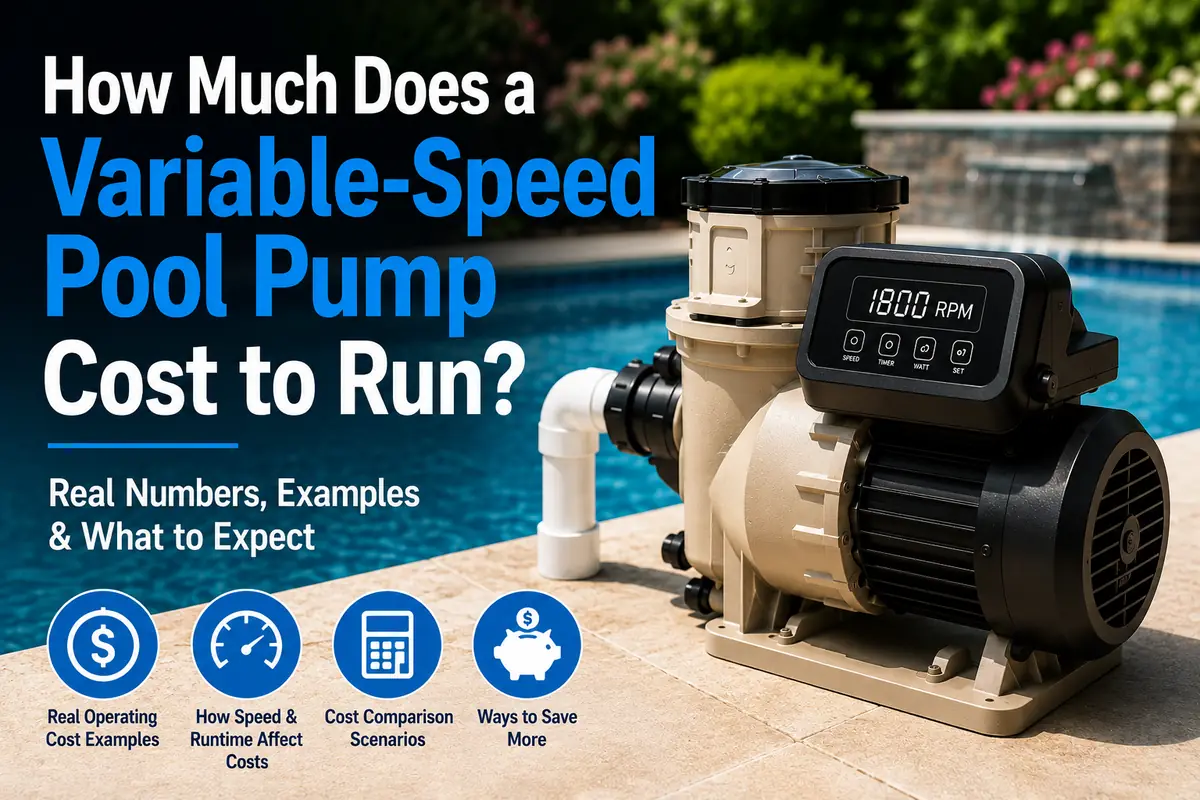
A variable-speed pool pump can cost dramatically less to operate than a traditional single-speed pump, but there isn't one annual cost that applies to every pool. Your actual electricity bill depends on how many watts the pump uses at each programmed speed, how long it runs, your local electricity rate, and how much flow your pool equipment requires.
Quick Answer: How Much Does a Variable-Speed Pool Pump Cost to Run?
A variable-speed pool pump's operating cost depends on how many watts it uses at each programmed speed, how long it operates and your electricity rate. For example, a pump drawing 500 watts for 10 hours a day at $0.16 per kilowatt-hour costs approximately $0.80 per day, $24 per 30-day month or $292 per year.
Those figures are illustrative, not estimates for every variable-speed pump. Actual consumption can differ substantially between pump models, speeds and plumbing systems.
For the most useful estimate, record the wattage and runtime of each programmed speed and calculate the electricity consumed by each operating period.
Operating Cost = (Watts ÷ 1,000) × Runtime in Hours × Electricity Rate per kWh
Enter your own numbers into our Pool Pump Operating Cost Calculator to estimate your operating expenses.
Variable-Speed Pool Pump Operating Cost at a Glance
The following table shows hypothetical operating costs at an electricity rate of $0.16 per kWh. It assumes the pump maintains the listed average electrical draw throughout its 12-hour daily schedule.
| Average Power | Daily Runtime | Daily Energy | Daily Cost | 30-Day Cost | Annual Cost |
|---|---|---|---|---|---|
| 200 watts | 12 hours | 2.4 kWh | $0.38 | $11.52 | $140.16 |
| 400 watts | 12 hours | 4.8 kWh | $0.77 | $23.04 | $280.32 |
| 600 watts | 12 hours | 7.2 kWh | $1.15 | $34.56 | $420.48 |
| 1,000 watts | 12 hours | 12 kWh | $1.92 | $57.60 | $700.80 |
| 1,500 watts | 12 hours | 18 kWh | $2.88 | $86.40 | $1,051.20 |
The table demonstrates why wattage and runtime must be considered together. It does not mean that a particular variable-speed pump will operate at any one of these wattages or provide adequate circulation at the associated cost.
How to Calculate Your Pool Pump's Electricity Cost
Calculating operating cost requires three measurements: electrical power, runtime and electricity price.
Step 1: Find Your Electricity Rate
Check your utility bill for the price you pay per kilowatt-hour (kWh).
Some utilities have different prices based on season, monthly consumption or time of day. If your electricity rate changes throughout the day, calculate the cost of each scheduled operating period using the applicable rate.
When evaluating potential savings, account for relevant energy-related charges rather than assuming the advertised base rate represents the full cost of additional electricity consumption.
Step 2: Find Your Pump's Actual Wattage
Many variable-speed pumps display or report electrical consumption through their controls or compatible applications.
If your pump provides this information, record the wattage at each speed you regularly use.
Do not assume that a particular RPM always corresponds to a specific wattage. Electrical consumption depends on the pump model, hydraulic resistance and operating conditions.
If wattage is unavailable, consult the manufacturer's performance documentation or obtain an appropriate electrical measurement.
Step 3: Record Your Daily Schedule
Suppose your pump uses the following hypothetical schedule:
| Operating Mode | Average Power | Daily Runtime |
|---|---|---|
| Low-speed filtration | 250 watts | 8 hours |
| Moderate-speed circulation | 600 watts | 2 hours |
| Higher-speed operation | 1,500 watts | 1 hour |
Calculate the energy consumption of each period separately.
Step 4: Calculate Daily Electricity Consumption
Low-speed filtration:
250 ÷ 1,000 × 8 = 2.0 kWh
Moderate-speed circulation:
600 ÷ 1,000 × 2 = 1.2 kWh
Higher-speed operation:
1,500 ÷ 1,000 × 1 = 1.5 kWh
Total daily electricity consumption:
2.0 + 1.2 + 1.5 = 4.7 kWh
Step 5: Calculate Daily, Monthly and Annual Cost
At a hypothetical electricity rate of $0.16 per kWh:
Daily cost: 4.7 × $0.16 = $0.752
30-day cost: $0.752 × 30 = $22.56
Annual cost: $0.752 × 365 = $274.48
| Period | Estimated Electricity Consumption | Estimated Cost |
|---|---|---|
| One day | 4.7 kWh | $0.75 |
| 30 days | 141 kWh | $22.56 |
| 365 days | 1,715.5 kWh | $274.48 |
This example assumes the same schedule and electricity rate throughout the year. Your actual annual cost may differ because of seasonal changes, equipment use and utility pricing.
Why RPM Has Such a Large Effect on Operating Cost
A variable-speed pump does not use the same amount of electricity at every operating speed.
For centrifugal pump systems, reducing speed can significantly reduce the electrical power required to move water.
This relationship is one reason variable-speed technology can reduce pool circulation energy consumption when lower-flow tasks are performed at reduced speeds.
However, the relationship between RPM and power consumption is affected by the pump and hydraulic system. Do not assume that cutting RPM in half will produce a particular percentage of energy savings in every installation.
Illustrative Power Consumption at Different Speeds
The following figures are hypothetical and are intended to demonstrate how electricity costs change with power consumption. They are not measurements or published performance specifications for a particular pump.
| Illustrative Operating Speed | Hypothetical Electrical Draw | Cost Per Hour at $0.16/kWh |
|---|---|---|
| 1,200 RPM | 150 watts | $0.024 |
| 1,600 RPM | 300 watts | $0.048 |
| 2,000 RPM | 600 watts | $0.096 |
| 2,600 RPM | 1,200 watts | $0.192 |
| 3,200 RPM | 2,000 watts | $0.320 |
Your pump may draw substantially different wattage at these speeds.
For guidance on selecting operating speeds, see What RPM Should I Run My Variable-Speed Pool Pump?.
Why Running Longer Doesn't Necessarily Cost More
A variable-speed pump operating for 12 hours can consume less electricity than a pump running for only six hours.
The determining factor is total energy consumption, not runtime alone.
Example: Comparing Two Pump Schedules
| Schedule | Average Power | Daily Runtime | Daily Energy | Daily Cost at $0.16/kWh |
|---|---|---|---|---|
| Lower-speed schedule | 300 watts | 12 hours | 3.6 kWh | $0.58 |
| Higher-speed schedule | 1,500 watts | 6 hours | 9 kWh | $1.44 |
The longer-running schedule consumes 60% less electricity in this hypothetical comparison.
However, the two schedules may move different volumes of water. They should not be treated as hydraulically equivalent without verifying actual flow.
Our guide to how long a variable-speed pool pump should run each day explains how speed and runtime can be balanced when developing a circulation schedule.
How Electricity Rates Change Your Pump Cost
The same pump schedule can have very different operating costs depending on your utility's electricity rate.
For example, consider a pump using 4.7 kWh per day.
| Electricity Rate | Daily Cost | 30-Day Cost | Annual Cost |
|---|---|---|---|
| $0.10/kWh | $0.47 | $14.10 | $171.55 |
| $0.15/kWh | $0.71 | $21.15 | $257.33 |
| $0.20/kWh | $0.94 | $28.20 | $343.10 |
| $0.25/kWh | $1.18 | $35.25 | $428.88 |
| $0.30/kWh | $1.41 | $42.30 | $514.65 |
The calculations use the same daily electricity consumption at every rate.
They demonstrate why your local electricity price is essential when evaluating potential savings or comparing replacement pumps.
Time-of-Use Pricing: Does It Matter When Your Pump Runs?
Some utilities charge different electricity rates depending on the time of day.
If your utility offers time-of-use pricing, shifting suitable filtration periods to lower-cost hours may reduce operating expenses.
Worked Example
Suppose your pump consumes 4 kWh during a scheduled filtration period.
| Electricity Period | Illustrative Rate | Energy Used | Operating Cost |
|---|---|---|---|
| Higher-priced period | $0.30/kWh | 4 kWh | $1.20 |
| Lower-priced period | $0.12/kWh | 4 kWh | $0.48 |
In this hypothetical example, operating during the lower-priced period saves $0.72 for the same amount of electricity.
However, not every operating period can necessarily be shifted. Heating, sanitation, skimming and other equipment requirements may determine when the pump needs to operate.
How Does a Variable-Speed Pump Compare With a Single-Speed Pump?
A traditional single-speed pump operates at essentially one motor speed whenever it is running.
A variable-speed pump can use reduced speeds for lower-flow tasks and higher speeds when additional flow is necessary.
This flexibility can reduce energy consumption, but the amount saved depends on the existing pump, replacement pump and operating schedule.
Illustrative Annual Cost Comparison
Consider two hypothetical schedules at $0.16 per kWh.
| Specification | Single-Speed Example | Variable-Speed Example |
|---|---|---|
| Daily energy consumption | 12 kWh | 4.7 kWh |
| Daily electricity cost | $1.92 | $0.75 |
| 30-day electricity cost | $57.60 | $22.56 |
| Annual electricity cost | $700.80 | $274.48 |
| Illustrative annual savings | $426.32 | |
This comparison assumes that both schedules satisfy the pool's circulation and equipment requirements. It is not a prediction of savings for a particular replacement.
Manufacturers may advertise substantial energy savings under defined comparison conditions. Those claims should be reviewed alongside their assumptions about runtime, pool size, electricity rates and pump performance.
For a broader technology comparison, see Variable-Speed vs. Single-Speed Pool Pumps.
If you're evaluating a replacement, compare available variable-speed pumps below. Verify the exact model's hydraulic performance, voltage, plumbing connections and automation compatibility before purchasing.
Compare Variable-Speed Pool Pumps on Amazon
What Determines Your Variable-Speed Pump Operating Cost?
| Factor | Why It Matters | What to Check |
|---|---|---|
| Electricity rate | Determines the price of each kWh consumed. | Your utility's applicable rates and charges. |
| Pump speed | Affects flow and electrical consumption. | Actual wattage at each programmed speed. |
| Daily runtime | Determines how long electricity is consumed. | Hours assigned to each operating mode. |
| Plumbing resistance | Influences hydraulic performance and operating requirements. | Pipe size, fittings, valves and equipment. |
| Filter condition | Changes hydraulic resistance as debris accumulates. | Pressure and cleaning requirements. |
| Heater | May require additional runtime or higher flow. | Manufacturer's operating-flow range. |
| Salt chlorinator | Requires sufficient flow and operating time to produce chlorine. | Flow requirements and chlorine demand. |
| Spa and water features | May require higher-flow operating periods. | Required flow and scheduled usage. |
Should You Run Your Pump at the Lowest Possible RPM?
Not necessarily.
The lowest available RPM may not provide adequate circulation or sufficient flow for connected equipment.
If speed is too low, a heater may not activate, a salt chlorine generator may report insufficient flow or a suction-side cleaner may not operate correctly.
The practical objective is to use the lowest speed that still provides the flow required for the task and equipment operating at that time, with an appropriate operating margin.
Our article on how many GPM a variable-speed pool pump should run explains why actual flow depends on the complete hydraulic system rather than RPM alone.
Does Pump Size Affect Operating Cost?
Yes, but pump size alone does not determine electricity consumption.
A larger variable-speed pump can operate below maximum speed when less flow is required. However, purchasing more hydraulic capacity than your system needs does not automatically improve efficiency.
Compare the manufacturer's pump performance curves, published efficiency information and expected operating points before choosing a replacement.
For the full sizing process, see How to Size a Variable-Speed Pool Pump.
How to Reduce Variable-Speed Pool Pump Operating Costs
Reducing electricity consumption should not come at the expense of adequate circulation, sanitation or equipment performance.
- Measure actual wattage. Use your pump's display or compatible controls when available.
- Establish an appropriate filtration speed. Avoid operating at unnecessarily high RPM during routine circulation.
- Use dedicated higher-flow periods. Program separate modes for heating, cleaning, spas and water features when necessary.
- Maintain the filter. Follow the manufacturer's cleaning instructions and monitor pressure at consistent pump speeds.
- Review runtime. Adjust the schedule based on pool conditions, sanitation requirements and equipment operation.
- Check utility pricing. Consider whether suitable filtration periods can operate during lower-cost hours.
- Reassess seasonally. Swimming activity, debris and heating requirements may change throughout the year.
- Track your results. Compare electricity consumption and water quality before and after schedule adjustments.
Can a Variable-Speed Pump Pay for Itself?
Potentially. The payback period depends on the additional installed cost of the variable-speed pump and the annual savings it actually produces.
When comparing two replacement options, use the additional cost of choosing variable speed rather than automatically using the full purchase price.
Additional Upfront Cost = Installed Variable-Speed Pump Cost − Installed Cost of Alternative
Simple Payback = Additional Upfront Cost ÷ Annual Energy Savings
Example: How Annual Savings Change Payback
Suppose choosing a variable-speed pump adds $800 to the installed cost compared with an alternative replacement.
| Estimated Annual Savings | Additional Upfront Cost | Simple Payback |
|---|---|---|
| $150 | $800 | 5.3 years |
| $250 | $800 | 3.2 years |
| $400 | $800 | 2 years |
| $500 | $800 | 1.6 years |
These are hypothetical examples. Actual payback depends on installation cost, existing pump consumption, electricity rates, runtime and achieved energy savings.
The simple-payback calculation also excludes financing, maintenance differences, equipment life and future electricity-price changes.
If you're considering an upgrade, comparing replacement pump prices can help establish the upfront portion of the calculation.
Compare Variable-Speed Pool Pumps on Amazon
Don't Forget Utility Rebates
Some electric utilities offer incentives for qualifying energy-efficient pool pumps.
Eligibility rules, approved equipment, installation requirements, rebate amounts and program availability can change.
Check with your utility before purchasing equipment rather than assuming a rebate will be available after installation.
Keep a Pump Operating-Cost Log
A simple log can help you understand how changes to your pump schedule affect electricity consumption.
| Operating Mode | RPM | Measured Watts | Daily Hours | Daily kWh |
|---|---|---|---|---|
| Low-speed filtration | Record RPM | Record watts | Record hours | Calculate |
| Skimming | Record RPM | Record watts | Record hours | Calculate |
| Heating | Record RPM | Record watts | Record hours | Calculate |
| Cleaning | Record RPM | Record watts | Record hours | Calculate |
| Spa or water feature | Record RPM | Record watts | Record hours | Calculate |
Record actual wattage rather than estimating power consumption from RPM alone.
If your electricity rate changes by time of day, calculate each operating period using the applicable rate.
Common Operating-Cost Calculation Mistakes
| Mistake | Why It Matters | Better Approach |
|---|---|---|
| Using horsepower instead of watts | Horsepower does not directly establish electrical consumption. | Use actual or appropriately estimated wattage. |
| Applying one wattage to every RPM | Power consumption changes with operating speed and system conditions. | Calculate each programmed speed separately. |
| Ignoring time-of-use rates | Electricity may cost more during certain periods. | Apply the correct rate to each operating period. |
| Comparing runtime alone | Longer operation can consume less energy when power draw is substantially lower. | Compare total daily kWh. |
| Ignoring actual flow | Two schedules may have different circulation performance. | Verify that each schedule meets the pool's requirements. |
| Assuming advertised savings | Manufacturer comparisons use particular operating assumptions. | Estimate savings using your own existing and replacement pump data. |
Frequently Asked Questions
How much does a variable-speed pool pump cost to run per day?
It depends on wattage, runtime and electricity price. For example, a pump drawing 500 watts for 10 hours at $0.16 per kWh costs approximately $0.80 per day.
How much does a variable-speed pool pump cost to run per month?
Using the same hypothetical 500-watt, 10-hour daily schedule at $0.16 per kWh, operating cost is approximately $24 over 30 days.
How much does a variable-speed pool pump cost per year?
The same hypothetical schedule costs approximately $292 over 365 days. Actual annual costs depend on seasonal schedules and electricity rates.
Is it cheaper to run a variable-speed pump longer at a lower speed?
It can be. A longer low-speed schedule may consume less electricity than a shorter high-speed schedule. Compare total kWh and verify that both schedules satisfy the pool's circulation requirements.
Does running at higher RPM increase electricity cost?
Generally, higher RPM increases electrical power consumption. The actual relationship depends on the pump and hydraulic system.
Can I save money by running my pump at night?
Possibly, if your utility offers lower electricity rates at night. The schedule must still satisfy filtration, sanitation and connected-equipment requirements.
How do I find my pool pump's wattage?
Check the pump's display, compatible application or manufacturer documentation. If those sources do not provide suitable information, an appropriate electrical measurement may be needed.
Will a larger variable-speed pump cost more to run?
Not necessarily under every operating condition. Actual consumption depends on pump efficiency, speed, hydraulic resistance and required flow.
How do I calculate the payback period for a variable-speed pump?
Divide the additional installed cost by the estimated annual energy savings. This provides a simple-payback estimate rather than a complete lifetime-cost analysis.
Are utility rebates available for variable-speed pool pumps?
Some utilities offer rebates for qualifying equipment. Check your provider's current eligibility and installation requirements before purchasing.
Bottom Line
The cost of operating a variable-speed pool pump is determined by its electrical consumption, runtime and electricity rate.
Watts ÷ 1,000 × Runtime × Electricity Rate = Operating Cost
For a pump using multiple programmed speeds, calculate each operating period separately and add the results together.
Reduced-speed operation can lower electricity consumption, but the pump must still provide adequate flow for filtration, sanitation, heating, cleaning, spas and water features.
The most useful operating schedule is one that meets the pool's actual requirements without consuming unnecessary electricity.
For the complete relationship between pump sizing, flow, RPM, runtime and efficiency, see our Complete Guide to Pool Pumps.
How We Research
Pool Equipment Lab evaluates pool equipment using manufacturer specifications, documentation, compatibility requirements, operating costs, warranty information, and owner feedback when relevant. We do not claim hands-on testing unless we actually performed it.
Sources
- U.S. Department of Energy — Dedicated-Purpose Pool Pumps — federal energy-conservation standards and test procedures for dedicated-purpose pool pumps.
- U.S. Department of Energy — Dedicated-Purpose Pool Pump Motors — current federal standards, motor requirements, and compliance information.
- Pentair — IntelliFlo3 Variable Speed & Flow Pool Pump — manufacturer information regarding variable-speed operation, energy consumption, pump performance, and operating features.
- Pentair — Pool Energy Savings — manufacturer explanation of variable-speed pump energy savings and factors affecting actual operating costs.
Operating-cost examples in this article are mathematical illustrations, not guaranteed costs or savings. Actual electricity consumption depends on pump model, speed, runtime, plumbing, equipment, hydraulic conditions, utility rates, and other factors.