
How to Size a Variable-Speed Pool Pump
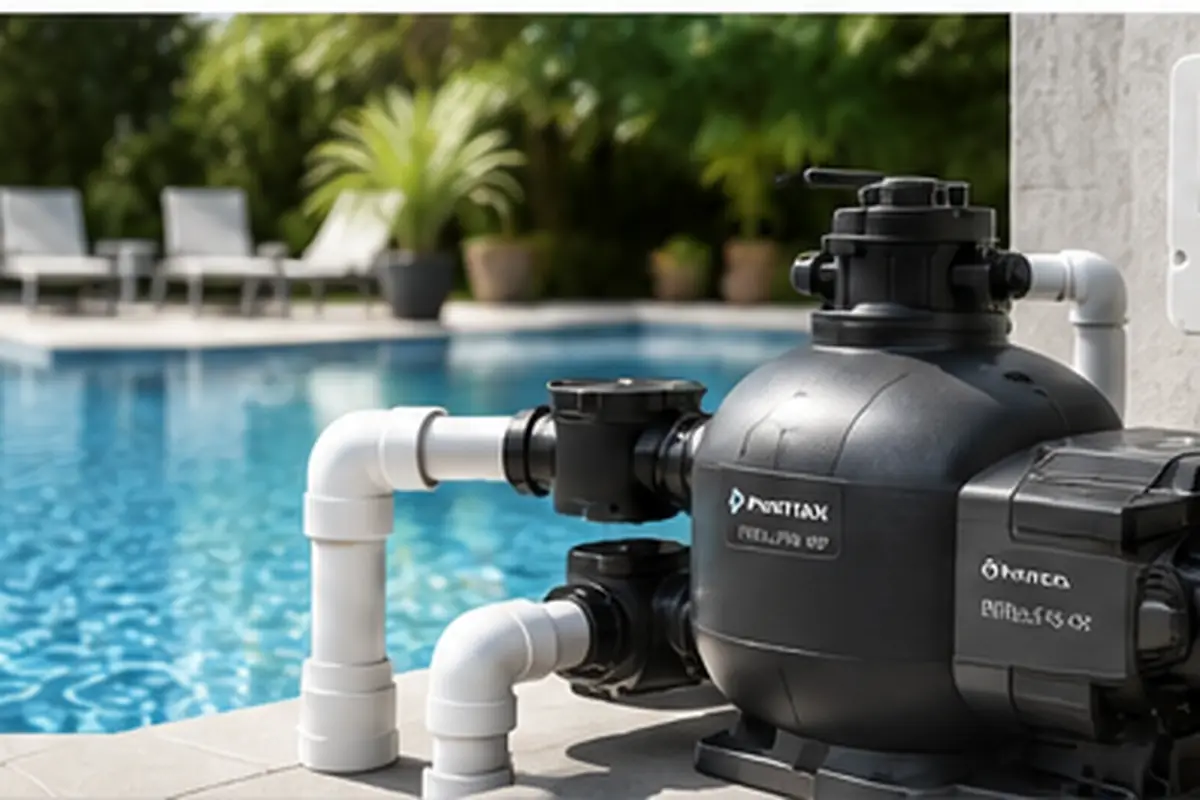
Choosing the right variable-speed pool pump isn't simply a matter of matching horsepower or buying the biggest pump available. The right pump must deliver the flow your pool and equipment require while operating efficiently across the speeds you'll actually use.
Quick Answer: How to Size a Variable-Speed Pool Pump
Size a variable-speed pool pump by determining the flow your pool needs, estimating the resistance of its plumbing and equipment, and checking whether the pump can deliver that flow at the required total dynamic head (TDH). Do not choose a pump based on pool gallons or horsepower alone.
For example, a 20,000-gallon pool would need approximately 42 gallons per minute (GPM) to move a theoretical pool volume through the circulation system in eight hours. But that number does not account for plumbing resistance, heater flow requirements, an attached spa or other equipment.
The pump must satisfy every required operating mode while staying within the flow and pressure limits of the connected equipment. A properly sized variable-speed pump can then use lower speeds for routine circulation and higher speeds when additional flow is needed.
Variable-Speed Pool Pump Sizing at a Glance
| Sizing Factor | What You Need to Determine | Why It Matters |
|---|---|---|
| Pool volume | Approximate total gallons | Provides a starting point for circulation calculations. |
| Routine circulation | Target flow and daily runtime | Establishes an initial filtration operating point. |
| Equipment requirements | Minimum and maximum flow specifications | Ensures the heater, salt system, filter and other equipment operate correctly. |
| High-flow features | Required flow for spas, waterfalls and cleaners | May determine the pump's maximum required hydraulic capacity. |
| Plumbing | Pipe sizes, lengths, fittings and valves | Determines resistance to water movement. |
| Total dynamic head | System resistance at each required flow | Establishes the conditions the pump must overcome. |
| Pump performance curve | Available flow at the estimated TDH | Shows whether a specific pump can meet the requirements. |
| Electrical and automation | Voltage, controls and compatibility | Determines whether the pump can be installed and operated as intended. |
For a broader explanation of pump operation, flow, efficiency and selection, see our Complete Guide to Pool Pumps.
Why Horsepower Alone Is Not Enough
Horsepower is one of the most visible specifications on a pool pump, but it does not tell you exactly how much water the pump will move through your plumbing.
Two pumps with similar horsepower ratings can have different hydraulic performance. The actual flow depends on the pump's design, operating speed and the resistance of the circulation system.
A pump's performance curve provides more useful sizing information because it shows the relationship between flow and total dynamic head.
Example: Two Pools With the Same Volume
Consider two hypothetical 20,000-gallon pools.
| Feature | Pool A | Pool B |
|---|---|---|
| Volume | 20,000 gallons | 20,000 gallons |
| Plumbing | Short, relatively simple runs | Longer, more complex runs |
| Filter | Cartridge filter | Cartridge filter |
| Heater | No | Yes |
| Attached spa | No | Yes |
| Water features | No | Multiple features |
| Maximum required flow | Determined primarily by circulation | May be determined by spa or water-feature operation |
Although both pools contain the same amount of water, Pool B may require considerably more hydraulic capacity.
Pool gallons alone cannot establish the appropriate pump model.
Step 1: Calculate Your Pool Volume
Start by estimating the amount of water in your pool. This helps establish an initial circulation-flow calculation.
If you do not know your pool's volume, use our Pool Volume Calculator.
Rectangular Pool Formula
Length × Width × Average Depth × 7.48 = Approximate Gallons
For example, consider a rectangular pool measuring 16 feet wide by 32 feet long with an average depth of 5 feet.
16 × 32 × 5 × 7.48 = 19,148.8 gallons
The estimated volume is approximately 19,149 gallons.
Round Pool Formula
For a round pool, a useful approximation is:
Diameter × Diameter × Average Depth × 5.9 = Approximate Gallons
For a hypothetical round pool measuring 18 feet in diameter with an average depth of 4 feet:
18 × 18 × 4 × 5.9 = 7,646.4 gallons
The estimated volume is approximately 7,646 gallons.
What About Irregular Pools?
Irregular pools are more difficult to estimate accurately.
If the pool has several distinct sections, divide it into simpler geometric shapes and estimate the volume of each section separately.
Construction plans or documented pool dimensions may provide a more reliable estimate than guessing.
Step 2: Estimate Your Initial Circulation Flow
Pool pump flow is commonly expressed in gallons per minute (GPM).
A traditional circulation calculation divides the pool's volume by a selected turnover period.
Required Average GPM = Pool Gallons ÷ Turnover Minutes
A turnover calculation represents the theoretical volume of water moved through the circulation system. It does not mean every gallon of pool water has passed through the filter, because the water mixes continuously.
Example: A 20,000-Gallon Pool
Consider a hypothetical 20,000-gallon pool.
| Turnover Period | Calculation | Average Flow |
|---|---|---|
| 6 hours | 20,000 ÷ 360 | 55.6 GPM |
| 8 hours | 20,000 ÷ 480 | 41.7 GPM |
| 10 hours | 20,000 ÷ 600 | 33.3 GPM |
| 12 hours | 20,000 ÷ 720 | 27.8 GPM |
The table illustrates how extending the circulation period reduces the average flow needed to move the same theoretical volume.
It does not establish that any particular turnover period is required or sufficient for your pool.
Actual circulation needs depend on sanitation, water quality, swimming activity, equipment requirements and applicable local standards.
Reference Table: Pool Volume and Average GPM
The following figures are mathematical references for different theoretical turnover periods.
| Pool Volume | 6 Hours | 8 Hours | 10 Hours | 12 Hours |
|---|---|---|---|---|
| 5,000 gallons | 13.9 GPM | 10.4 GPM | 8.3 GPM | 6.9 GPM |
| 10,000 gallons | 27.8 GPM | 20.8 GPM | 16.7 GPM | 13.9 GPM |
| 15,000 gallons | 41.7 GPM | 31.3 GPM | 25 GPM | 20.8 GPM |
| 20,000 gallons | 55.6 GPM | 41.7 GPM | 33.3 GPM | 27.8 GPM |
| 25,000 gallons | 69.4 GPM | 52.1 GPM | 41.7 GPM | 34.7 GPM |
| 30,000 gallons | 83.3 GPM | 62.5 GPM | 50 GPM | 41.7 GPM |
Use these figures as starting points, not as automatic pump-sizing requirements.
Our Pool Pump Sizing Calculator can help estimate initial circulation flow. For additional context, see How Many GPM Should a Variable-Speed Pool Pump Run?.
Step 3: Identify Every Equipment Flow Requirement
Your circulation pump may serve several pieces of equipment, each with its own operating requirements.
Before selecting a pump, identify the exact equipment connected to the circulation system.
| Equipment | What to Verify |
|---|---|
| Pool filter | Rated flow and maximum operating pressure |
| Gas heater | Minimum and maximum operating flow |
| Heat pump | Required operating-flow range |
| Salt chlorine generator | Minimum flow and any maximum-flow limits |
| Solar heating | Collector and system flow requirements |
| Suction-side cleaner | Required suction and flow |
| In-floor cleaning system | Required flow and pressure |
| Attached spa | Required jet flow and hydraulic configuration |
| Water features | Required flow for the intended appearance and operation |
Always use the manufacturer's specifications for the exact equipment installed.
Example: Different Operating Modes
Consider a hypothetical pool with these requirements.
| Operating Mode | Illustrative Required Flow |
|---|---|
| Routine circulation | 35 GPM |
| Heating | 45 GPM |
| Attached spa | 85 GPM |
These numbers are hypothetical, not manufacturer specifications.
The pump may need to deliver only 35 GPM during routine circulation but substantially more when the spa operates.
If the heater operates simultaneously with the spa, verify the requirements of both pieces of equipment and the resulting hydraulic configuration.
Do not simply add every equipment flow requirement together. Determine which equipment operates simultaneously, whether components share the same flow path and whether any features use separate pumps.
Step 4: Check the Filter's Flow Limit
The filter is a critical part of pump sizing.
A pump capable of producing high flow is not automatically suitable for a filter with a lower rated capacity.
Check the filter manufacturer's published specifications for the exact model.
Example: Pump Capacity vs. Filter Limit
Suppose a hypothetical pool has a filter rated for a maximum flow of 75 GPM.
Its routine circulation requirement is 40 GPM, but an attached spa operating mode is estimated to require 95 GPM.
If all 95 GPM would pass through that filter, the proposed operating mode exceeds the filter's hypothetical rating.
Possible solutions require evaluating the complete system, including filter sizing, plumbing and equipment configuration.
Simply purchasing a larger pump does not resolve the filter limitation.
For more about filter flow limits, sizing, pressure and maintenance, see our Complete Guide to Pool Filters.
Step 5: Evaluate Your Plumbing
Pipe diameter, pipe length, fittings, valves and equipment all contribute resistance to water movement.
As flow increases, friction losses generally increase as well.
Attempting to move substantially more water through restrictive plumbing may require considerably more pump power without producing a proportional improvement in useful circulation.
Plumbing Details to Record
| Component | What to Record |
|---|---|
| Suction plumbing | Pipe diameter, length and number of suction lines |
| Return plumbing | Pipe diameter, length and number of return lines |
| Fittings | Elbows, tees, reducers and other fittings |
| Valves | Type, size and operating positions |
| Filter | Exact model and hydraulic characteristics |
| Heater | Exact model and flow requirements |
| Additional equipment | Salt system, solar heating, cleaners and water features |
| Elevation | Relevant elevation differences and discharge conditions |
Older pools may have plumbing that limits the useful flow available from a modern high-capacity pump.
Do not assume that installing a more powerful pump will overcome every plumbing limitation safely or efficiently.
Step 6: Estimate Total Dynamic Head
Total dynamic head, or TDH, represents the total head the pump must overcome while moving water through the system.
It is commonly expressed in feet of head.
TDH depends on the hydraulic characteristics of the installation and the operating flow.
Relevant factors include suction and return plumbing, fittings, valves, filters, heaters, sanitation equipment, water features and any applicable static elevation differences.
Why TDH Changes Pump Performance
Consider a hypothetical pump operating at a fixed speed.
| Illustrative System Head | Illustrative Flow at the Same RPM |
|---|---|
| 30 feet | 80 GPM |
| 40 feet | 70 GPM |
| 50 feet | 60 GPM |
| 60 feet | 45 GPM |
These figures are hypothetical and are not a performance curve for a particular pump.
They illustrate the general relationship: as resistance increases, a centrifugal pump typically produces less flow at the same speed.
For an existing installation, TDH may need to be estimated or measured using appropriate hydraulic information. A qualified pool professional can help when accurate measurements are unavailable.
Step 7: Read the Pump Performance Curve
Once you know the required flow and estimated TDH, compare those conditions with the manufacturer's performance curve for the exact pump model.
A typical pump curve plots:
- Flow rate: Usually expressed in GPM.
- Total dynamic head: Usually expressed in feet of head.
Variable-speed pump documentation may include several curves corresponding to different motor speeds.
Worked Example: Finding an Operating Point
Suppose a hypothetical pool requires 60 GPM at an estimated 50 feet of TDH.
The pump must be capable of delivering approximately 60 GPM at 50 feet of head.
To evaluate a candidate pump:
- Find the manufacturer's performance curve for the exact model.
- Locate 60 GPM on the flow axis.
- Locate 50 feet of head on the head axis.
- Identify the operating-speed curve that can deliver the required flow at that head.
- Verify that the pump can operate at that point within its specified limits.
- Repeat the process for other required operating modes.
A pump's advertised maximum flow may occur under conditions with much less resistance than your pool has.
Do not use maximum advertised GPM as a substitute for checking the performance curve.
Step 8: Evaluate Every Operating Mode
A variable-speed pump should be sized for more than routine filtration.
Identify the operating modes the pool actually needs and check whether the candidate pump can meet each requirement.
Example: A Pool With Filtration, Heating and a Spa
Consider these hypothetical operating points.
| Operating Mode | Required Flow | Estimated TDH |
|---|---|---|
| Routine filtration | 35 GPM | 25 feet |
| Heating | 45 GPM | 40 feet |
| Attached spa | 90 GPM | 65 feet |
These values are illustrative and are not recommendations for a particular pool.
The candidate pump must be evaluated at all three operating points, not just the 35 GPM filtration requirement.
If the pump cannot deliver 90 GPM at 65 feet of head, it does not meet the hypothetical spa requirement, even if it can easily handle routine filtration.
Also confirm that the filter, heater, plumbing and other equipment can safely accommodate the resulting operating conditions.
Step 9: Check Electrical and Automation Compatibility
Hydraulic performance is the starting point, but the pump must also be compatible with the installation.
Electrical Requirements
Verify the exact pump model's voltage, circuit and installation requirements.
Some variable-speed pumps support 115V operation, while others require 208–230V service.
Replacing a 115V pump with a model requiring 208–230V may involve electrical modifications.
Have electrical work performed by a qualified professional where required.
Automation Requirements
If the pool has automation, confirm compatibility using the exact pump and controller model numbers.
Compatible automation may allow the system to change pump speed when the heater, spa, cleaner or water features operate.
Do not assume that a pump and automation system are compatible simply because they can operate independently.
See our Complete Guide to Pool Automation for more information.
Step 10: Compare Efficiency and Operating Costs
Once you identify pumps capable of meeting the required hydraulic operating points, compare their efficiency and expected operating costs.
For each candidate, review:
- Published efficiency information.
- Electrical consumption at relevant operating conditions, when available.
- Expected daily operating schedule.
- Local electricity rates.
- Purchase and installation costs.
- Warranty and service requirements.
Example: Two Possible Operating Schedules
Suppose the following hypothetical schedules both satisfy a pool's circulation and equipment requirements.
| Operating Detail | Schedule A | Schedule B |
|---|---|---|
| Average electrical draw | 900 watts | 350 watts |
| Daily runtime | 6 hours | 12 hours |
| Daily energy | 5.4 kWh | 4.2 kWh |
| Daily cost at $0.18/kWh | $0.97 | $0.76 |
| Annual cost | $354.78 | $275.94 |
In this example, Schedule B consumes less electricity despite operating twice as long.
However, the two schedules should not be treated as equivalent unless their actual flow and equipment performance have been verified.
For detailed operating-cost calculations, see How Much Does a Variable-Speed Pool Pump Cost to Run?.
Why Variable-Speed Pumps Change the Sizing Process
A single-speed pump operates at essentially one primary motor speed.
A variable-speed pump can be programmed to provide different operating conditions throughout the day.
This means the pump does not necessarily need to run at the speed required by the pool's highest-demand feature during ordinary filtration.
For example, a properly sized variable-speed pump might operate at a lower speed for routine circulation and increase speed only when the attached spa or waterfall is activated.
That flexibility is useful, but it does not eliminate the need for proper hydraulic sizing.
Once the pump is selected, our guide to what RPM to run a variable-speed pool pump explains how to establish practical operating speeds.
Is a Bigger Variable-Speed Pump Better?
Not automatically.
A higher-capacity pump may be appropriate when the pool has demanding operating modes, such as spa jets, substantial water features or complex plumbing.
However, additional pump capacity does not eliminate plumbing restrictions or increase the flow ratings of filters and other equipment.
Example: A Pool That Needs Only Moderate Flow
Suppose a hypothetical pool requires 40 GPM for routine circulation and has no attached spa, large water features or other high-flow operating modes.
A pump capable of delivering the required 40 GPM at the system's estimated head may be sufficient.
Choosing a pump with substantially more maximum capacity provides little practical benefit if that additional flow will never be needed.
Compare the complete operating range and efficiency of suitable models rather than assuming the largest available pump is necessary.
What About Pools With Spas and Water Features?
Attached spas and water features can substantially increase maximum pump requirements.
A pool might need relatively modest flow during everyday filtration but much higher flow when operating spa jets or a waterfall.
When evaluating a pool with several features, determine:
- The required flow for each feature.
- Which features share the circulation pump.
- Which features may operate simultaneously.
- Whether separate pumps are installed.
- The system head associated with each operating mode.
- The flow and pressure limits of equipment in each operating path.
A higher-capacity variable-speed pump may be appropriate if it can satisfy the high-flow requirements while providing suitable reduced-speed operation for routine circulation.
Complete Example: Sizing a Pump for a 20,000-Gallon Pool
Consider a hypothetical 20,000-gallon residential pool with a cartridge filter, salt chlorine generator and gas heater.
1. Establish an Initial Circulation Reference
Using an illustrative eight-hour turnover period:
20,000 ÷ 480 = 41.7 GPM
This gives an initial circulation reference of approximately 42 GPM.
2. Identify Equipment Requirements
Next, check the exact filter, salt system and heater specifications.
For this hypothetical example, assume the heater requires at least 45 GPM, the salt system's minimum requirement is below that level and the filter can safely accommodate the intended flow.
These values are illustrative and are not specifications for a particular heater or salt system.
3. Estimate System Head
Suppose a hydraulic assessment estimates the following operating conditions.
| Operating Mode | Required Flow | Estimated TDH |
|---|---|---|
| Routine circulation | 42 GPM | 35 feet |
| Heating | 45 GPM | 40 feet |
4. Compare Manufacturer Performance Curves
Review candidate pumps to confirm they can deliver both operating points.
A suitable pump must provide approximately 42 GPM at 35 feet of head for the hypothetical circulation mode and 45 GPM at 40 feet of head during heating.
5. Verify the Complete System
Before choosing the pump, confirm the filter's flow rating, the heater's operating range, the salt system's flow requirements, plumbing compatibility, voltage and any automation requirements.
If an attached spa or large water feature were added, the maximum required pump capacity might change substantially even though the pool's volume remained 20,000 gallons.
This example demonstrates why pool gallons alone cannot establish the appropriate pump size.
Common Variable-Speed Pool Pump Sizing Mistakes
| Mistake | Why It Matters | What to Do Instead |
|---|---|---|
| Matching the old pump's horsepower | The original pump may have been incorrectly sized, and different models have different hydraulic performance. | Recalculate the system's actual requirements. |
| Buying the largest pump available | Additional capacity may not be useful or compatible with existing equipment. | Match the pump to required operating points. |
| Ignoring the filter | Excessive flow can exceed equipment ratings. | Check the exact filter's specifications. |
| Ignoring heater and salt-system requirements | Insufficient flow may prevent equipment from operating. | Verify required operating-flow ranges. |
| Using turnover as the only calculation | Turnover does not account for plumbing resistance or high-flow features. | Evaluate all operating modes and TDH. |
| Using advertised maximum GPM | Maximum flow may occur at much lower resistance than the actual pool system. | Use the manufacturer's performance curve. |
| Ignoring simultaneous equipment operation | Multiple operating requirements may need to be satisfied at the same time. | Evaluate actual equipment combinations and flow paths. |
| Ignoring voltage and automation | A hydraulically suitable pump may still be incompatible with the installation. | Verify electrical and control requirements. |
Variable-Speed Pool Pump Sizing Checklist
- Estimate the pool's total water volume.
- Calculate an initial circulation-flow reference.
- Identify every piece of equipment served by the pump.
- Record the manufacturer's minimum and maximum flow requirements.
- Identify attached spas, cleaners and water features.
- Determine which equipment and features may operate simultaneously.
- Check the filter's flow and pressure limits.
- Record the plumbing layout, pipe sizes, fittings and valves.
- Estimate TDH for each important operating mode.
- Compare the required operating points with manufacturer performance curves.
- Verify voltage, plumbing connections and automation compatibility.
- Compare efficiency, operating costs, installation requirements and warranty terms.
Choosing a Specific Variable-Speed Pump
Once you know the hydraulic performance your pool requires, you can compare specific pump models based on their performance curves, efficiency, voltage, plumbing connections, controls, automation compatibility and warranty requirements.
Our Best Variable-Speed Pool Pumps: How to Choose the Right One guide explains what to compare when moving from pump sizing to selecting a particular model.
If you're ready to shop after determining your requirements, compare available variable-speed pumps below. Verify the exact model's specifications and performance curve before ordering.
Compare Variable-Speed Pool Pumps on Amazon
Frequently Asked Questions
What size variable-speed pump do I need for a 20,000-gallon pool?
Pool volume alone cannot establish the correct pump size. An illustrative eight-hour turnover calculation gives approximately 42 GPM, but you must also account for equipment requirements, plumbing resistance and high-flow features.
How much horsepower does my pool pump need?
There is no reliable horsepower rule based solely on pool gallons. Determine the required flow and TDH, then compare manufacturer performance curves for suitable models.
Is a 3 HP variable-speed pump too big for my pool?
That depends on the installation. A high-capacity pump may be useful for spas and water features but unnecessary for a simpler pool. Evaluate actual hydraulic requirements and equipment limits.
What does TDH mean?
TDH stands for total dynamic head. It represents the total head the pump must overcome to move water through the system at a particular operating condition.
Why do two pumps with the same horsepower produce different flow?
Different pump designs and performance characteristics produce different relationships between flow and head. Compare the manufacturers' performance curves rather than horsepower alone.
Can I use a turnover calculation to size my pump?
A turnover calculation provides an initial circulation reference, but it does not account for system resistance or the flow requirements of connected equipment.
Does my filter affect pump sizing?
Yes. The filter adds hydraulic resistance and has operating limits that must be respected. Check the specifications for the exact filter model.
Do I need a larger pump if I have an attached spa?
Possibly. Spa jets may require substantially more flow than routine pool filtration. Determine the required flow and TDH for spa mode before selecting a pump.
Can a variable-speed pump compensate for restrictive plumbing?
It may increase speed to provide additional flow within its operating limits, but it cannot eliminate plumbing restrictions or override equipment flow and pressure limits.
Should I replace my existing pump with the same horsepower?
Not without checking the system's requirements. The existing pump may have been incorrectly sized, and replacement models with similar horsepower can have different hydraulic performance.
Bottom Line
Variable-speed pool pump sizing begins with required flow and system resistance, not horsepower.
Estimate pool volume, identify the flow requirements of connected equipment, evaluate plumbing and TDH, and compare those requirements with manufacturer performance curves.
The selected pump should meet the pool's highest legitimate operating demand while providing appropriate reduced-speed operation for routine circulation.
Matching the pump to the complete circulation system is more useful than matching horsepower to pool gallons.
How We Research
Pool Equipment Lab evaluates pool equipment using manufacturer specifications, documentation, compatibility requirements, operating costs, warranty information, and owner feedback when relevant. We do not claim hands-on testing unless we actually performed it.
Sources
- Pentair — IntelliFlo3 Variable Speed & Flow Pool Pump — manufacturer product specifications, features, manuals, and technical documentation.
- Pentair — SuperMax VS Variable Speed Pool Pump — manufacturer specifications and performance information.
- Jandy — VS FloPro 1.3 HP Variable-Speed Pump — manufacturer specifications and application information.
- Jandy — VS FloPro 3.8 HP Variable-Speed Pump — manufacturer specifications and application information.
Product specifications and manufacturer documentation can change. Verify current requirements and performance data for the exact pump and equipment models before installation.