
Can Pool Automation Control a Variable-Speed Pump?
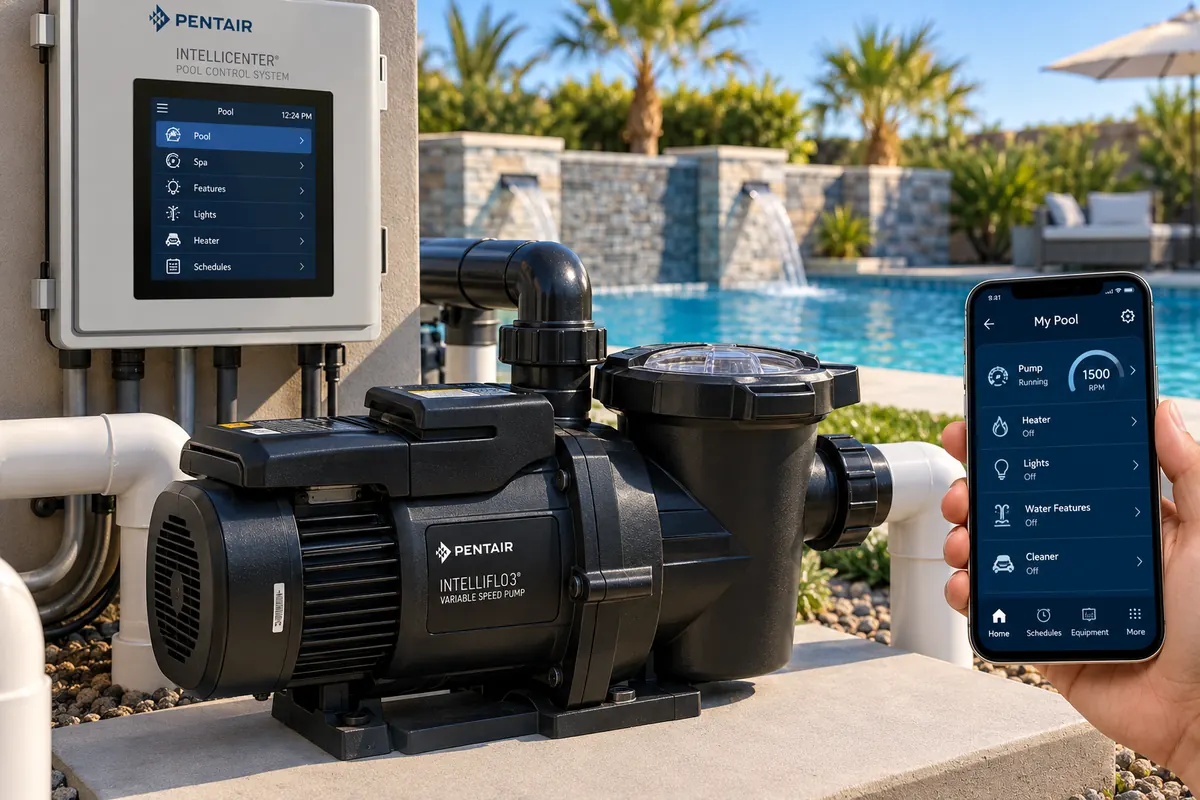
Variable-speed pool pumps become considerably more flexible when they are integrated with a compatible automation system. Instead of operating at the same speed for every task, the pump can be programmed around different pool functions.
The key is communication compatibility between the pump and the automation controller.
Quick Answer: Can Pool Automation Control a Variable-Speed Pump?
Yes. Compatible pool automation systems can control supported variable-speed pumps, including their operating schedules and, in many cases, individual pump speeds. This allows the circulation system to provide different flow rates for filtration, heating, spa operation, cleaning and water features without requiring the owner to adjust the pump manually each time.
The important distinction is compatibility. An automation controller that can turn a pump on and off does not necessarily support direct speed control. Before purchasing or connecting equipment, verify the exact pump model, controller, communication method and available features.
Variable-Speed Pump Automation at a Glance
| Feature | What It Does | What to Verify |
|---|---|---|
| On/off control | Starts or stops supported pump operation | Approved control method |
| Speed control | Selects supported pump RPM or operating modes | Direct communication compatibility |
| Daily scheduling | Runs the pump at programmed times | Controller scheduling capabilities |
| Heater coordination | Provides appropriate circulation when heating is requested | Required heater flow and supported automation functions |
| Spa operation | Coordinates compatible pump and valve functions | Plumbing and equipment configuration |
| Water features | Activates appropriate pump settings for supported features | Required flow and feature-circuit support |
| Remote access | Allows supported pump functions to be controlled through an app | Network and controller compatibility |
Can Automation Control Pump Speed?
Compatible pool automation systems can control supported variable-speed pumps rather than simply switching them on and off.
Depending on the equipment, the controller may be able to select programmed speeds, associate speeds with particular pool functions and coordinate operation with other equipment.
For a broader look at controllers, scheduling, equipment compatibility and connected pool equipment, see our Complete Guide to Pool Automation.
Why Variable-Speed Pump Control Matters
A swimming pool does not necessarily need the same water flow for every function.
Different operating conditions may require different pump speeds, including:
- Routine filtration.
- Pool heating.
- Spa operation.
- Water features.
- Pressure-side cleaning.
- Salt chlorine generation.
Automation can coordinate these operating modes without requiring the owner to manually adjust the pump every time another piece of equipment operates.
For more about variable-speed pump operation, sizing, flow and efficiency, see our Complete Guide to Pool Pumps.
How Does Automation Communicate With a Variable-Speed Pump?
Compatible variable-speed pumps can use a communication connection to receive commands from an automation controller.
The exact wiring, communication protocol and supported functions depend on the manufacturer and equipment models.
Direct communication may allow the controller to request particular pump speeds or operating modes. Basic switching does not necessarily provide these capabilities.
| Control Method | Typical Function | Important Limitation |
|---|---|---|
| Compatible digital communication | Controls supported pump speeds and operating modes | Requires compatible equipment and configuration |
| Approved external control input | Selects supported preset functions on certain pumps | Available functions vary by model |
| Basic relay control | Switches an approved electrical circuit | Does not automatically provide variable-speed control |
| Pump's internal controller | Runs schedules and speeds programmed directly on the pump | May not coordinate automatically with other equipment |
Do not assume that interrupting power to a variable-speed pump is an acceptable control method. Follow the pump manufacturer's approved wiring and automation instructions.
See How Does Pool Automation Work? for more about how controllers communicate with and coordinate compatible pool equipment.
Can Automation Schedule Pump Operation?
Yes. Compatible controllers can operate the circulation system according to programmed schedules.
More advanced automation can associate pump speeds with specific functions instead of relying on a single daily operating schedule.
For example, a system might use a lower speed during routine filtration and a higher speed when a water feature is activated.
Example: A Daily Variable-Speed Pump Schedule
Consider a hypothetical pool with a variable-speed pump, a heater and a salt chlorine generator.
The following example illustrates how different pump settings might be coordinated throughout the day.
| Time | Operating Mode | Illustrative Pump Speed |
|---|---|---|
| 8:00 a.m.–12:00 p.m. | Routine filtration and sanitation | 1,500 RPM |
| 12:00 p.m.–2:00 p.m. | Heating | 2,200 RPM |
| 2:00 p.m.–6:00 p.m. | Routine filtration and sanitation | 1,500 RPM |
| 6:00 p.m.–7:00 p.m. | Water-feature operation | 2,600 RPM |
These speeds and times are illustrative, not recommended settings. The actual RPM required depends on the pump, plumbing, filter, heater, sanitation equipment and other connected features.
Any programmed schedule must also provide adequate circulation and sanitation for the pool.
Can Different Features Use Different Pump Speeds?
Compatible automation systems may allow different speeds to be associated with different equipment functions.
For example, routine filtration may use one speed while a water feature or heater requires another.
Some systems use feature circuits or similar programming functions to associate equipment operation with particular pump settings.
Pentair IntelliCenter is one automation platform to investigate for installations using compatible Pentair variable-speed pumps. Check the exact controller and pump documentation to confirm supported functions and configuration requirements.
Compare Pentair IntelliCenter Pool Automation on Amazon
For more about selecting appropriate operating speeds, see What RPM Should I Run My Variable-Speed Pool Pump?.
Can Automation Reduce Pump Energy Use?
The automation controller does not change the fundamental efficiency of the pump.
However, it can make it easier to operate the pump at appropriate speeds rather than running it unnecessarily fast throughout the day.
For many centrifugal pool-pump systems, electrical power requirements increase rapidly as pump speed rises. Actual savings depend on the pump, plumbing and operating conditions.
Example: Comparing Two Pump Schedules
Consider a hypothetical variable-speed pump with the following measured power consumption:
| Operating Mode | Power | Daily Runtime | Daily Energy Use |
|---|---|---|---|
| Lower-speed filtration | 350 W | 8 hours | 2.8 kWh |
| Higher-speed operation | 1,600 W | 8 hours | 12.8 kWh |
At an illustrative electricity rate of $0.18 per kWh, the lower-speed schedule would cost approximately $0.50 per day, compared with $2.30 per day for the higher-speed schedule.
However, the two schedules may circulate different amounts of water. They should not be considered equivalent unless both meet the pool's circulation and equipment requirements.
You can estimate electricity expenses using your pump's actual wattage, runtime and electricity rate with our Pool Pump Operating Cost Calculator.
What Happens When the Heater Turns On?
Pool heaters generally require adequate water flow to operate safely and correctly.
A properly configured automation system can coordinate compatible equipment so the circulation pump provides the required flow when heating is requested.
Example: Coordinating Heating and Pump Speed
Suppose a pool normally operates at a low filtration speed, but its heater requires more flow than that setting provides.
A compatible controller may be configured to request a higher pump speed whenever heating is activated.
When heating ends, the system may return to its normal programmed operating mode.
The appropriate pump speed must be established using the heater's flow requirements and the actual hydraulic performance of the installation.
See Pool Automation and Pool Heaters for more about coordinating circulation, heating, temperature settings and schedules.
What About a Salt Chlorine Generator?
Salt chlorine generators require sufficient water flow and should operate only under conditions permitted by the equipment manufacturer.
Automation can help coordinate circulation schedules with compatible sanitation equipment.
However, the pump's minimum operating speed may not provide enough flow for the salt chlorine generator.
Verify the actual operating flow and follow the manufacturer's installation and control requirements.
Do not rely solely on a programmed schedule as a substitute for the sanitation equipment's required flow-sensing and safety provisions.
Can Automation Coordinate a Pool Cleaner?
Some pool-cleaning systems depend on circulation flow, while others use separate pumps or operate independently.
Compatible automation may be able to coordinate pump operation with cleaning schedules.
For example, a suction-side cleaner may need a different pump setting than routine filtration.
A pressure-side cleaner that uses a booster pump may require coordinated operation of both the main circulation pump and the booster pump.
The exact arrangement depends on the cleaner, plumbing and automation system.
Can Automation Control Multiple Pumps?
Some advanced automation systems support multiple pumps.
This can be useful on pools with:
- A main circulation pump.
- A dedicated spa pump.
- A separate water-feature pump.
- Other specialized circulation equipment.
The number of supported pumps and the available control functions vary by controller.
Confirm the system's capacity and supported pump models before planning a multi-pump installation.
What Happens When Two Features Request Different Speeds?
A pool may occasionally have several functions operating at once.
For example, the filtration schedule may request a lower speed while the heater or a water feature requires additional flow.
Compatible controllers use their own programming rules to determine how simultaneous requests are handled.
Before commissioning the system, verify:
- How the controller handles overlapping schedules.
- Which equipment functions require minimum flow.
- Whether the requested pump settings satisfy simultaneous equipment demands.
- How the system behaves when a feature turns off.
Do not assume every automation platform uses the same priority rules.
What If the Pump and Automation Are Different Brands?
Cross-brand compatibility should never be assumed.
Some combinations may provide basic switching or limited external control, while advanced speed control may require compatible communication between the pump and controller.
Check the automation manufacturer's supported-equipment documentation for the exact pump model.
If a compatible communication interface or adapter is required, include it in the installation plan.
Can You Add Automation to an Existing Variable-Speed Pump?
Possibly. The answer depends on the pump's supported external-control methods and the automation system you intend to use.
Before purchasing an upgrade, identify:
- The exact pump manufacturer and model.
- The pump's current control method.
- Supported communication connections.
- The existing automation-controller model.
- Any required interfaces or accessories.
- Supported software or firmware requirements.
An existing variable-speed pump may already provide useful internal scheduling even if it cannot communicate directly with your preferred automation controller.
What If the Automation App Stops Working?
A lost network connection does not necessarily mean the pump has stopped operating.
Some automation systems continue running locally programmed schedules even when remote smartphone access is unavailable.
Check the local controller and pump status before changing settings.
Follow the manufacturer's instructions for diagnosing network or controller problems.
Common Variable-Speed Pump Automation Problems
| Problem | Possible Cause | Initial Check |
|---|---|---|
| Pump runs but speed cannot be changed | Unsupported communication or incorrect configuration | Pump compatibility and controller setup |
| Pump does not follow the automation schedule | Conflicting schedules or control settings | Controller and pump programming |
| Heater reports insufficient flow | Programmed pump speed may be too low | Actual flow and heater requirements |
| Water feature performs poorly | Insufficient flow or incorrect operating mode | Feature requirements and programmed speed |
| App cannot control the pump | Network, account or controller communication issue | Local control and connection status |
| Pump stops unexpectedly | Schedule conflict, equipment protection or system fault | Displayed error messages and manufacturer diagnostics |
Do not modify electrical wiring, bypass equipment protection or open energized control enclosures while troubleshooting. Use qualified service personnel when electrical or communication-hardware repairs are necessary.
Variable-Speed Pump Automation Buying Checklist
- Exact pump model compatibility.
- Automation-controller compatibility.
- Supported speed-control functions.
- Required communication wiring or interfaces.
- Available automation circuits.
- Daily scheduling capabilities.
- Support for multiple operating modes.
- Heater and sanitation coordination.
- Water-feature and cleaner requirements.
- Support for multiple pumps, if needed.
- Remote-access capabilities.
- Manufacturer installation instructions.
If you are comparing controllers for a pool with a variable-speed pump, start by verifying which automation platforms support your specific pump and the level of control they provide.
Compare Pool Automation Systems on Amazon
Frequently Asked Questions
Can pool automation change the RPM of a variable-speed pump?
Yes, when the controller and pump support compatible speed-control communication. Basic on/off switching alone does not necessarily provide RPM control.
Can I schedule different pump speeds throughout the day?
Compatible systems can associate supported speeds with daily schedules or particular equipment functions. The available programming options depend on the controller and pump.
Will automation make my variable-speed pump more efficient?
Automation does not change the pump's inherent efficiency, but it can help reduce unnecessary high-speed operation by coordinating appropriate speeds and schedules.
Can automation increase pump speed when the heater turns on?
Some compatible systems can coordinate pump speed with heating requests. The configured speed must satisfy the heater's actual water-flow requirements.
Can a salt chlorine generator work with a low pump speed?
Yes, if the actual water flow satisfies the salt chlorine generator's operating requirements. Pump RPM alone does not establish whether adequate flow is available.
Can automation control a suction-side pool cleaner?
Compatible automation may coordinate pump speeds and schedules for a suction-side cleaner. The required settings depend on the cleaner and plumbing configuration.
Can one automation system control two variable-speed pumps?
Some systems support multiple pumps, but the number and types of supported pumps vary. Check the controller's exact specifications.
Will a different-brand automation controller work with my pump?
Possibly, but cross-brand compatibility must be verified. Basic switching and advanced speed control may have different compatibility requirements.
Do I need automation if my pump already has a built-in schedule?
Not necessarily. A pump's internal scheduling may meet your needs. Automation adds value when you want supported pump functions coordinated with other equipment or centralized controls.
What happens to the pump if my internet connection goes down?
Some controllers continue running locally programmed schedules during an internet outage. Check the manufacturer's documentation for the behavior of your exact system.
Bottom Line
Compatible pool automation can coordinate variable-speed pump operation with filtration, heating, sanitation, cleaning and water features.
The main benefit is not simply remote pump control. It is the ability to provide appropriate circulation for different equipment functions without unnecessary high-speed operation.
Before buying or connecting equipment, verify exact pump compatibility, supported control methods, required wiring and the flow requirements of every connected system.
How We Research
Pool Equipment Lab evaluates pool equipment using manufacturer specifications, documentation, compatibility requirements, operating costs, warranty information, and owner feedback when relevant. We do not claim hands-on testing unless we actually performed it.