
The Complete Guide to Pool Cleaners
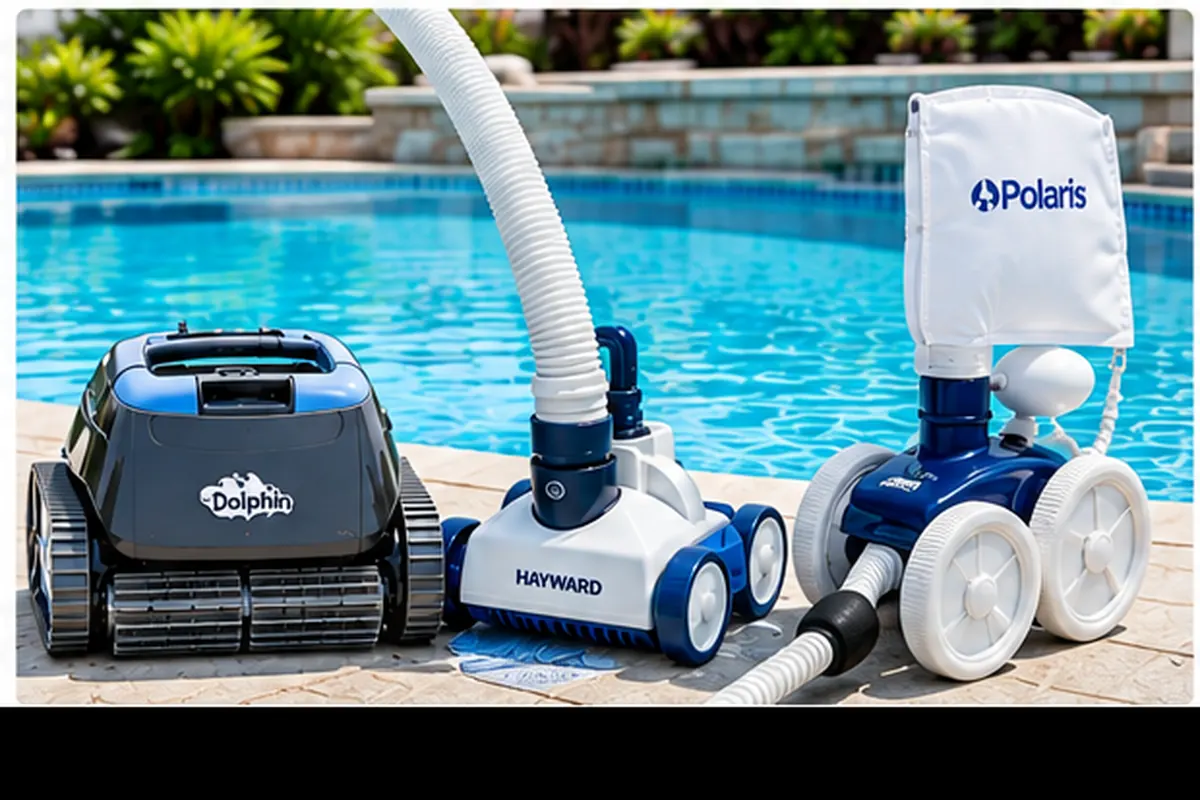
Automatic pool cleaners can reduce routine vacuuming and help remove dirt, leaves, sand, and other debris from pool surfaces. But robotic, suction-side, and pressure-side cleaners accomplish that job in very different ways.
This guide explains how each major type of automatic pool cleaner works, where each design performs best, what equipment it requires, and what to consider when choosing a cleaner for your swimming pool.
Quick Answer: What Type of Automatic Pool Cleaner Do You Need?
Automatic pool cleaners fall into three main categories: robotic, suction-side and pressure-side. Robotic cleaners use their own motors and onboard filtration. Suction-side cleaners use suction from the pool's circulation pump. Pressure-side cleaners use pressurized water and may require a booster pump.
For pools with mixed debris, a robotic cleaner with appropriate filtration and cleaning coverage is one option to consider. Suction-side cleaners can suit pools with primarily fine debris and adequate pump flow. Pressure-side cleaners with large collection bags can suit pools that regularly collect leaves and other larger debris.
The appropriate choice depends on your pool's dimensions, shape, surface, debris load, existing equipment, cleaning requirements and budget.
Automatic Pool Cleaners Compared
| Feature | Robotic | Suction-Side | Pressure-Side |
|---|---|---|---|
| Power source | Onboard electric motors | Pool-pump suction | Pressurized pool water; some need a booster pump |
| Debris collection | Onboard basket or filter | Pool filtration system or inline canister | Onboard bag on many models |
| Connection | Dedicated power supply or onboard battery, depending on model | Skimmer or dedicated suction line | Compatible pressure-side plumbing |
| Cleaning coverage | Floor, walls and waterline on certain models | Depends on model and pool conditions | Depends on model and pool conditions |
| Typical maintenance | Empty basket, clean filter and inspect brushes or tracks | Inspect hoses, clear blockages and maintain pool filtration | Empty bag and inspect hoses, fittings and drive components |
| Important buying factor | Coverage, filtration and pool compatibility | Required suction flow and plumbing | Booster-pump requirements and debris capacity |
For a direct comparison, see Robotic vs. Suction vs. Pressure Pool Cleaners.
What Is an Automatic Pool Cleaner?
An automatic pool cleaner is equipment designed to move through a swimming pool and collect dirt and debris with less manual vacuuming by the pool owner.
Automatic cleaners can help remove material from the pool floor. Some models also clean walls, scrub surfaces or reach the waterline.
A pool cleaner does not replace proper circulation, filtration, sanitation or routine pool maintenance. It handles a specific part of pool care: removing debris from pool surfaces.
How Pool Cleaners Work
An automatic cleaner needs a source of power to move through the pool and collect debris. The major difference between cleaner types is where that power comes from.
- Robotic: Uses onboard electric motors and a self-contained debris collection system.
- Suction-side: Uses suction created by the pool's circulation pump.
- Pressure-side: Uses pressurized water from the circulation system and may require a dedicated booster pump.
These differences affect plumbing requirements, energy consumption, maintenance and how debris is handled.
Robotic Pool Cleaners
Robotic pool cleaners operate independently from the pool's primary circulation system. Instead of relying on the pool pump for propulsion and cleaning suction, they use onboard electric motors.
An internal pump draws water and debris through the cleaner. Debris is captured in an onboard basket, cartridge or other filtration element, and filtered water returns directly to the pool.
For a more detailed explanation of their motors, filtration, navigation and cleaning cycles, see How Do Robotic Pool Cleaners Work?
Advantages of Robotic Pool Cleaners
- Independent from the main pool pump and filter.
- Self-contained debris collection.
- Many models actively scrub pool surfaces.
- Some models clean floors, walls and the waterline.
- Fine- and large-debris filtration may be available.
- Advanced models may offer scheduling or app-based features.
For example, Pentair's Prowler 920 is designed with onboard debris filtration and wall-cleaning capabilities. Exact cleaning coverage and filter options vary by model.
Potential Disadvantages
- Initial purchase cost can be higher.
- Debris baskets and filters require cleaning.
- Motors and electronics add components that may eventually need repair.
- Cleaning coverage differs significantly between models.
- Power-supply placement, cable management or battery charging may require attention.
Compare robotic cleaners by pool-size rating, cleaning coverage, filtration, debris capacity, power arrangement and available features.
Compare Robotic Pool Cleaners on Amazon
Do Robotic Cleaners Need the Pool Pump?
No. Their cleaning operation does not depend on the pool pump or a booster pump.
This independence is a major difference between robotic cleaners and hydraulic suction- or pressure-side cleaners. However, normal pool circulation and filtration are still required for proper water maintenance.
Suction-Side Pool Cleaners
A suction-side pool cleaner connects to the suction side of the circulation system, generally through a skimmer or dedicated vacuum line.
The pool pump creates the suction that operates the cleaner and pulls debris from the pool.
See How Do Suction-Side Pool Cleaners Work? for a closer look at cleaner flow, debris handling and circulation-system requirements.
Where Does the Debris Go?
Debris collected by a traditional suction cleaner enters the pool's suction system.
Depending on the setup, debris may be intercepted by an inline leaf canister or pump basket before smaller material reaches the pool filter.
Advantages of Suction-Side Cleaners
- Relatively simple mechanical design.
- Often lower initial purchase cost.
- No separate electrical cleaner motor.
- Uses existing circulation equipment.
- Can work particularly well with smaller debris such as sand and silt.
Potential Disadvantages
- Depends on pool-pump operation.
- Cleaner debris can increase the load on the filtration system.
- Correct suction and flow are important.
- Large debris can create restrictions in some systems.
- Hoses require periodic inspection.
Compare suction-side cleaners by flow requirements, pool coverage, hose configuration and the type of debris they are designed to handle.
Compare Suction-Side Pool Cleaners on Amazon
Pressure-Side Pool Cleaners
A pressure-side cleaner operates from the pressure side of an inground pool's circulation system.
Pressurized water is delivered to the cleaner and used to create movement and cleaning action. Some pressure-side cleaners operate from available return-side pressure, while others require a dedicated booster pump.
See How Do Pressure-Side Pool Cleaners Work? for more about booster pumps, debris bags, feed hoses and cleaner operation.
Where Does Pressure-Side Debris Go?
Many pressure-side cleaners collect debris in an onboard bag rather than sending the material into the pool filter.
This can be useful when the pool receives substantial leaves or similar debris, provided the cleaner's intake and collection bag are suitable.
Advantages of Pressure-Side Cleaners
- Good large-debris capability on suitable models.
- Onboard debris collection on many models.
- Reduces cleaner debris entering the main pool filter.
- Can be useful for pools with substantial leaves and similar debris.
Potential Disadvantages
- Some models require a booster pump.
- Compatible plumbing is required.
- Feed hoses and fittings require maintenance.
- Wheels and internal moving parts eventually wear.
Compare pressure-side cleaners by debris capacity, plumbing compatibility, feed-hose requirements and whether a booster pump is needed.
Compare Pressure-Side Pool Cleaners on Amazon
Which Cleaner Fits Your Pool's Debris?
The type and amount of debris around your pool should play a major role in cleaner selection.
| Pool Condition | Cleaner Characteristics to Consider |
|---|---|
| Mostly sand or silt | Suction-side cleaner suited to fine debris or robotic cleaner with fine filtration |
| Frequent leaves and acorns | Pressure-side cleaner with suitable debris bag or robotic cleaner with a large intake and basket |
| Mixed fine and large debris | Cleaner with compatible filtration options and adequate debris capacity |
| Frequent wall or waterline buildup | Model specifically rated for wall climbing or waterline scrubbing |
| Pool with steps and benches | Model with documented coverage suitable for the pool's shape |
These are selection considerations rather than guarantees. Cleaning performance depends on the exact model, pool geometry and operating conditions.
Practical Examples: Matching a Cleaner to a Pool
Example 1: A Small Pool with Fine Desert Dust
Consider a relatively small pool that mainly collects dust, sand and silt.
A suction-side cleaner designed for fine debris may be worth comparing if the existing circulation system provides adequate suction. A robotic cleaner with fine-filtration media is another option, particularly if independent operation is important.
Example 2: A Pool Surrounded by Trees
Consider a pool that regularly collects leaves and larger debris.
Compare pressure-side cleaners with appropriately sized collection bags and robotic cleaners with large debris openings and baskets. Check how easily each model handles and empties its collected debris.
Example 3: A Pool with Walls, Steps and Benches
Consider a pool with several changes in depth, multiple steps and seating areas.
Review the manufacturer's cleaning-coverage specifications. A model advertised as a wall-climbing cleaner may not necessarily clean every step, bench or sharp transition.
Some areas may still require occasional manual brushing or vacuuming.
Pool Size Matters
Cleaner manufacturers commonly specify the pool sizes their products are designed to handle.
For corded robotic cleaners, cable length can affect coverage. Cordless robotic models have battery-runtime and charging considerations.
Hydraulic cleaners need appropriate hose length and sufficient system flow or pressure.
Choose a cleaner rated for the dimensions and configuration of your pool.
Pool Shape and Surface Matter
A rectangular pool with broad transitions presents a different cleaning environment from a freeform pool with benches, steps, sharp corners or unusual floor transitions.
Consider:
- Pool shape.
- Floor-to-wall transitions.
- Steps and benches.
- Drain covers.
- Ladders.
- Pool-surface material.
- Depth changes.
Cleaner compatibility and coverage should be verified against the manufacturer's specifications.
Do You Need Wall and Waterline Cleaning?
Not every automatic cleaner cleans the same surfaces.
Some are primarily floor cleaners. Others can climb walls, while certain robotic cleaners are designed to scrub up to the waterline.
If wall or waterline cleaning is important, verify that capability rather than assuming it is standard.
Energy Use and Pool Cleaners
Cleaner energy requirements depend on their design and operating conditions.
Suction-side cleaners depend on the pool pump operating at sufficient flow. Pressure-side cleaners depend on circulation-system pressure and may also use a booster pump.
Robotic cleaners use their own electrical systems and do not require the pool pump or booster pump for cleaning propulsion.
To compare operating costs, consider the electrical consumption and runtime of every pump or cleaner motor required for the cleaning cycle.
Pool Cleaner Maintenance
Even automatic cleaners require routine maintenance. The specific tasks depend on cleaner type.
Robotic Cleaner Maintenance
- Empty debris baskets.
- Rinse filter media as directed.
- Inspect brushes.
- Inspect wheels or tracks.
- Check the cable when applicable.
- Keep intake openings clear.
- Follow the manufacturer's storage and charging instructions.
Suction Cleaner Maintenance
- Inspect hoses and connections.
- Remove obstructions.
- Maintain the pump basket.
- Keep the pool filter clean.
- Verify appropriate cleaner flow.
- Inspect moving components for wear.
Pressure Cleaner Maintenance
- Empty and inspect the debris bag.
- Check feed hoses and swivels.
- Inspect wheels and drive components.
- Check wall fittings and screens.
- Verify booster-pump operation when required.
Why Pool Cleaners Stop Moving
A cleaner that stops moving does not necessarily need replacement. The likely cause depends on the cleaner type.
| Cleaner Type | Possible Causes | Initial Checks |
|---|---|---|
| Robotic | Blocked intake, full basket, drive obstruction or power problem | Check the approved power supply, basket, intake, brushes and tracks |
| Suction-side | Insufficient suction, clogged hose, full basket or incorrect valve setting | Check pool-pump operation, accessible baskets, hoses and cleaner flow |
| Pressure-side | Insufficient pressure, feed-hose leak, blocked screen or worn drive component | Check pump operation, wall fitting, feed hose and booster pump if required |
For a step-by-step troubleshooting process, see Why Is My Pool Cleaner Not Moving?
Suction Cleaner Problems
Common areas to investigate include insufficient suction or flow, a dirty pool filter, a full pump basket, air entering the suction system, a blocked cleaner hose, incorrect valve settings or debris inside the cleaner.
Pressure Cleaner Problems
Check pool-pump operation, the booster pump where required, water pressure, the wall fitting and screen, feed-hose leaks, drive components and wheels.
Robotic Cleaner Problems
Check the approved electrical supply, cleaner power supply, filter basket, intake openings, brushes, wheels or tracks and visible obstructions.
Always follow the manufacturer's troubleshooting and electrical safety instructions. Do not attempt internal electrical repairs unless qualified.
Should You Buy a Robotic Pool Cleaner?
A robotic cleaner is worth considering when you want cleaning to operate independently from the pool's circulation system.
It may also suit owners who want features such as active scrubbing, onboard filtration, wall cleaning, scheduling or app control.
However, those features vary by model and can increase purchase cost.
Dolphin is one of the major robotic-cleaner product lines you may encounter when comparing available models.
Compare Dolphin Robotic Pool Cleaners on Amazon
Should You Buy a Suction-Side Cleaner?
A suction-side cleaner is worth considering when a relatively simple design and initial cost are priorities.
It can be particularly appropriate for pools that primarily collect fine debris and have a circulation system capable of providing the required cleaner flow.
Compare Suction-Side Pool Cleaners on Amazon
Should You Buy a Pressure-Side Cleaner?
A pressure-side cleaner is worth considering for pools with substantial leaf debris, particularly when the pool already has compatible cleaner plumbing.
Check whether the exact model requires a booster pump before buying.
Polaris is one of the major pressure-side cleaner product lines you may encounter when comparing available models.
Compare Polaris Pressure-Side Pool Cleaners on Amazon
What to Consider Before Buying Any Pool Cleaner
- Pool size and shape.
- Pool-surface material.
- Floor, wall and waterline cleaning requirements.
- Typical debris type and quantity.
- Existing plumbing and pump equipment.
- Energy requirements.
- Debris capacity.
- Ease of cleaning the cleaner itself.
- Replacement-part availability.
- Warranty.
- Purchase price and ongoing ownership costs.
Don't Choose a Cleaner Based Only on Price
A less expensive cleaner is not necessarily the least expensive or most convenient cleaner to own.
Consider the equipment required to operate it, maintenance, replacement parts, debris handling and whether it provides the cleaning coverage your pool needs.
Likewise, buying a feature-rich robotic cleaner may not provide additional value if the pool does not require those features.
Frequently Asked Questions
Are robotic pool cleaners better than suction-side cleaners?
They operate differently. Robotic cleaners have independent motors and onboard filtration, while suction-side cleaners use the existing circulation pump. Compare cleaning coverage, debris handling, equipment requirements and cost for your particular pool.
Do robotic cleaners replace the pool filter?
No. A robotic cleaner collects debris during its cleaning cycle, but the pool still needs normal circulation, filtration and sanitation.
Do all robotic cleaners climb walls?
No. Cleaning coverage varies by model. Verify floor, wall and waterline capabilities in the manufacturer's specifications.
Does a suction-side cleaner need the pool pump running?
Yes. A suction-side cleaner depends on the pool pump to create the suction required for operation.
Do pressure-side cleaners always need a booster pump?
No. Some models operate using available return-side pressure, while others require a dedicated booster pump. Check the requirements of the exact cleaner model.
Which cleaner handles leaves?
Pressure-side cleaners with suitable collection bags and robotic cleaners with appropriately sized intakes and baskets can handle leaves. Performance depends on the model and the amount and type of debris.
Can an automatic cleaner clean pool steps?
Some models may clean certain steps or benches, but coverage depends on pool geometry and cleaner design. Do not assume that a wall-climbing cleaner will clean every step.
How often should I run my pool cleaner?
Cleaning frequency depends on debris load, pool use, weather and the cleaner's coverage. Follow the manufacturer's operating guidance and adjust your schedule based on how quickly debris accumulates.
Bottom Line
Robotic cleaners provide independent operation and onboard filtration. Suction-side cleaners use the existing circulation system. Pressure-side cleaners commonly use onboard debris collection and can be useful for pools with larger debris.
Choose equipment that matches your pool size and shape, typical debris, existing plumbing, desired cleaning coverage, maintenance preferences and budget. Confirm the exact model's specifications before purchasing.
How We Research
Pool Equipment Lab evaluates pool equipment using manufacturer specifications, documentation, compatibility requirements, operating costs, warranty information, and owner feedback when relevant. We do not claim hands-on testing unless we actually performed it.