
What RPM Should I Run My Variable-Speed Pool Pump?
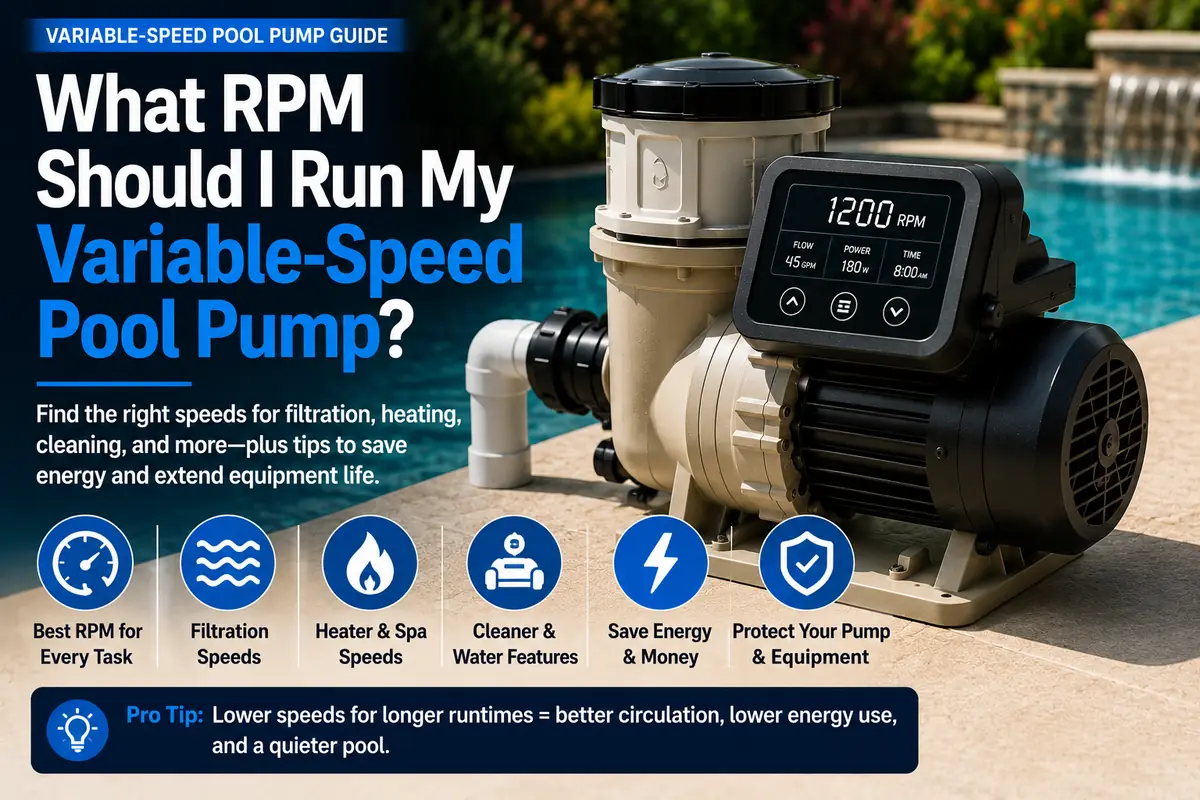
There isn't one perfect RPM setting for every variable-speed pool pump. The best speed depends on what the pump is doing, your plumbing resistance, filter condition, heater requirements, sanitation equipment, water features, and the amount of flow your pool actually needs. For everyday filtration, the goal is usually to find the lowest pump speed that still provides adequate circulation and keeps the equipment operating correctly.
Quick Answer: What RPM Should a Variable-Speed Pool Pump Run?
For many residential pools, 1,200 to 1,800 RPM can be a useful starting range for everyday filtration. However, there is no universal RPM setting that works for every pool.
The appropriate speed depends on your pool's plumbing, filter condition, actual water flow and the requirements of any equipment operating at the same time.
Instead of choosing one speed for the entire day, use lower RPM for routine filtration when practical and program higher speeds for tasks that need additional flow, such as skimming, heating, cleaning or spa operation.
The goal is to find the lowest practical speed that provides adequate circulation and satisfies the requirements of every piece of equipment operating during that period.
Variable-Speed Pool Pump RPM Starting Points
The following ranges are illustrative starting points for exploring different operating modes. They are not manufacturer specifications or universal recommendations.
| Pool Function | Illustrative Starting RPM | What to Verify |
|---|---|---|
| Basic filtration | 1,200–1,800 RPM | Adequate circulation and proper sanitation-system operation |
| Surface skimming | 1,800–2,400 RPM | Floating debris is being pulled effectively into the skimmers |
| Salt chlorine generator | Equipment-dependent | Required flow is maintained with an operating margin |
| Pool heater | Equipment-dependent; some systems may need 2,000–2,800 RPM or more | Heater operates within its specified flow range |
| Pool cleaner | Varies by cleaner type | Required suction, pressure or flow is available |
| Attached spa | Some systems may need 2,500–3,450 RPM | Jet performance and all equipment operating limits |
| Water features | Varies widely | Required flow and desired appearance |
Do not program a speed solely because it appears in this table. Confirm that the pump and connected equipment can operate safely at the resulting flow.
For a broader explanation of variable-speed operation, flow, sizing, efficiency and pump selection, see our Complete Guide to Pool Pumps.
Why Lower RPM Can Reduce Electricity Consumption
A variable-speed pump does not need to run at maximum speed simply because it can.
Reducing speed generally reduces flow, hydraulic pressure and the electrical power required by the pump.
The relationship is not linear. Cutting pump speed by a particular percentage does not necessarily reduce electrical consumption by the same percentage.
This is why longer periods of reduced-speed circulation can sometimes use less electricity than shorter periods of high-speed operation.
Example: Comparing Electrical Consumption at Different Speeds
Consider the following hypothetical operating measurements. These values are illustrative and are not published specifications for any particular pump.
| Operating Setting | Illustrative Electrical Draw | Runtime | Daily Energy |
|---|---|---|---|
| Lower speed | 250 watts | 12 hours | 3 kWh |
| Moderate speed | 600 watts | 8 hours | 4.8 kWh |
| Higher speed | 1,500 watts | 4 hours | 6 kWh |
At a hypothetical electricity rate of $0.18 per kWh, these schedules cost approximately $0.54, $0.86 and $1.08 per day, respectively.
The example demonstrates how electrical draw and runtime affect operating cost. It does not establish that the schedules move the same volume of water or provide equivalent circulation.
To compare your own settings, use our Pool Pump Operating Cost Calculator.
Best RPM for Everyday Pool Filtration
If your pump and equipment allow it, approximately 1,500 RPM can be a practical initial setting to investigate for routine filtration.
Start with a clean filter, confirm that the pump is properly primed and allow the system to stabilize.
Then check the following:
- Water is circulating throughout the pool.
- Skimmers are drawing water effectively.
- Return jets have adequate flow.
- The filter is operating normally.
- The salt chlorine generator, if installed, has sufficient flow.
- Any other flow-sensitive equipment is operating correctly.
If the system performs correctly, reduce the speed in small increments and reassess.
One pool may circulate adequately at 1,300 RPM, while another may require 1,700 RPM or more because of its plumbing and equipment.
Do not continue lowering the speed after circulation or equipment performance becomes inadequate. Establish a reasonable operating margin above the minimum acceptable setting.
Don't Judge Filtration by RPM Alone
RPM tells you how quickly the pump motor is turning. It does not tell you exactly how much water is moving through the pool.
Actual flow is measured in gallons per minute (GPM).
Two pools using identical pumps at 1,500 RPM can have different flow rates because their hydraulic systems are different.
What Changes Actual Flow?
| System Factor | How It Can Affect Flow |
|---|---|
| Pipe diameter | Smaller or restrictive plumbing can increase friction loss. |
| Plumbing length | Longer runs generally introduce additional resistance. |
| Fittings and valves | Elbows, check valves and partially closed valves can increase resistance. |
| Filter condition | Accumulated debris can restrict flow. |
| Heater | Introduces additional hydraulic resistance and operating requirements. |
| Equipment configuration | Different suction and return arrangements change system resistance. |
| Water features | Can introduce additional flow requirements. |
This is why copying someone else's RPM schedule may not produce the same results on your pool.
Our guide to how many GPM a variable-speed pool pump should run explains why identical RPM settings can produce different actual flow rates.
How to Calculate Circulation at a Given RPM
Once you know the actual GPM at a particular speed, you can calculate the theoretical volume of water moved during a scheduled period.
Gallons Circulated = GPM × 60 × Runtime in Hours
Example: A Pump Producing 30 GPM
Suppose your pump delivers a measured 30 GPM at a particular operating speed.
| Daily Runtime | Theoretical Volume Moved |
|---|---|
| 4 hours | 7,200 gallons |
| 6 hours | 10,800 gallons |
| 8 hours | 14,400 gallons |
| 10 hours | 18,000 gallons |
| 12 hours | 21,600 gallons |
These calculations show theoretical volume moved through the system. They do not guarantee that every gallon in the pool has passed through the filter, because pool water mixes continuously.
Use the calculation as a planning tool alongside actual water quality, circulation and equipment requirements.
What RPM Should I Use With a Salt Chlorine Generator?
A salt chlorine generator generally requires a minimum amount of water flow before it will produce chlorine.
The exact requirement depends on the salt system.
A practical approach is to establish a pump setting that reliably satisfies the chlorinator's flow requirement and provides an operating margin.
Do not intentionally operate directly on the edge of the flow-switch threshold.
Why an Operating Margin Matters
As the filter accumulates debris, hydraulic resistance can increase. At a fixed RPM, that additional resistance may reduce actual flow.
If the pump is programmed barely above the chlorinator's minimum flow requirement, chlorine production may stop as the filter becomes dirty.
Check the manufacturer's specified flow requirements and verify that the system operates reliably under normal conditions.
For more about salt cells, flow, sizing and chlorine production, see our Complete Guide to Saltwater Pool Systems.
What RPM Should I Run With a Pool Heater?
Pool heaters and heat pumps generally require water flow within a specified operating range.
That may mean the pump needs to run faster during heating than during basic filtration.
For example, a hypothetical pool might filter adequately at 1,400 RPM but require 2,200 RPM when its heater operates.
Those speeds are illustrative, not manufacturer recommendations.
The correct setting must be based on the heater's flow requirements and the actual hydraulic characteristics of the pool system.
If Your Heater Reports a Flow Error
Check the following before making large changes to pump speed:
- Whether the pump is properly primed.
- Whether the filter is excessively dirty.
- Whether the valves are correctly positioned.
- Whether adequate water flow is reaching the heater.
- Whether the installation meets the manufacturer's requirements.
If the heater repeatedly shuts down because of a flow-related condition, identify the cause rather than repeatedly increasing RPM without checking the system.
See our Complete Guide to Pool Heaters for more information about heater operation, sizing and flow requirements.
What RPM Should I Use for Better Skimming?
Very low pump speeds may provide adequate filtration while producing weak surface skimming.
Instead of operating at a higher speed for the entire filtration cycle, consider a dedicated skimming period.
Example: Two-Speed Filtration and Skimming
A hypothetical pump schedule might include:
| Operating Mode | Illustrative RPM | Purpose |
|---|---|---|
| Routine filtration | 1,400 RPM | Lower-speed circulation |
| Surface skimming | 2,200 RPM | Improved surface-debris removal |
| Heating or other equipment | Equipment-dependent | Meet the connected equipment's flow requirements |
These are illustrative settings. Actual RPM should be adjusted for the individual pool and verified against its equipment requirements.
What RPM Should I Use for a Pool Cleaner?
The answer depends heavily on the type of cleaner.
Robotic Pool Cleaners
Robotic cleaners generally operate independently of the circulation pump.
They typically do not require a dedicated pump RPM, although the pool still needs appropriate circulation and filtration.
Suction-Side Pool Cleaners
Suction-side cleaners depend on suction generated by the circulation system.
They may require a higher pump speed or valve adjustment to achieve the manufacturer's specified operating conditions.
Pressure-Side Pool Cleaners
Pressure-side cleaners have different requirements depending on whether they operate from the main circulation system or use a dedicated booster pump.
Follow the cleaner manufacturer's flow, pressure and installation requirements rather than selecting an arbitrary RPM.
Our Complete Guide to Pool Cleaners explains how robotic, suction-side and pressure-side cleaners interact with pool equipment.
What RPM Should I Run for an Attached Spa?
Spa mode often requires substantially more flow than everyday pool filtration.
If the circulation pump also powers spa jets, the pump may need to operate at a relatively high speed to provide the desired jet action.
However, maximum speed is not automatically necessary.
Increase speed only as needed to achieve the required performance while keeping the filter, heater, plumbing and other equipment within their operating limits.
Example: Different Requirements for Pool and Spa Modes
Consider a hypothetical pool-and-spa installation.
| Operating Mode | Illustrative Required Flow |
|---|---|
| Routine pool filtration | 35 GPM |
| Spa jet operation | 90 GPM |
These are hypothetical flow requirements, not recommendations for a particular spa or pump.
The example demonstrates why a single RPM may not satisfy every operating mode.
Determine the actual flow requirements of the spa and compare them with the pump's performance at the system's operating head.
What RPM Should I Run for Water Features?
Waterfalls, deck jets, bubblers, laminars and other water features can require very different flow rates.
For these applications, pump speed affects both water movement and the appearance of the feature.
A waterfall may produce the desired effect at one setting, while a bubbler or deck jet may require another.
Variable-speed pumps can support separate operating programs for different effects when the equipment and controls allow them.
Verify the required flow and all equipment operating limits before programming higher-speed modes.
Should My Variable-Speed Pump Run 24 Hours a Day?
It can, but it does not necessarily need to.
Continuous low-speed operation may provide steady circulation and may be appropriate for some pools. Other pools can maintain suitable water quality with scheduled filtration periods.
The appropriate schedule depends on:
- Pool size.
- Sanitation method.
- Debris load.
- Climate.
- Swimming activity.
- Water temperature.
- Connected-equipment requirements.
- Electricity pricing.
For more guidance on building a daily schedule, see How Long Should You Run a Variable-Speed Pool Pump Each Day?.
Should I Run My Pump Faster During the Day?
Not necessarily, but a scheduled higher-speed period may be useful under certain conditions.
Higher flow can improve surface skimming when leaves and other debris are entering the pool.
It may also be necessary while heating, cleaning or water features are operating.
Otherwise, a lower filtration speed may provide adequate circulation.
If your electric utility has time-of-use pricing, consider whether some routine filtration can be shifted to lower-cost periods without compromising sanitation or equipment operation.
Does a Dirty Filter Change the RPM I Need?
Yes. A dirty filter can change the relationship between RPM and actual water flow.
As the filter collects debris, hydraulic resistance increases. At the same fixed RPM, actual flow may decrease.
This is another reason not to program a pump barely above the minimum flow required by a heater or salt system.
Example: Fixed RPM and Increasing Filter Resistance
Consider the following hypothetical measurements taken at the same pump speed.
| Filter Condition | Pump Speed | Illustrative Flow |
|---|---|---|
| Clean filter | 1,800 RPM | 40 GPM |
| Partially loaded filter | 1,800 RPM | 35 GPM |
| More heavily loaded filter | 1,800 RPM | 30 GPM |
These are illustrative values, not measurements or performance specifications for a particular pump.
The example demonstrates why a speed that initially satisfies equipment requirements may become inadequate as filter resistance increases.
How Flow-Control Pumps Differ
Some modern pumps can control by flow rather than RPM alone.
Pentair's IntelliFlo3 VSF, for example, includes sensorless flow control designed to adjust pump speed as system conditions change to maintain a programmed flow within its operating limits.
If you are considering the IntelliFlo3 1.5 HP discussed here, the model referenced in the original comparison is Pentair 011065. Verify the exact configuration and current manufacturer specifications before purchasing.
Check IntelliFlo3 1.5 HP Price on Amazon
For more about filter resistance, pressure, sizing and maintenance, see our Complete Guide to Pool Filters.
Should I Just Run at 3,450 RPM?
For many pools, running near maximum speed throughout routine filtration is unnecessary.
High speed may be appropriate for certain high-demand functions, but operating a variable-speed pump near maximum RPM can increase electrical consumption substantially.
Higher speed generally means:
- Greater electrical demand.
- Higher hydraulic pressure.
- More pump and water-flow noise.
- Greater flow through connected equipment.
Use high-speed operation when the system requires high flow, and verify that the resulting flow and pressure remain within all equipment limits.
A Better Way to Program Your Pump
Instead of selecting one RPM and running it all day, establish different speeds for different operating requirements.
Example Daily RPM Schedule
The following hypothetical schedule illustrates how a residential pool might combine routine filtration with dedicated higher-flow periods.
| Time | Illustrative RPM | Purpose | Duration |
|---|---|---|---|
| 8:00 AM–10:00 AM | 2,200 RPM | Surface skimming | 2 hours |
| 10:00 AM–4:00 PM | 1,400 RPM | Low-speed filtration | 6 hours |
| 4:00 PM–6:00 PM | 1,800 RPM | Additional circulation | 2 hours |
| Total | Mixed-speed operation | Daily circulation | 10 hours |
This schedule is an example, not a recommended program for every pool.
The actual speeds and durations should be based on your pool's hydraulic characteristics, water quality and connected equipment.
How to Find a Practical RPM for Your Pool
- Start with a clean filter. Establish a consistent baseline before adjusting pump settings.
- Choose a moderate initial speed. If your system permits it, approximately 1,500 to 1,800 RPM may be a useful starting range for investigating routine filtration.
- Verify proper priming. Confirm that the pump is operating normally before making adjustments.
- Check skimmer and return flow. Make sure circulation is adequate.
- Confirm filter operation. Check pressure and the manufacturer's operating requirements.
- Check flow-sensitive equipment. Verify that the salt system, heater and other connected equipment operate correctly.
- Reduce speed gradually. Make small adjustments and allow the system to stabilize after each change.
- Identify the practical minimum. Stop reducing speed when circulation or equipment performance becomes inadequate.
- Provide an operating margin. Set the final speed sufficiently above any minimum-flow threshold to accommodate normal changes in system resistance.
- Create additional programs. Establish separate higher-flow settings for skimming, heating, cleaning, spa operation and water features where necessary.
Keep a Record of Your Pump Settings
Recording your settings can help you identify changes in circulation performance and compare electricity consumption.
| Operating Mode | RPM | Measured GPM | Daily Runtime | Notes |
|---|---|---|---|---|
| Routine filtration | Record setting | Record flow | Record hours | Check circulation and sanitation. |
| Surface skimming | Record setting | Record flow | Record hours | Check debris removal. |
| Heating | Record setting | Record flow | Record hours | Verify heater operation. |
| Cleaning | Record setting | Record flow | Record hours | Verify cleaner performance. |
| Spa or water feature | Record setting | Record flow | Record hours | Verify required performance. |
When comparing filter pressure, record the pump RPM at the same time. Pressure readings taken at different speeds should not be compared as though the operating conditions were identical.
Don't Forget the Filter
Establish your initial programming with a clean filter and normal system operation.
As the filter collects debris, increasing resistance can reduce flow at a fixed RPM.
If you program the pump with a clean filter and set the speed exactly at a salt system's minimum-flow threshold, that system may stop producing chlorine as the filter becomes dirty.
Provide an operating margin and follow the filter manufacturer's cleaning instructions.
Common RPM Programming Mistakes
| Mistake | Why It Matters | What to Do Instead |
|---|---|---|
| Copying another pool's RPM | Actual flow depends on the individual hydraulic system. | Verify performance on your own pool. |
| Running at maximum speed unnecessarily | Can increase electricity consumption without providing a corresponding benefit. | Use the speed required for each task. |
| Operating at the minimum flow threshold | Normal filter loading may cause equipment to stop operating. | Provide a reasonable operating margin. |
| Ignoring filter condition | Increasing resistance can reduce flow at fixed RPM. | Monitor pressure and follow cleaning guidance. |
| Using one RPM for every function | Filtration, heating, cleaning and spa operation can have different requirements. | Create separate programs where appropriate. |
| Choosing speed by noise alone | Quiet operation does not establish adequate circulation. | Verify actual flow and equipment performance. |
| Ignoring electricity consumption | Higher speed can substantially increase operating cost. | Compare measured or estimated wattage and runtime. |
Frequently Asked Questions
Is 1,500 RPM enough for a variable-speed pool pump?
It may be sufficient for routine filtration on some pools, but actual flow depends on the pump and hydraulic system. Verify circulation and connected-equipment requirements.
Can I run my variable-speed pool pump at 1,200 RPM?
Possibly, if your pump supports that speed and the resulting flow satisfies all operating requirements. Do not assume it will be adequate without checking your system.
Is 2,000 RPM too high for everyday filtration?
Not necessarily. Some systems need higher speeds because of plumbing resistance or connected equipment. Evaluate actual flow and electrical consumption.
What RPM should I use for a saltwater pool?
Use a speed that reliably satisfies the salt chlorinator's specified flow requirement with an appropriate operating margin.
What RPM should I use when heating the pool?
Select a setting that keeps water flow within the heater manufacturer's operating range. The required RPM depends on your pump and plumbing.
Should I increase RPM when using a pool cleaner?
It depends on the cleaner. Suction-side and certain pressure-side cleaners may require specific circulation settings, while robotic cleaners generally operate independently.
Does higher RPM always mean better filtration?
No. The filter must receive appropriate flow, but excessive flow is not automatically beneficial and can exceed equipment limits.
Why does my pool have less flow at the same RPM?
Possible causes include a dirty filter, restricted baskets, changed valve positions, plumbing restrictions or other changes in system resistance.
Should I run my variable-speed pump at maximum speed?
Use maximum or near-maximum speed only when necessary for a particular operating requirement and when the resulting flow and pressure remain within equipment limits.
Can I use different RPM settings throughout the day?
Yes. Separate settings for routine filtration, skimming, heating, cleaning and water features are one of the main advantages of variable-speed pumps.
Bottom Line
There is no single RPM that every variable-speed pool pump should use.
For basic filtration, approximately 1,200 to 1,800 RPM can be a useful starting range for many residential systems, but the correct setting depends on the pool's hydraulics and equipment.
Use the lowest practical speed that still provides adequate circulation and satisfies every piece of equipment operating at that time. Then establish higher-speed programs for tasks that require additional flow.
If you are researching a variable-speed pump with programmable operating modes, you can compare available models below.
How We Research
Pool Equipment Lab evaluates pool equipment using manufacturer specifications, documentation, compatibility requirements, operating costs, warranty information, and owner feedback when relevant. We do not claim hands-on testing unless we actually performed it.
Sources
- Pentair — IntelliFlo3 Variable Speed & Flow Pool Pump — manufacturer information covering variable-speed and flow operation, programming, efficiency, and current pump capabilities.
- Pentair — IntelliFlo3 VSF Pool Pump Support — manufacturer guidance covering manual, timer, and scheduled pump operation.
- Jandy — ePump Variable-Speed Pool Pump — manufacturer information covering programmable variable-speed operation and automation compatibility.
Pump speeds and flow requirements vary by pool, plumbing system, and connected equipment. Always verify the installation and operating requirements for your specific pump, filter, heater, sanitation system, cleaner, and other equipment.