
Best Variable-Speed Pool Pumps: How to Choose the Right One
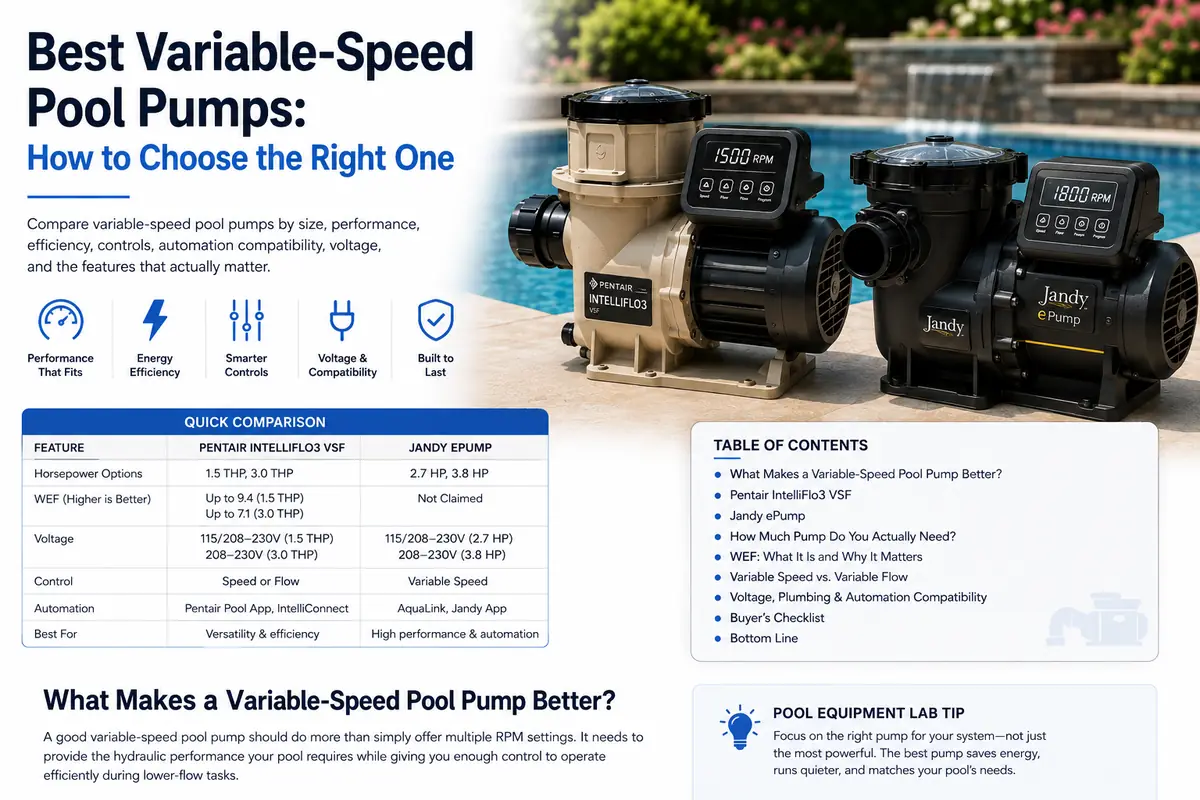
The best variable-speed pool pump isn't necessarily the biggest, most powerful, or most expensive model. The right choice depends on your pool's plumbing, equipment, required flow, automation system, electrical service, and the range of operating conditions the pump needs to handle. This guide explains how to compare variable-speed pumps using specifications that actually matter instead of relying on horsepower or marketing claims alone.
Quick Answer: How to Choose a Variable-Speed Pool Pump
A variable-speed pool pump should be selected based on the flow your pool actually needs, the resistance of its plumbing, the requirements of connected equipment and the pump's electrical and control specifications. Horsepower alone is not enough to determine whether a pump is suitable.
Two pumps with similar advertised horsepower can have different hydraulic performance, efficiency, voltage requirements and automation capabilities. Likewise, two pools containing the same amount of water can need very different pumps.
This guide examines the Pentair IntelliFlo3 VSF and Jandy ePump as documented examples, then explains how to compare pump performance, energy efficiency, installation requirements and long-term operating costs.
Variable-Speed Pool Pump Comparison at a Glance
The following comparison summarizes the manufacturer-published configurations discussed in this guide. Verify current specifications for the exact model number before purchasing, because product configurations and documentation can change.
| Specification | Pentair IntelliFlo3 VSF 1.5 THP | Pentair IntelliFlo3 VSF 3.0 THP | Jandy ePump 2.7 HP | Jandy ePump 3.8 HP |
|---|---|---|---|---|
| Advertised capacity | 1.5 THP | 3.0 THP | 2.7 HP | 3.8 HP |
| Published WEF in referenced documentation | 9.4 | 7.1 | Verify exact model | Verify exact model |
| Voltage in referenced documentation | 115/208–230V | 208–230V | 115/208–230V for dual-voltage version | 208–230V |
| Operating control | Variable speed and flow | Variable speed and flow | Variable speed | Variable speed |
| Automation considerations | Pentair-compatible controls and app functionality | Pentair-compatible controls and app functionality | Compatible Jandy controls | Compatible Jandy controls |
| Primary sizing consideration | Required system flow and head | Required system flow and head | Required system flow and head | Required system flow and head |
These specifications are not interchangeable performance ratings. In particular, advertised horsepower does not establish how much water a pump will move through your plumbing. Compare manufacturer performance curves at the total dynamic head relevant to your pool.
How Pool Equipment Lab Researches Variable-Speed Pumps
Pool Equipment Lab does not describe products as hands-on tested unless we have actually tested them ourselves.
For research-based buying guides, we examine available manufacturer specifications, installation manuals, hydraulic performance information, efficiency data, electrical requirements, controls, automation compatibility, warranty documentation and maintenance considerations.
We distinguish documented specifications from advertised benefits. Claims about energy savings, quiet operation and improved performance depend on installation conditions and should not be assumed to apply equally to every pool.
Our evaluation focuses on whether a pump's documented capabilities match the requirements of a particular installation rather than treating brand recognition or maximum horsepower as a substitute for system design.
For a broader explanation of pump types, flow, RPM, sizing and efficiency, see our Complete Guide to Pool Pumps.
Pentair IntelliFlo3 VSF
The Pentair IntelliFlo3 VSF is a variable-speed and variable-flow pump platform with 1.5 THP and 3.0 THP configurations in the manufacturer documentation referenced for this guide.
Its distinguishing capability is the option to program operation by either motor speed or flow.
With speed-based operation, the pump attempts to maintain a selected RPM. With flow-based operation, its control system can adjust motor speed to maintain a programmed flow as hydraulic resistance changes, subject to the pump's operating limits.
Published Specifications
| Specification | 1.5 THP | 3.0 THP |
|---|---|---|
| Total horsepower | 1.5 THP | 3.0 THP |
| Published WEF in referenced documentation | 9.4 | 7.1 |
| Voltage in referenced documentation | 115/208–230V | 208–230V |
| Speed-based programming | Yes | Yes |
| Flow-based programming | Yes | Yes |
Verify the exact model, voltage, plumbing connections, controls and current published efficiency specifications before purchasing.
When Variable-Flow Control Can Be Useful
Consider a hypothetical pool with a target circulation flow of 40 GPM.
At a fixed RPM, the actual flow may decline as the filter collects debris and system resistance increases.
A compatible flow-controlled pump can attempt to compensate by increasing motor speed to maintain the programmed flow, provided it has sufficient available capacity and remains within its operating limits.
| Condition | Fixed-Speed Control | Flow-Based Control |
|---|---|---|
| Clean filter | Maintains programmed RPM | Adjusts RPM to target programmed flow |
| Filter resistance increases | Actual flow may decrease | May increase RPM to compensate |
| System reaches pump limits | Flow depends on available performance | Cannot maintain flow beyond available performance |
Flow-based control does not eliminate the need to clean filters or correct plumbing problems. It also does not guarantee that a programmed flow can be maintained under every operating condition.
Controls and Connectivity
Pentair provides compatible app-based control and programming options for the IntelliFlo3 platform. Available functions depend on the installed configuration and accessories.
Check the exact pump and control-system documentation to determine whether your installation supports the scheduling, remote access and automation functions you want.
What to Consider Before Buying
- Whether the 1.5 THP or 3.0 THP configuration meets the pool's required flow and head.
- Whether the existing electrical service matches the selected model.
- Whether the pump's plumbing connections suit the equipment pad.
- Whether flow-based control would provide a practical benefit for the installation.
- Whether the pump integrates with existing automation.
- Whether the installation meets the manufacturer's warranty requirements.
The larger configuration should not be selected solely because it has more horsepower. Determine whether the pool has an operating mode that actually requires the additional hydraulic capacity.
IntelliFlo3 shopping reference: The affiliate listing below was identified for the Pentair IntelliFlo3 VSF 1.5 HP, model 011065. Confirm the product identity, seller listing and current specifications before ordering.
Check IntelliFlo3 1.5 HP Price on Amazon
Jandy ePump
Jandy's ePump lineup includes variable-speed configurations intended for residential pool and spa circulation, including higher-flow applications.
The manufacturer documentation referenced for this guide identifies 2.7 HP and 3.8 HP configurations, with a dual-voltage version of the 2.7 HP model.
Jandy describes its 3.8 HP model as offering greater hydraulic performance than its 2.7 HP ePump. The manufacturer has advertised a 24% performance difference, but that claim should be interpreted using the relevant performance curves and test conditions rather than assuming a 24% improvement at every operating point.
What to Examine
- Manufacturer performance curves at the system's expected total dynamic head.
- Available voltage configurations.
- Compatibility with existing Jandy AquaLink or other controls.
- Required plumbing connections and equipment-pad clearance.
- Operating requirements for attached spas and water features.
- Warranty and installation requirements.
Example: A Pool With Multiple Operating Modes
Consider a hypothetical installation with the following flow requirements.
| Operating Mode | Illustrative Required Flow |
|---|---|
| Routine filtration | 35 GPM |
| Heating | 45 GPM |
| Attached spa | 90 GPM |
| Water feature | 110 GPM |
These figures are hypothetical and are not specifications for a particular Jandy pump.
In an installation like this, the selection process must account for the highest legitimate operating demand, including whether equipment operates simultaneously.
A pump capable of providing 35 GPM for filtration is not automatically capable of delivering 110 GPM through the same plumbing.
Use the manufacturer's performance curves to determine whether the selected model can produce the required flow at the expected system head.
Automation Considerations
Jandy automation compatibility may be relevant for pools already using AquaLink or planning to install compatible controls.
Depending on the equipment and configuration, automation can coordinate pump operation with filtration, heating, spa mode and water features.
Verify compatibility using the exact pump and automation model numbers. Do not assume every Jandy pump supports every Jandy control system or feature.
Don't Choose a Pump Based on Brand Alone
Brand familiarity, parts availability, installer experience and manufacturer support are useful considerations, but they do not replace hydraulic sizing.
A high-capacity pump may provide more performance than a simple residential pool requires.
Conversely, a lower-capacity pump may not satisfy an installation with demanding spa jets, long plumbing runs or large water features.
Start with the system's requirements, then compare models that can meet them.
Compare Variable-Speed Pool Pumps on Amazon
How Much Pump Do You Actually Need?
Pool volume is useful when estimating circulation requirements, but it does not determine pump size by itself.
Two pools with the same water volume can have very different hydraulic requirements.
Example: Two 20,000-Gallon Pools
| System Feature | Pool A | Pool B |
|---|---|---|
| Pool volume | 20,000 gallons | 20,000 gallons |
| Filtration | Basic filtration | Filtration with additional equipment |
| Plumbing | Relatively short runs | Longer, more complex runs |
| Attached spa | No | Yes |
| Water features | No | Multiple features |
| Additional equipment | Limited | Heater and salt chlorinator |
| Pump selection | Based on filtration requirements | Based on all required operating modes |
Pool B may require substantially more hydraulic capability despite containing the same amount of water as Pool A.
Our guide on how to size a variable-speed pool pump explains the sizing process. You can also use our Pool Pump Sizing Calculator to estimate an initial circulation-flow requirement.
How to Read a Pool Pump Performance Curve
A manufacturer performance curve shows the relationship between water flow and the hydraulic resistance a pump can overcome.
Flow is commonly expressed in gallons per minute (GPM), while resistance is expressed as total dynamic head (TDH), often in feet of head.
For variable-speed pumps, the manufacturer may publish multiple curves corresponding to different motor speeds.
Worked Example: Matching a Pump to System Head
Suppose a hypothetical pool requires 60 GPM during a particular operating mode, and the estimated system head at that flow is 50 feet.
The pump must be capable of delivering approximately 60 GPM at 50 feet of head.
It is not enough for the pump's advertising to mention a maximum flow greater than 60 GPM. That maximum may be measured at much lower resistance.
To evaluate a candidate pump:
- Locate the manufacturer's performance curve for the exact model.
- Find 60 GPM on the flow axis.
- Find 50 feet of head on the head axis.
- Identify whether an available speed curve passes through the required operating point.
- Confirm that the resulting operation remains within the pump's and connected equipment's limits.
For an existing pool, an installer may need to measure or estimate system head. An inaccurate head estimate can lead to an unsuitable pump selection.
What Is WEF?
Weighted Energy Factor (WEF) is an efficiency metric used for dedicated-purpose pool pumps under applicable standardized test procedures.
WEF expresses the volume of water moved relative to electrical energy consumed under the prescribed test conditions. It is commonly reported in thousands of gallons per kilowatt-hour.
It provides more useful standardized efficiency information than horsepower alone.
How to Interpret WEF
Consider two hypothetical pumps with the following published ratings.
| Specification | Hypothetical Pump A | Hypothetical Pump B |
|---|---|---|
| WEF | 8.0 | 10.0 |
| Standardized water movement per kWh | 8,000 gallons | 10,000 gallons |
Under the relevant standardized test procedure, Pump B's rating indicates more water moved per unit of electrical energy.
However, this does not establish that Pump B will consume less electricity in every real-world installation.
The pumps may have different hydraulic capabilities, and their actual operating points may differ from the standardized test conditions.
WEF is most useful alongside performance curves, system requirements and electrical specifications.
Variable Speed vs. Variable Flow
Variable-speed and variable-flow control are related, but they are not identical.
| Feature | Speed-Based Control | Flow-Based Control |
|---|---|---|
| Programmed target | Motor RPM | Water flow |
| Response to increasing filter resistance | Maintains RPM; actual flow may decline | May increase RPM to maintain target flow |
| Primary benefit | Direct speed scheduling | Flow-oriented scheduling |
| Important limitation | RPM does not establish actual GPM | Target flow is limited by available pump performance |
Neither approach eliminates the need for proper hydraulic design.
For a deeper explanation of speed and water movement, see How Many GPM Should a Variable-Speed Pool Pump Run?.
Check Voltage Before Buying
Electrical compatibility is a critical part of pump selection.
Some variable-speed pumps require 208–230V service, while certain models support 115V as well.
Do not assume every configuration in a manufacturer's product family has the same voltage requirements.
Example: Replacing a 115V Pump
Suppose an existing pool pump operates on a 115V circuit.
Replacing it with a pump that requires 208–230V may involve electrical modifications.
Before purchasing, verify:
- The voltage available at the equipment pad.
- The exact replacement pump's voltage requirements.
- The required circuit and overcurrent protection.
- Wiring and installation instructions.
- Applicable electrical requirements and permit needs.
Electrical installation and modifications should be performed by a qualified professional where required.
Check Plumbing Connections and Equipment-Pad Space
A replacement pump may not fit the same plumbing layout as the original equipment.
Compare the exact pump dimensions and installation requirements before ordering.
| Installation Detail | What to Check |
|---|---|
| Pipe diameter | Existing suction and return plumbing |
| Inlet and outlet | Size, height and position |
| Unions | Compatible connection sizes and fittings |
| Equipment-pad clearance | Space for installation, service and ventilation |
| Straight pipe | Any manufacturer-required straight-pipe sections |
| Electrical access | Location of wiring connections and controls |
Major plumbing changes can increase installation costs and should be included when comparing replacement options.
Automation Compatibility Matters
If the pool already has automation, confirm compatibility before selecting a replacement pump.
Compatible automation can coordinate different pump operating modes with other equipment.
For example, a programmed system may use:
- Lower speed for routine filtration.
- A separate setting for heater operation.
- Higher flow for spa mode.
- Dedicated programs for water features.
- Scheduled operation for compatible cleaning equipment.
Compatibility must be checked using the exact pump and automation model numbers.
Some integrations may require specific software, communication interfaces or accessories.
Our Complete Guide to Pool Automation explains how pumps, heaters, valves, lights and sanitation equipment can work together.
Compare Operating Cost, Not Just Purchase Price
A pump's purchase price is only one part of its ownership cost.
Variable-speed pumps can reduce electricity consumption by operating lower-flow tasks at reduced speeds, but actual savings depend on the installation and schedule.
Worked Example: Daily Electricity Cost
Consider two hypothetical operating schedules.
| Operating Detail | Schedule A | Schedule B |
|---|---|---|
| Average electrical draw | 1,000 watts | 300 watts |
| Daily runtime | 6 hours | 12 hours |
| Daily energy | 6 kWh | 3.6 kWh |
| Daily cost at $0.18/kWh | $1.08 | $0.65 |
| 30-day cost | $32.40 | $19.44 |
In this hypothetical example, Schedule B uses less electricity despite running twice as long.
However, the schedules may circulate different volumes of water. Do not treat them as equivalent without verifying actual flow and equipment performance.
See How Much Does a Variable-Speed Pool Pump Cost to Run? for a detailed explanation, or use our Pool Pump Operating Cost Calculator to estimate costs using your own numbers.
Don't Automatically Buy the Highest Horsepower
Variable-speed technology allows a higher-capacity pump to operate below its maximum speed, but that does not mean the largest available model is appropriate for every pool.
A pump with more capacity than the installation needs may:
- Cost more to purchase.
- Require electrical modifications.
- Provide hydraulic capacity that is never used.
- Produce flow beyond the useful operating range of existing equipment if programmed incorrectly.
Conversely, selecting a pump that cannot meet the pool's highest legitimate flow requirement can create performance problems.
The objective is to select a pump that can meet all required operating modes while providing practical reduced-speed operation for everyday circulation.
When Higher Hydraulic Capacity May Be Necessary
Some pools have operating modes that require substantially more flow than routine filtration.
Examples include:
- Attached spas with multiple jets.
- Large waterfalls.
- Multiple water features.
- In-floor cleaning systems.
- Long or restrictive plumbing.
- Complex equipment configurations.
In these installations, compare the required operating points with manufacturer performance curves before deciding which pump configuration is suitable.
When a Lower-Capacity Pump May Be Sufficient
A straightforward residential pool may have modest circulation requirements and no high-flow operating modes.
For example, a pool with basic filtration, short plumbing runs, no attached spa and no major water features may not require a 3 HP-class pump.
However, pool volume and equipment descriptions alone are insufficient to establish the correct model. Verify the required flow and system head.
Should You Replace a Working Single-Speed Pump?
A functioning pump does not automatically need to be replaced immediately simply because variable-speed technology is available.
The financial decision depends on the existing pump's energy consumption, expected remaining service life, electricity costs and the installed price of a replacement.
Example: Calculating Simple Payback
Suppose the following hypothetical figures apply:
| Item | Illustrative Amount |
|---|---|
| Existing pump annual electricity cost | $600 |
| Replacement pump annual electricity cost | $250 |
| Estimated annual savings | $350 |
| Installed replacement cost | $1,400 |
| Simple payback | 4 years |
Simple Payback = Installed Cost ÷ Annual Savings
In this example:
$1,400 ÷ $350 = 4 years
This simplified calculation excludes financing, future electricity-rate changes, maintenance differences, equipment failure, rebates and the remaining life of the existing pump.
Use actual operating measurements and installation quotes when evaluating your own pool.
Federal Pool Pump Efficiency Requirements
Dedicated-purpose pool pumps are subject to applicable federal energy-conservation standards administered by the U.S. Department of Energy.
These requirements use defined equipment classifications and standardized test procedures. They should not be summarized as a universal ban on every single-speed pool pump.
Certain dedicated-purpose pool pump motors are also subject to separate federal requirements, with compliance dates and classifications that depend on the equipment.
When selecting replacement equipment, verify the current requirements applicable to the exact pump or motor.
Variable-Speed Pool Pump Buying Checklist
Use this checklist before comparing prices or ordering a replacement pump.
- Calculate pool volume. Establish a starting point for circulation planning.
- Determine routine flow. Estimate the flow required for everyday circulation.
- Identify maximum operating demand. Include spas, water features and other equipment that may operate simultaneously.
- Estimate system head. Use appropriate measurements or professional hydraulic calculations.
- Check the performance curve. Confirm that the pump can meet each required operating point.
- Verify filter limits. Make sure the resulting flow remains within the filter's operating specifications.
- Review heater and sanitation requirements. Confirm the necessary flow ranges.
- Check voltage. Verify the electrical service and the exact pump's requirements.
- Check plumbing compatibility. Review connection sizes, clearances and installation instructions.
- Verify automation compatibility. Check exact model numbers and any required accessories.
- Compare efficiency and operating costs. Review WEF and estimate real-world energy use.
- Review warranty terms. Confirm installation and registration requirements.
Frequently Asked Questions
What makes a variable-speed pool pump efficient?
Variable-speed pumps can reduce electrical consumption by operating at lower speeds when full hydraulic output is unnecessary. Actual efficiency depends on the pump, system resistance and operating schedule.
Is a 3 HP variable-speed pump better than a 1.5 HP pump?
Not automatically. The appropriate capacity depends on the pool's required flow and system head. A higher-capacity pump may be necessary for demanding equipment but unnecessary for simpler installations.
What is WEF on a pool pump?
WEF stands for Weighted Energy Factor. It is a standardized efficiency metric describing water movement relative to electrical energy consumption under applicable test conditions.
Is a higher WEF always better?
A higher WEF indicates greater efficiency under the relevant standardized test conditions, but the pump must also provide the hydraulic performance required by your installation.
What is the difference between variable speed and variable flow?
Speed-based control targets a motor RPM. Flow-based control attempts to maintain a programmed flow by adjusting motor speed as hydraulic conditions change, within the pump's operating limits.
Can I replace a 115V pump with a 230V pump?
Possibly, but electrical modifications may be necessary. Verify the replacement pump's specifications and have the installation evaluated by a qualified professional where required.
Do variable-speed pumps work with pool automation?
Many do, but compatibility varies by pump, automation system and installed accessories. Confirm support using the exact model numbers.
Will a larger pump always circulate water faster?
Not necessarily. Actual flow depends on both pump performance and the hydraulic resistance of the plumbing and equipment.
Is it worth replacing a working single-speed pump?
That depends on current electricity consumption, operating hours, electricity rates, replacement cost, expected remaining service life and available incentives.
What should I check before buying a variable-speed pump?
Start with required flow and system head. Then compare performance curves, efficiency, voltage, plumbing connections, controls, automation compatibility, installation requirements, warranty terms and operating costs.
Bottom Line
A variable-speed pool pump should be matched to the pool's actual hydraulic, electrical and equipment requirements rather than selected by horsepower or brand recognition alone.
The Pentair IntelliFlo3 VSF and Jandy ePump illustrate different available configurations and control options. Their suitability depends on the flow, head, electrical service and automation requirements of the installation.
Determine what your pool needs first. Then compare documented pump performance, efficiency, installation requirements and ownership costs before choosing a model.
How We Research
Pool Equipment Lab evaluates pool equipment using manufacturer specifications, documentation, compatibility requirements, operating costs, warranty information, and owner feedback when relevant. We do not claim hands-on testing unless we actually performed it.
Sources
- U.S. Department of Energy — Dedicated-Purpose Pool Pumps — federal efficiency standards, test procedures, and regulatory information for dedicated-purpose pool pumps.
- U.S. Department of Energy — Dedicated-Purpose Pool Pump Motors — current federal motor efficiency standards and compliance information.
- Pentair — IntelliFlo3 Variable Speed & Flow Pool Pump — current IntelliFlo3 specifications including THP, WEF, voltage, plumbing connections, and control features.
- Jandy — ePump 2.7 HP Variable-Speed Pump — manufacturer specifications, voltage, programming, and automation information.
- Jandy — ePump 3.8 HP Variable-Speed Pump — manufacturer specifications, hydraulic performance, plumbing, and automation information.
Product specifications, availability, warranty terms, and regulatory requirements can change. Verify current manufacturer documentation for the exact model before purchasing or installing pool equipment.