
Cartridge vs. Sand vs. DE Pool Filters: Which Is Best?
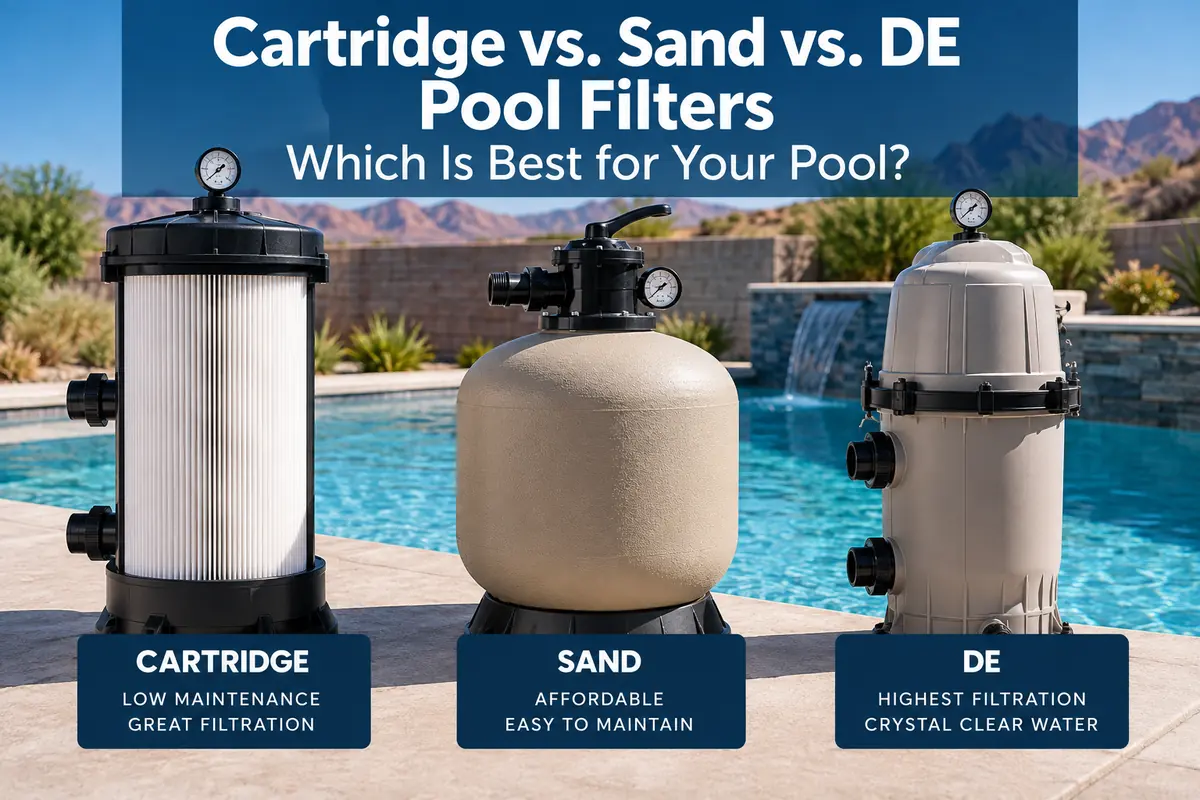
Cartridge, sand, and diatomaceous earth (DE) filters can all keep a swimming pool clean, but they do it differently. The best choice depends on how much filtration you want, how you prefer to clean the filter, your pool's flow requirements, and how much maintenance you are willing to perform.
This guide compares the three major residential pool filter types so you can understand the tradeoffs before choosing one for a new pool or replacing an existing filter.
Quick Answer: Cartridge vs. Sand vs. DE Pool Filters
Cartridge, sand and diatomaceous earth (DE) filters all remove suspended debris from swimming pool water, but they differ in how they capture particles, how they are cleaned and what routine maintenance involves.
Cartridge filters use pleated elements that are removed and rinsed. Sand filters use a bed of granular media that is normally cleaned by backwashing. DE filters use a fine layer of diatomaceous earth supported by internal grids or other elements and require periodic media replenishment.
The appropriate choice depends on your pool's flow requirements, local water conditions, available installation space, maintenance preferences and budget. Filtration performance matters, but so do cleaning procedures, replacement-media costs and water consumption.
Cartridge vs. Sand vs. DE Pool Filters at a Glance
| Feature | Cartridge | Sand | DE |
|---|---|---|---|
| Filtration media | Pleated cartridge elements | Granular filter media | Diatomaceous earth supported by grids or elements |
| Routine cleaning | Remove and rinse cartridges | Backwash | Backwash or clean elements, then replenish DE as specified |
| Routine backwashing | Not required | Generally required | Depends on filter design |
| Water discharged during cleaning | Water used for rinsing | Pool water discharged during backwashing | Depends on cleaning method |
| Maintenance tasks | Cartridge removal, cleaning and eventual replacement | Backwashing and periodic media inspection or replacement | DE replenishment, backwashing where applicable and internal cleaning |
| Fine-particle filtration | Effective, depending on cartridge design | Depends on media and filter design | Designed for very fine filtration |
| Media replacement | Replacement cartridges | Sand or other approved granular media | DE replenishment and eventual grid or element replacement |
| Installation consideration | Space to open housing and remove cartridges | Backwash valve and suitable waste discharge | Space for servicing and appropriate DE handling |
There is no single pool filter type that meets every owner's requirements. Compare the actual specifications and maintenance instructions of the models under consideration rather than relying only on general descriptions of each technology.
For a broader look at filter operation, sizing, pressure and maintenance, see our Complete Guide to Pool Filters.
How a Cartridge Pool Filter Works
A cartridge filter sends pool water through pleated filtration elements. Debris is captured by the media while filtered water travels through the filter and returns to the pool.
One important characteristic is that a cartridge filter normally does not require backwashing. When cleaning is necessary, the pump is shut down, the filter is fully depressurized and the cartridges are removed according to the manufacturer's instructions.
Large cartridge filters can provide substantial filtration area within a relatively compact housing. That gives the media room to accumulate debris before restriction becomes excessive.
Advantages of Cartridge Filters
- No routine backwashing.
- Cleaning does not require discharging large quantities of pool water through a backwash cycle.
- Large residential models provide substantial filtration area.
- Relatively straightforward filtration operation.
- Compatible with variable-speed pool systems when correctly sized.
- Cartridges can be inspected directly during cleaning.
Disadvantages of Cartridge Filters
- Cartridges eventually require replacement.
- Cleaning multiple large cartridges can take time.
- Oils, scale and embedded debris may require approved cleaning treatments.
- Replacement cartridges add a periodic ownership expense.
- The filter needs sufficient service clearance for cartridge removal.
Example: Cleaning a Four-Cartridge Filter
Suppose a residential filter contains four large cartridge elements.
When the manufacturer's cleaning criterion is reached, all four cartridges may need to be removed, inspected and cleaned.
This requires more hands-on work than operating a sand filter's backwash valve, but it does not require a routine backwash cycle that sends pool water to waste.
When comparing cartridge filters, consider how easily the housing opens, the weight and size of the cartridges, and the available space for removing them.
For more about replacement timing and signs of wear, see How Long Do Pool Filter Cartridges Last?.
If cartridge filtration matches your maintenance and installation requirements, compare available models and their specifications below.
Compare Cartridge Pool Filters on Amazon
How a Sand Pool Filter Works
A sand filter passes water through a bed of granular filtration media. Suspended debris is captured as water moves through the media.
As debris accumulates, resistance through the filter generally increases.
Instead of opening the tank for every cleaning, the system is normally backwashed by directing water through the filter in the reverse flow pattern specified by the manufacturer and discharging dirty water through a waste line.
After backwashing, some filter designs require a rinse cycle before returning to normal filtration.
Advantages of Sand Filters
- Simple routine operation.
- Backwashing can clean the filter without removing internal filtration elements.
- Long-established filtration technology.
- Routine maintenance is generally straightforward when the installation has a suitable waste-discharge arrangement.
- Granular media does not normally need to be removed during each cleaning.
Disadvantages of Sand Filters
- Backwashing consumes pool water.
- A suitable waste-water discharge arrangement is needed.
- Standard sand filtration generally captures less-fine material than DE filtration.
- Granular media eventually requires inspection, service or replacement.
- Backwashing may require additional water and chemical adjustments afterward.
Example: Estimating Backwash Water Use
Suppose a hypothetical sand-filter installation discharges 50 gallons per minute during backwashing.
If the backwash runs for three minutes:
50 GPM × 3 minutes = 150 gallons
If the same system requires a one-minute rinse at the same flow:
50 GPM × 1 minute = 50 gallons
The combined discharge would be approximately 200 gallons.
These figures are illustrative. Actual discharge depends on the equipment, operating flow and manufacturer's required cleaning procedure.
When evaluating a sand filter, consider where backwash water will go and whether local requirements restrict its discharge.
If backwash-based maintenance suits your pool, compare available sand-filter models below.
Compare Sand Pool Filters on Amazon
How a DE Pool Filter Works
DE filters use diatomaceous earth as filtration media over internal grids or other supporting elements.
The DE forms a fine filtration layer that captures very small suspended particles as pool water passes through it.
Pentair describes DE as an effective filtration technology for trapping fine dirt and debris.
Depending on the filter design, maintenance may involve backwashing, opening and cleaning the internal elements, and replenishing the specified amount of DE media.
Advantages of DE Filters
- Very fine-particle filtration.
- Can produce clear-looking water when properly operated and maintained.
- Suitable for owners who prioritize fine filtration and are comfortable with the required maintenance.
Disadvantages of DE Filters
- Additional maintenance steps compared with many cartridge and sand-filter routines.
- DE media must be handled and replenished according to the manufacturer's instructions.
- Internal grids or elements require periodic inspection and cleaning.
- Some designs require backwashing.
- Media handling and waste disposal require attention to manufacturer instructions and applicable local requirements.
Why DE Replenishment Matters
DE filters are designed to operate with a specified quantity of filtration media.
After backwashing or internal cleaning, the appropriate amount of DE must be added according to the instructions for the exact model.
The required quantity after backwashing may differ from the amount specified after a complete internal cleaning.
Too little or too much DE can interfere with proper operation. Do not estimate the required amount from the filter's physical size alone.
Follow the manufacturer's handling instructions and avoid inhaling airborne DE dust.
If DE filtration matches your water-clarity goals and maintenance preferences, compare available models below.
Compare DE Pool Filters on Amazon
Which Pool Filter Uses the Least Water During Cleaning?
Cartridge filters do not normally require a backwash cycle. Their cartridges are removed and rinsed instead.
Sand filters and many DE filters discharge pool water during backwashing.
The actual amount depends on the equipment, flow rate and length of the cleaning cycle.
Illustrative Cleaning-Water Comparison
| Filter Type | Illustrative Cleaning Method | Water-Use Consideration |
|---|---|---|
| Cartridge | Remove and rinse elements. | Uses rinse water but does not require routine backwash discharge. |
| Sand | Backwash and rinse as specified. | Discharges pool water during the cleaning cycle. |
| DE | Backwash or clean internal elements. | Water use depends on the design and maintenance procedure. |
For a location where replacement water is expensive or water conservation is important, the amount of water discharged during routine maintenance may be a significant selection factor.
However, actual annual water use also depends on cleaning frequency, filter sizing and debris load.
Which Pool Filter Is Easiest to Maintain?
Maintenance preferences vary. Some owners prefer operating a backwash valve, while others prefer removing and rinsing cartridges.
DE maintenance includes additional media-handling steps.
| Maintenance Task | Cartridge | Sand | DE |
|---|---|---|---|
| Routine cleaning | Remove and clean elements. | Backwash. | Backwash or clean elements as specified. |
| Open filter during every routine cleaning | Generally yes. | Generally no. | Depends on design and cleaning procedure. |
| Replenish filtration media after routine backwashing | Not applicable. | Not normally. | Generally required after backwashing. |
| Periodic internal inspection | Inspect cartridges during cleaning. | Inspect media and internal components as required. | Inspect grids or elements as required. |
Whichever type you choose, cleaning should generally be based on system performance and manufacturer guidance rather than an arbitrary calendar schedule.
See How Often Should You Clean a Pool Filter? for more about pressure rise, debris load and cleaning intervals.
Which Pool Filter Provides the Clearest Water?
DE filtration is designed to capture very fine suspended material. Cartridge filtration also provides effective fine-particle removal, while conventional sand filtration uses a different media design and generally has different particle-capture characteristics.
However, particle-size claims vary by filter design, media and test conditions. A published micron figure does not describe every aspect of real-world filtration performance.
Filter type is only one part of water clarity.
Proper circulation, sanitizer levels, balanced water chemistry, adequate runtime and a correctly sized filtration system all matter.
Example: Why Fine Filtration Alone Is Not Enough
Suppose a pool uses a filter designed to capture very fine particles, but the pool has inadequate sanitizer levels and an active algae problem.
The filter may collect suspended material, but it does not correct the underlying sanitation problem.
Likewise, a correctly maintained sand or cartridge filter can support clear pool water when circulation and water chemistry are properly managed.
Evaluate filtration as one component of the complete pool-care system.
How Filter Type Affects Ongoing Ownership Costs
The purchase price is only one part of the cost of owning a pool filter.
Consider replacement media, water consumption, cleaning supplies, maintenance time and potential professional-service expenses.
| Expense | Cartridge | Sand | DE |
|---|---|---|---|
| Replacement media | Cartridges eventually require replacement. | Granular media eventually requires service or replacement. | DE must be replenished; grids or elements may eventually require replacement. |
| Cleaning supplies | Water and approved cleaning products when needed. | Backwash water and any required maintenance supplies. | DE media and other approved maintenance supplies. |
| Water replacement | Primarily cleaning and other routine pool-water losses. | Includes backwash and rinse discharge. | Depends on the cleaning method. |
| Professional maintenance | Depends on owner preference and service requirements. | Depends on owner preference and service requirements. | May include additional media and internal-component servicing. |
Compare costs using actual replacement-part prices and the maintenance requirements of the models you are considering.
Annual expenses can vary substantially with debris load, water prices, service frequency and local labor costs.
Which Filter Type Fits Different Pool Conditions?
The following examples illustrate how different pool conditions can affect the selection process.
Pool in a Water-Conservation Area
If reducing routine backwash discharge is important, examine cartridge-filter options and compare their cleaning-water requirements with those of sand and DE systems.
Consider the amount of water used during cartridge rinsing as well as how frequently cleaning is required.
Pool With Heavy Seasonal Debris
For a pool exposed to frequent leaves, dust or pollen, consider filtration area, dirt-holding capacity and cleaning accessibility.
A filter with greater compatible filtration area may provide longer intervals between cleaning under otherwise similar conditions.
Skimmer baskets and other debris-removal equipment can also reduce the load reaching the filter.
Pool Owner Who Prefers Backwashing
If you prefer cleaning the filter without removing cartridges during every routine maintenance session, evaluate sand-filter models and the required waste-discharge arrangements.
Compare backwash procedures, water consumption and media-maintenance requirements.
Pool Owner Prioritizing Fine Filtration
If capturing very fine suspended material is a primary requirement, review DE-filter specifications alongside compatible cartridge-filter options.
Compare published filtration performance, maintenance procedures, media costs and installation requirements.
Don't Ignore Filter Size
Regardless of filter type, the filter must safely handle the flow produced by the circulation system.
Pool volume can help establish average circulation requirements, but the final filter must accommodate the pump's actual operating flow.
This includes higher-speed modes used for heaters, cleaners, spas or water features when water passes through the filter.
Example: A 20,000-Gallon Pool
A theoretical eight-hour turnover for a 20,000-gallon pool requires:
20,000 ÷ (8 × 60) = 41.7 GPM
Suppose the same pool's pump produces 70 GPM during a higher-speed operating mode.
The filter must accommodate that higher relevant flow, not just the 41.7-GPM average circulation calculation.
Always compare the manufacturer's rated flow, filtration area, plumbing requirements and operating limits with the rest of the pool system.
See How Big Should My Pool Filter Be? for the full sizing process, or use our Pool Filter Sizing Calculator for a starting estimate.
Watch Filter Pressure After Installation
Once the filter is installed and clean, establish its normal pressure at a known pump speed.
Changes from that baseline can help identify when the filter is becoming restricted or when another circulation problem may be developing.
With a variable-speed pump, compare pressure readings taken at the same RPM and with the same valve configuration.
Follow the manufacturer's cleaning threshold for the exact filter rather than assuming every model should be cleaned after the same PSI increase.
See Why Is My Pool Filter Pressure High? Causes and Fixes for more about interpreting pressure changes.
Common Mistakes When Comparing Pool Filter Types
| Mistake | Why It Matters | What to Check Instead |
|---|---|---|
| Comparing filtration area across different technologies | Cartridge, sand and DE area ratings describe different media designs. | Compare specifications within each technology. |
| Choosing by pool gallons alone | Does not account for actual pump flow. | Evaluate circulation requirements and operating flow. |
| Ignoring backwash discharge | May create installation or water-use problems. | Check waste-water arrangements and local requirements. |
| Considering purchase price only | Overlooks replacement media and maintenance expenses. | Estimate ongoing ownership costs. |
| Ignoring service clearance | May make cartridge or grid removal difficult. | Review manufacturer dimensions and service-space requirements. |
| Assuming fine filtration solves every clarity problem | Filtration does not replace sanitation and water-chemistry management. | Evaluate the complete pool-care system. |
A Practical Pool Filter Selection Checklist
- Calculate pool volume. Establish the amount of water being circulated.
- Determine actual pump flow. Include all relevant operating modes.
- Review filter flow ratings. Verify that candidate models meet the system's requirements.
- Choose your preferred maintenance method. Compare cartridge removal, sand backwashing and DE maintenance.
- Consider water consumption. Evaluate routine cleaning and backwash requirements.
- Compare filtration specifications. Review performance claims for the actual models.
- Estimate ongoing costs. Include replacement media, cleaning supplies and any professional service.
- Check installation space. Confirm plumbing compatibility and required service clearances.
- Review manufacturer instructions. Understand the maintenance procedure before purchasing.
- Compare compatible models. Evaluate the complete equipment specifications rather than one advertised feature.
For a broader buying guide covering filter type, sizing, flow rate, maintenance and other selection factors, see Best Pool Filters: How to Choose.
Frequently Asked Questions
What is the difference between cartridge, sand and DE pool filters?
Cartridge filters use pleated elements, sand filters use granular media, and DE filters use a fine layer of diatomaceous earth supported by internal elements. Their filtration characteristics and cleaning procedures differ.
Do cartridge filters require backwashing?
No. Cartridge filters are normally cleaned by removing and rinsing the filtration elements according to the manufacturer's instructions.
Do sand filters waste water?
Sand filters normally discharge pool water during backwashing and any required rinse cycle. The amount depends on the equipment and cleaning procedure.
Do DE filters require backwashing?
Many DE filters use backwashing, but maintenance procedures vary by design. Some require internal cleaning, and the correct amount of DE must be replenished as specified by the manufacturer.
Which filter captures the finest particles?
DE filters are designed for very fine-particle filtration. Actual performance varies by model, media and operating conditions, so review manufacturer specifications rather than relying only on general filtration claims.
Which pool filter requires the least hands-on cleaning?
Routine sand-filter backwashing generally does not require removing internal filtration elements. Cartridge filters require cartridge removal and cleaning, while DE systems have additional media-handling requirements. Overall maintenance frequency depends on the pool and equipment.
Can a cartridge filter be used with a variable-speed pump?
Yes, provided the filter is properly sized and all relevant pump operating modes remain within the manufacturer's flow and pressure limits.
Is a larger pool filter always better?
Additional compatible filtration area can provide more dirt-holding capacity and potentially longer cleaning intervals. However, equipment cost, available space, plumbing and actual system requirements still matter.
Can I replace a sand filter with a cartridge filter?
Potentially. Verify flow capacity, plumbing connections, available space and service clearance. Changing technologies may also require modifications to the existing installation.
Does filter type determine whether pool water stays clear?
Filter type affects particle removal, but clear water also depends on appropriate sanitation, circulation, water chemistry, filtration capacity and maintenance.
Bottom Line
Cartridge, sand and DE filters offer different combinations of filtration performance, cleaning procedures, water consumption and ongoing maintenance.
Compare the characteristics of each technology against your pool's actual flow requirements, installation conditions and preferred maintenance routine.
The final decision should be based on compatible equipment specifications and total ownership requirements rather than filtration technology or advertised particle size alone.
How We Research
Pool Equipment Lab evaluates pool equipment using manufacturer specifications, documentation, compatibility requirements, operating costs, warranty information, and owner feedback when relevant. We do not claim hands-on testing unless we actually performed it.