
Best Pool Filters: How to Choose
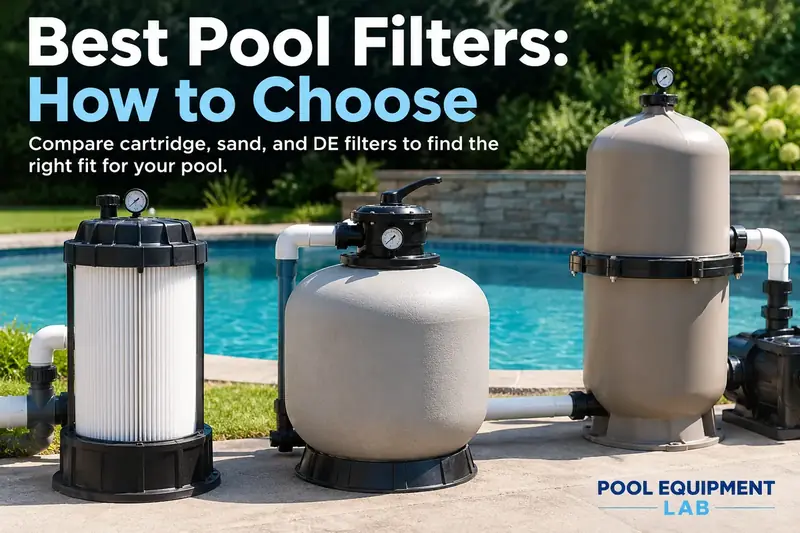
Choosing a pool filter is not simply a matter of finding the model with the highest flow rate or largest filter area. Cartridge, sand, and diatomaceous earth (DE) filters all remove debris from pool water, but they differ considerably in filtration performance, maintenance requirements, water use, and operating routine.
For most pool owners, the best pool filter is the one that is correctly sized for the circulation system and provides the right balance between water clarity and the amount of maintenance you are willing to perform. This guide explains how the three major filter types compare and what to look for before buying one.
Quick Answer: Which Type of Pool Filter Should You Choose?
Choose a pool filter based on your circulation system's flow rate, pool size, maintenance preferences and water-conservation needs. Cartridge filters eliminate routine backwashing, sand filters offer convenient valve-operated cleaning, and diatomaceous earth (DE) filters provide particularly fine filtration but require more involved maintenance.
All three can maintain clear residential pool water when correctly sized and maintained. Before comparing brands or prices, confirm that the filter can safely handle your pump's operating flow and that you have enough equipment-pad space for installation and servicing.
Cartridge vs. Sand vs. DE Pool Filters at a Glance
| Feature | Cartridge | Sand | DE |
|---|---|---|---|
| Filtration method | Pleated filter elements | Granular filter media | DE-coated grids or elements |
| Routine cleaning | Remove and rinse cartridges | Backwash | Backwash or disassemble, depending on design |
| Routine backwash water | None | Required when backwashing | Required on backwash-style models |
| Replacement consumables | Cartridge elements | Filter media when replacement is necessary | DE powder and replacement grids when necessary |
| Fine-particle capture | Generally finer than conventional sand | Depends on media and filter design | Generally the finest of the three |
| Primary maintenance consideration | Hands-on cartridge cleaning | Backwash water and discharge | Media handling and grid maintenance |
How the Three Main Pool Filter Types Work
Residential swimming pools generally use cartridge, sand or DE filtration. All three remove suspended particles from water circulating through the pool's filtration system, but they capture debris and are cleaned differently.
The pump moves water through the filter, where suspended debris is trapped before the water returns to the pool.
For a broader explanation of filtration equipment and operation, see our Complete Guide to Pool Filters.
Cartridge Pool Filters
Cartridge filters contain one or more pleated filter elements inside a pressure-rated tank. Water passes through the filter material, which captures suspended debris.
When the cartridges become dirty, the pump is shut off, pressure is safely released and the elements are removed for cleaning according to the manufacturer's instructions.
Because cartridge filters do not require routine backwashing, they can be particularly useful where conserving pool water is important.
Advantages of Cartridge Filters
- No routine backwashing.
- Large filter-area options are available.
- Replacement elements are available for many residential models.
- Cleaning does not require a backwash waste line.
- Suitable for installations where water conservation matters.
Potential Drawbacks
- Cleaning requires opening the filter tank.
- Large cartridges can take time to rinse thoroughly.
- Cartridges eventually need replacement.
- Replacement-element cost varies by model.
Example: When a Cartridge Filter Makes Sense
Consider a homeowner in a dry climate who wants to minimize the amount of pool water discharged during routine maintenance.
A properly sized cartridge filter avoids the regular backwashing required by a conventional sand filter. The tradeoff is that the homeowner must periodically open the filter and rinse the elements.
The actual cleaning interval depends on cartridge area, pool use, debris load and the manufacturer's pressure-based cleaning instructions.
Compare Cartridge Pool Filters on Amazon
Sand Pool Filters
Sand filters contain a bed of granular filtration media. Water passes through the media, which traps suspended particles before the filtered water returns to the pool.
When the filter becomes dirty, a multiport or other compatible valve arrangement can redirect water through the filter and send accumulated debris to a waste line.
This process is called backwashing.
Advantages of Sand Filters
- Relatively simple operation.
- Cleaning generally does not require removing internal elements.
- Filter media can provide extended service when properly maintained.
- Available in a wide range of residential sizes.
Potential Drawbacks
- Backwashing consumes pool water.
- Discharge plumbing and an appropriate disposal location are necessary.
- Conventional sand generally captures larger particles than DE filtration.
- Valves, laterals and other internal components can require maintenance.
Example: Backwash Water Use
Suppose a sand filter is backwashed at an illustrative flow rate of 40 gallons per minute for three minutes.
Backwash Water = 40 GPM × 3 minutes = 120 gallons
If the filter requires two additional minutes of rinsing at the same flow, another 80 gallons would be discharged.
The total would be approximately 200 gallons for that cleaning session.
This example is hypothetical. Actual water use depends on the filter, pump flow, valve configuration and manufacturer's cleaning instructions.
Before selecting a sand filter, consider where the discharged water will go and whether local rules restrict pool-water disposal.
Compare Sand Pool Filters on Amazon
Diatomaceous Earth (DE) Pool Filters
DE filters use diatomaceous earth as filtration media. The powder coats internal grids or other supported elements, creating a fine filtration surface that traps suspended particles.
DE filters are known for their ability to capture very fine debris, making them attractive when fine-particle removal is a priority.
Advantages of DE Filters
- Very fine filtration capability.
- Can capture particles that may pass through coarser filtration media.
- Multiple residential sizes and configurations are available.
Potential Drawbacks
- Maintenance is generally more involved.
- DE media must be replenished after specified cleaning procedures.
- Internal grids or elements require periodic inspection.
- Backwashing may be necessary, depending on the design.
- Media handling and disposal require attention to manufacturer instructions and applicable local rules.
DE Filter Maintenance Example
After a DE filter is backwashed, some of its existing filtration media is discharged along with the dirty water.
The owner must add the amount of fresh DE specified by the manufacturer for the particular cleaning procedure.
Do not assume that the full initial DE charge is appropriate after every backwash. Follow the exact filter's instructions for initial charging, backwashing and complete cleaning.
Compare DE Pool Filters on Amazon
Which Pool Filter Removes the Smallest Particles?
DE generally provides the finest filtration of the three conventional pool-filter technologies. Cartridge filters generally capture finer particles than conventional sand filters, although actual performance depends on the specific media and filter design.
Published micron ratings should be treated as product-specific rather than universal guarantees.
| Filter Type | General Filtration Characteristic | Important Qualification |
|---|---|---|
| DE | Very fine particle capture | Performance depends on media coating, grid condition and operation |
| Cartridge | Fine particle capture | Varies with cartridge material and construction |
| Sand | Conventional granular filtration | Varies with media type, condition and filter design |
Extremely fine filtration is not the only factor affecting pool-water clarity. Circulation, sanitation, water chemistry, cleaning frequency and debris load also matter.
How Important Is Pool Filter Size?
Filter type matters, but proper sizing is equally important.
A filter must accommodate the circulation system's expected flow without exceeding its rated operating limits.
Additional filter area or media capacity can also provide more room for debris accumulation before cleaning is necessary.
Before buying, compare:
- Pool volume.
- Required circulation flow.
- Pump operating flow.
- Filter design flow rate.
- Filter area or media capacity.
- Plumbing diameter.
- Available equipment-pad space.
Use our Pool Filter Sizing Calculator to estimate the filtration capacity your system may require.
Example: Checking Filter Flow Compatibility
Suppose your circulation system operates at 45 GPM during normal filtration and can reach 70 GPM during certain higher-flow operations.
You are comparing two hypothetical filters:
| Specification | Filter A | Filter B |
|---|---|---|
| Maximum rated flow | 60 GPM | 90 GPM |
| Normal filtration flow | 45 GPM | 45 GPM |
| Possible higher-flow operation | 70 GPM | 70 GPM |
| Higher-flow compatibility | Exceeds rated maximum | Within rated maximum |
Filter A would not be appropriate for the illustrated 70 GPM operating condition without changes to the system.
Filter B has a higher rated flow capacity, but its complete specifications, pressure rating, plumbing requirements and installation instructions would still need to be checked.
These are hypothetical filters and flow rates, not specifications for particular products.
Should You Oversize a Pool Filter?
In many installations, selecting a filter with more capacity than the minimum requirement can be useful.
A larger filtration area may reduce how quickly debris accumulates relative to the available filter surface, potentially extending the time between cleanings.
However, the filter must still be compatible with the pump, plumbing, available equipment-pad space and manufacturer's installation requirements.
Our guide on how big your pool filter should be explains the sizing considerations in greater detail.
Which Pool Filter Requires the Least Maintenance?
Maintenance convenience depends on which tasks you prefer.
| Maintenance Task | Cartridge | Sand | DE |
|---|---|---|---|
| Open tank for routine cleaning | Yes | Usually no | Depends on cleaning procedure |
| Backwash | No | Yes | Some models |
| Rinse removable elements | Yes | Not normally | During specified maintenance |
| Replenish filtration media after backwashing | No | No | Yes |
| Replace filtration components eventually | Cartridges | Media or internal parts as needed | Grids or other internal parts as needed |
Sand filters provide convenient valve-operated cleaning but discharge pool water. Cartridge filters avoid routine backwashing but require hands-on cleaning. DE filters require additional attention to their filtration media.
Which Pool Filter Uses the Least Water?
Cartridge filters have an important advantage where water conservation matters because routine cleaning does not require backwashing.
Cartridge elements are removed and rinsed instead.
Sand filters and many DE filters use backwashing, which sends pool water to waste.
Actual water consumption depends on the filter, cleaning frequency, backwash duration, rinse flow and maintenance practices.
Don't Choose a Filter Based Only on Micron Rating
Fine filtration can improve particle removal, but micron performance should not be the only factor in your decision.
A filter with extremely fine particle capture may require a maintenance routine that is more involved than you want.
Consistent maintenance, adequate circulation and appropriate water chemistry are essential regardless of filter type.
Match the Filter to Your Pool Pump
The pump and filter must operate as a system.
A powerful pump paired with an undersized filter can create unnecessary restriction and potentially operate outside the filter's intended flow range.
When evaluating a filter, check its rated flow and plumbing requirements against the expected operating conditions of the pump.
If you are also replacing the pump, see our Complete Guide to Pool Pumps before selecting the circulation equipment.
What About Variable-Speed Pool Pumps?
Variable-speed pumps allow pool owners to operate the circulation system at different speeds depending on the task.
Lower-speed filtration can reduce flow compared with operating the pump continuously at high speed.
Filter sizing should accommodate the flow rates the system may experience during normal filtration as well as higher-flow functions where applicable.
Our variable-speed pool pump sizing guide explains the pump side of the equation.
Use Filter Pressure to Guide Maintenance
The filter pressure gauge can help identify when accumulated debris is increasing resistance through the system.
After cleaning or installing a filter, record its normal operating pressure under consistent pump conditions.
Compare later readings with that baseline and follow the manufacturer's cleaning instructions.
For variable-speed systems, remember that pressure changes with pump speed. Compare readings taken at the same operating setting.
Never open a pressurized filter tank. Shut down the equipment and follow the manufacturer's complete pressure-release procedure before servicing it.
When Should You Replace an Existing Pool Filter?
You do not necessarily need to replace the entire filter whenever filtration performance declines.
Depending on the filter type, the problem may involve dirty or damaged cartridges, deteriorated media, damaged DE grids, a pressure issue, a valve problem or another circulation-system restriction.
If your pressure gauge is reading unusually high, review our guide to high pool filter pressure before assuming the entire filter needs replacement.
Cartridge-filter owners can also review our guide explaining how long pool filter cartridges last.
Common Pool Filter Problems
| Problem | Possible Cause | Initial Check |
|---|---|---|
| Pressure rises quickly after cleaning | Heavy debris load, incomplete cleaning or restricted filtration | Cleaning procedure, water condition and normal pressure baseline |
| Weak return flow with high pressure | Dirty filter or downstream restriction | Filter condition and circulation-system diagnostics |
| Debris returns to the pool | Damaged cartridge, lateral, grid or valve component | Filter-specific internal components |
| Water leaks around the tank | Seal, clamp or housing problem | Shut down and follow the manufacturer's inspection procedure |
| Unusually low filter pressure | Low pump flow, suction restriction or gauge problem | Pump operation, baskets and pressure gauge |
| Frequent cleaning required | Heavy debris load, undersized filter or water-quality problem | Filter sizing, pool conditions and maintenance history |
Do not operate a filter with damaged pressure-containing components, and never attempt to loosen a clamp or lid while the system is pressurized.
How to Choose the Right Pool Filter for Your Pool
Start with the pool and circulation system rather than the brand name printed on the filter tank.
Ask yourself:
- How large is the pool?
- What flow rate must the filter support?
- How much equipment-pad space is available?
- Do you want to backwash the filter?
- Is water conservation important?
- How much hands-on cleaning are you willing to perform?
- How important is extremely fine filtration?
- Are replacement cartridges or filter media readily available?
Once you know those answers, compare appropriately sized models rather than choosing solely on price.
Compare Pool Filters on Amazon
Frequently Asked Questions
Is a cartridge, sand or DE filter better for a residential pool?
All three can maintain clear water when properly sized and maintained. Cartridge filters avoid routine backwashing, sand filters provide convenient valve-operated cleaning, and DE filters generally provide the finest filtration.
Which pool filter requires the least hands-on cleaning?
Sand filters generally allow routine cleaning through backwashing rather than removing filter elements. However, they require backwash water and suitable discharge plumbing.
Which pool filter conserves the most water?
Cartridge filters avoid routine backwashing. Their elements are removed and rinsed instead, although the cleaning process still uses some water.
Does a larger pool filter reduce cleaning frequency?
Additional filtration area or media capacity may allow more debris to accumulate before cleaning is necessary. Actual cleaning intervals depend on filter design, pump flow and pool conditions.
Can I use a cartridge filter with a variable-speed pump?
Yes, provided the filter's rated flow and pressure limits accommodate the pump's operating range and the rest of the circulation system.
Are DE filters difficult to maintain?
DE filters generally require more involved maintenance because the owner must manage the filtration media as well as inspect and clean internal components according to the manufacturer's instructions.
How do I know when to clean my pool filter?
Record the normal pressure after cleaning and follow the manufacturer's recommended pressure increase or other maintenance indicators. Compare pressure readings under consistent pump operating conditions.
Do I need to replace my filter if pool water becomes cloudy?
Not necessarily. Cloudiness may involve circulation, sanitation, water chemistry, heavy debris loading or filter maintenance. Diagnose the cause before replacing the entire filter.
Can I replace a sand filter with a cartridge filter?
Often, but the replacement must accommodate the system's flow and pressure requirements. Plumbing connections, equipment-pad space and servicing clearances may also need to change.
Should I choose a pool filter based on micron rating?
Micron performance is one consideration, but flow compatibility, filter capacity, maintenance requirements, water consumption and replacement-part availability also matter.
Bottom Line
Cartridge, sand and DE filters can all maintain clear residential pool water when properly sized, operated and maintained.
Cartridge filters eliminate routine backwashing, sand filters provide straightforward valve-operated cleaning, and DE filters offer particularly fine filtration with a more involved maintenance routine.
Choose the filtration technology that accommodates your circulation system and matches the maintenance routine, water use and equipment configuration you are prepared to manage.
How We Research
Pool Equipment Lab evaluates pool equipment using manufacturer specifications, documentation, compatibility requirements, operating costs, warranty information, and owner feedback when relevant. We do not claim hands-on testing unless we actually performed it.