
How Big Should My Pool Filter Be?
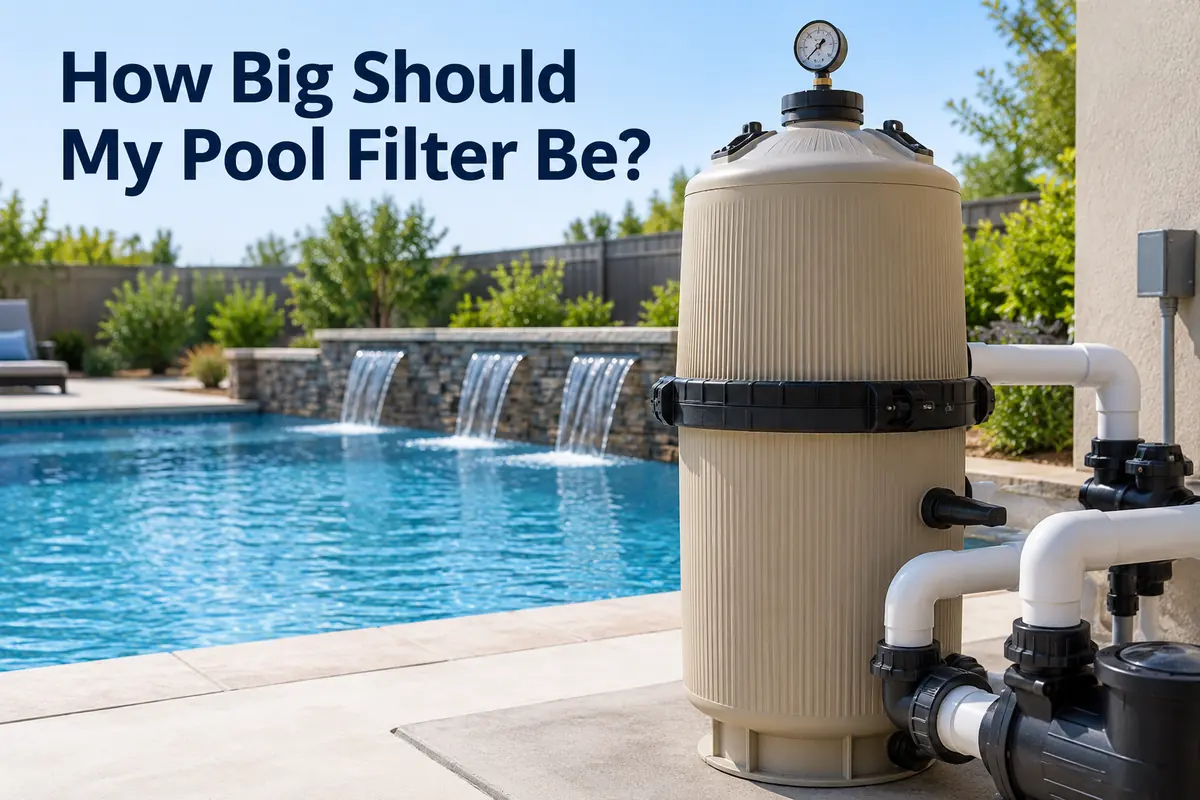
Choosing the right pool filter size involves more than matching a filter to the number of gallons in your pool. The filter also has to accommodate the circulation system's flow rate while providing enough filtration capacity to handle debris without requiring constant cleaning.
Here is how to evaluate pool filter size without relying on an oversimplified gallons-only rule.
Quick Answer: How Big Should Your Pool Filter Be?
Your pool filter should be sized to accommodate the actual water flow produced by your circulation system, with enough filtration area and dirt-holding capacity for your pool's operating conditions. Pool volume provides a starting point, but it does not determine the correct filter size by itself.
For example, circulating 20,000 gallons over eight hours requires an average flow of approximately 41.7 gallons per minute (GPM). However, if your pump also operates at higher flow rates for a heater, cleaner, spa or water feature, the filter must safely accommodate those operating conditions.
Start by calculating your circulation requirements, determine your pump's expected flow range and then compare the manufacturer's specifications for filters of the same technology.
Pool Filter Sizing at a Glance
| Factor | What to Check | Why It Matters |
|---|---|---|
| Pool volume | Approximate number of gallons. | Establishes the amount of water being circulated. |
| Circulation period | Planned operating hours. | Helps calculate average required flow. |
| Required flow | Average GPM. | Provides a starting circulation target. |
| Actual pump flow | Expected flow at each operating speed. | Determines the flow the filter must accommodate. |
| Filter type | Cartridge, sand or DE. | Determines which filtration-area specifications are relevant. |
| Manufacturer flow rating | Rated and maximum permitted flow. | Establishes the filter's operating limits. |
| Filtration area | Media area within the selected filter type. | Influences dirt loading and maintenance intervals. |
| Installation | Plumbing, available space and service access. | Determines whether the equipment fits the existing system. |
1. Pool Filter Size Starts With Required Flow
The first useful number is the average flow required to circulate the pool's water over the desired circulation period.
Pool Volume ÷ Circulation Time in Minutes = Average Required GPM
For example, moving 18,000 gallons over eight hours requires:
18,000 ÷ (8 × 60) = 37.5 GPM
That does not automatically mean a filter rated for 38 GPM is the appropriate choice. The filter must also work with the pump's actual operating flow and the hydraulic characteristics of the complete system.
One theoretical turnover does not guarantee that every gallon of water passes through the filter exactly once, nor does turnover alone establish adequate sanitation or circulation.
If you don't know your pool's approximate capacity, start with our Pool Volume Calculator. You can then use the Pool Filter Sizing Calculator to estimate a starting filter size.
2. Calculate Your Average Circulation Flow
Dividing pool volume by the intended circulation period provides a useful starting point for evaluating filtration requirements.
For example, a pool containing 15,000 gallons requires different average flow rates depending on the circulation period.
| Circulation Period | Calculation | Average Required Flow |
|---|---|---|
| 6 hours | 15,000 ÷ 360 | 41.7 GPM |
| 8 hours | 15,000 ÷ 480 | 31.3 GPM |
| 10 hours | 15,000 ÷ 600 | 25 GPM |
| 12 hours | 15,000 ÷ 720 | 20.8 GPM |
These figures represent theoretical average flow for one pool-volume turnover during the stated period. They are not universal operating recommendations.
Actual circulation requirements depend on equipment, pool use, sanitation needs and applicable local requirements.
3. Pool Filter Flow Requirements by Pool Volume
The following table shows theoretical average flow rates for different pool volumes and circulation periods.
| Pool Volume | 6-Hour Circulation | 8-Hour Circulation | 10-Hour Circulation | 12-Hour Circulation |
|---|---|---|---|---|
| 5,000 gallons | 13.9 GPM | 10.4 GPM | 8.3 GPM | 6.9 GPM |
| 10,000 gallons | 27.8 GPM | 20.8 GPM | 16.7 GPM | 13.9 GPM |
| 15,000 gallons | 41.7 GPM | 31.3 GPM | 25 GPM | 20.8 GPM |
| 20,000 gallons | 55.6 GPM | 41.7 GPM | 33.3 GPM | 27.8 GPM |
| 25,000 gallons | 69.4 GPM | 52.1 GPM | 41.7 GPM | 34.7 GPM |
| 30,000 gallons | 83.3 GPM | 62.5 GPM | 50 GPM | 41.7 GPM |
Use these calculations to understand average circulation requirements. Do not select a filter solely by matching one of these figures to its advertised flow rating.
4. Check the Filter's Maximum Flow Rating
Every filter model has manufacturer specifications. Depending on the filter, these can include filtration area, design flow, maximum flow, turnover capacity and maximum working pressure.
The pool's actual operating flow must remain within the filter manufacturer's limits.
This becomes particularly important with variable-speed pumps because the system may operate at several different speeds.
A low-speed filtration schedule might produce modest flow, while a higher-speed spa, cleaner or water-feature mode could produce substantially more.
Example: Why Average Flow Is Not Enough
Suppose a 20,000-gallon pool has a theoretical eight-hour circulation requirement of approximately 41.7 GPM.
Its pump operates in several modes:
| Operating Mode | Hypothetical Flow |
|---|---|
| Low-speed filtration | 35 GPM |
| Normal filtration | 45 GPM |
| Higher-speed equipment mode | 75 GPM |
These are hypothetical flow measurements, not specifications for a particular pump.
In this example, selecting a filter based only on the 41.7-GPM circulation calculation would overlook the system's 75-GPM operating mode.
The selected filter must accommodate the highest relevant flow passing through it, while the complete system remains within all applicable equipment limits.
5. Why Filter Square Footage Can Be Confusing
Filter area is useful when comparing models of the same basic technology, but the square-foot numbers for cartridge, sand and DE filters should not be treated as interchangeable.
A large cartridge filter can have hundreds of square feet of pleated media. A sand filter may have only a few square feet of effective filter area yet be appropriate for the same pool.
The technologies use different filtration media and have different design characteristics.
Cartridge Filter Area
Cartridge filters use pleated media to provide a large filtration surface within a relatively compact housing.
When comparing compatible cartridge filters, additional media area can provide greater capacity for accumulated debris and may extend the interval between cleanings.
Sand Filter Area
Sand filters use a bed of granular filtration media.
The effective filtration area is generally related to the filter bed's cross-sectional area rather than the total surface area of pleated media.
Compare sand filters using the manufacturer's specified filtration area, design flow and other relevant ratings.
DE Filter Area
DE filters use diatomaceous earth supported by internal grids or other filtration elements.
Their published filtration-area ratings describe a different media arrangement from cartridge and sand filters.
Compare DE models using their own manufacturer specifications and required operating conditions.
| Filter Type | What Its Area Rating Represents | Useful Comparison |
|---|---|---|
| Cartridge | Pleated filtration-media area. | Compare compatible cartridge models by area, flow rating and dirt capacity. |
| Sand | Effective filtration-bed area. | Compare sand models by design flow, filtration area and operating requirements. |
| DE | Effective filtration area of the DE-supported elements. | Compare DE models by area, flow rating and maintenance requirements. |
For more about the differences between filter technologies, sizing, pressure and maintenance, see our Complete Guide to Pool Filters.
6. Is a Larger Pool Filter Better?
Within a compatible product family, additional filtration area can provide useful advantages.
More media area can increase dirt-holding capacity and may allow the filter to operate longer before accumulated debris creates excessive restriction.
That does not mean there is unlimited benefit to installing the largest filter available. Cost, equipment-pad space, plumbing size and actual system requirements still matter.
Example: Two Compatible Cartridge Filters
Suppose you are comparing two hypothetical cartridge filters from the same product family.
| Specification | Filter A | Filter B |
|---|---|---|
| Filtration area | 200 sq ft | 400 sq ft |
| Filter technology | Cartridge | Cartridge |
| Media area | Baseline | Twice Filter A's area |
| Potential maintenance consideration | Less total media area. | More area available for debris accumulation. |
Filter B has twice the filtration area in this hypothetical comparison.
That may provide greater dirt-holding capacity and longer cleaning intervals under otherwise similar conditions.
However, twice the filtration area does not guarantee twice the time between cleanings. Actual results depend on debris load, filter design, flow rate and operating conditions.
Additional filtration area may affect how frequently maintenance is necessary. See How Often Should You Clean a Pool Filter? for more about pressure rise, debris load and cleaning intervals.
Once you've determined the filter type and flow capacity your system requires, see Best Pool Filters: How to Choose to compare the major selection factors before choosing a filter.
You can also compare pool filter models and prices below.
Compare Pool Filters on Amazon
7. Filter Size and Variable-Speed Pumps
Variable-speed pumps make proper filter selection especially important because system flow changes with pump speed.
Do not size the filter only around the lowest everyday filtration speed if the pump will also operate at substantially higher speeds for other functions.
The filter and every other component in the circulation path need to remain within their operating limits at the highest relevant system flow.
How to Evaluate Different Pump Speeds
Identify each operating mode that sends water through the filter.
For example:
- Normal daily filtration.
- Heater operation.
- Salt chlorinator operation.
- Cleaner operation.
- Spa operation.
- Water-feature operation.
Determine the expected flow for each relevant mode and verify that the filter can safely accommodate it.
Remember that pump RPM alone does not establish GPM. Actual flow depends on the pump and the resistance of the complete circulation system.
Our Complete Guide to Pool Pumps explains how pump flow, RPM and system resistance affect the rest of the circulation system.
8. Don't Forget the Rest of the Equipment
The filter is only one component in the circulation system.
Pipe diameter, pipe length, fittings, valves, heaters, salt systems, cleaners and water features can all affect actual flow.
Manufacturer pump curves and actual system measurements provide more useful information than horsepower alone.
Example: Why Pump Horsepower Is Not Enough
Two pools can use pumps with the same advertised horsepower but have different actual flow rates because their plumbing and equipment create different levels of hydraulic resistance.
A system with long pipe runs, numerous fittings and additional equipment may have a different operating flow from a simpler system using the same pump.
For accurate equipment selection, consider the pump's performance curve and the expected system operating conditions.
If you're also selecting the circulation pump, our Pool Pump Sizing Calculator can provide a starting flow estimate.
9. A Practical Pool Filter Sizing Process
- Determine pool volume. Calculate your pool's approximate water capacity.
- Establish circulation requirements. Choose an appropriate circulation period based on your pool and equipment requirements.
- Calculate average required GPM. Divide pool volume by the circulation period in minutes.
- Determine actual pump flow. Evaluate the pump's expected operating range using appropriate performance data or measurements.
- Identify all operating modes. Include higher-flow modes for connected equipment.
- Choose a filter technology. Compare cartridge, sand and DE filtration based on your maintenance and installation requirements.
- Compare models within that technology. Review filtration area, rated flow and other manufacturer specifications.
- Verify operating limits. Ensure the selected filter accommodates the highest relevant system flow.
- Consider additional filtration area. Evaluate whether greater media area offers useful maintenance benefits.
- Confirm installation requirements. Check plumbing connections, available equipment-pad space and service clearance.
10. Worked Example: Sizing a Filter for a 20,000-Gallon Pool
Suppose you have a 20,000-gallon swimming pool and want to calculate the average flow associated with an eight-hour circulation period.
Step 1: Convert Hours to Minutes
8 × 60 = 480 minutes
Step 2: Calculate Average Flow
20,000 ÷ 480 = 41.7 GPM
The theoretical average flow requirement is approximately 41.7 GPM.
Step 3: Identify Actual Pump Flow
Suppose the pump produces the following hypothetical flow rates:
| Operating Mode | Flow |
|---|---|
| Daily filtration | 45 GPM |
| Higher-speed operation | 70 GPM |
The filter must safely accommodate the actual flow passing through it, including the higher-flow operating mode.
Step 4: Compare Compatible Filters
When evaluating filters, check each model's published flow rating and confirm that the selected equipment can accommodate the system's relevant operating range.
Within your preferred filter technology, compare filtration area, maintenance requirements, plumbing connections and service access.
Do not select a filter based only on the 41.7-GPM circulation calculation.
11. Common Pool Filter Sizing Mistakes
| Mistake | Why It Matters | What to Do Instead |
|---|---|---|
| Choosing by pool gallons alone | Does not account for actual pump flow. | Calculate circulation requirements and evaluate operating flow. |
| Using pump horsepower as a flow rating | Horsepower does not establish actual GPM. | Review pump curves and system conditions. |
| Ignoring higher-speed pump modes | The filter may experience greater flow than expected. | Check all relevant operating modes. |
| Comparing square footage across filter types | Cartridge, sand and DE area ratings represent different media designs. | Compare models within the same technology. |
| Ignoring equipment-pad space | The filter may not fit or allow proper servicing. | Check dimensions and required clearances. |
| Assuming the largest filter is always necessary | May add cost and installation requirements without proportional benefit. | Balance capacity with actual system needs. |
| Ignoring maximum operating limits | Can result in an incompatible or unsafe installation. | Follow the exact manufacturer's specifications. |
12. Filter Size and Maintenance Frequency
Filter size can affect how frequently cleaning is necessary, but it is only one factor.
Cleaning intervals also depend on:
- Seasonal debris.
- Dust and pollen.
- Pool usage.
- Water chemistry.
- Algae problems.
- Pump operating conditions.
- Filtration-media condition.
A larger filter with additional compatible media area may handle more accumulated debris before cleaning becomes necessary.
However, an unusually heavy debris load can still require frequent maintenance, even with a generously sized filter.
Use the manufacturer's pressure and flow criteria to determine when cleaning is appropriate.
Frequently Asked Questions
What size filter do I need for a 10,000-gallon pool?
Start by calculating the average circulation flow. A theoretical eight-hour turnover requires approximately 20.8 GPM. The final filter must also accommodate the pump's actual operating flow, including higher-speed modes.
What size filter do I need for a 15,000-gallon pool?
A theoretical eight-hour turnover requires approximately 31.3 GPM. Use this as a starting circulation estimate, then verify actual pump flow and the filter manufacturer's operating limits.
What size filter do I need for a 20,000-gallon pool?
A theoretical eight-hour turnover requires approximately 41.7 GPM. However, the appropriate filter depends on actual system flow, filter technology, maintenance requirements and installation conditions.
Can a pool filter be too big?
Additional filtration area can provide useful dirt-holding capacity, but very large equipment may add unnecessary cost, occupy more space or create installation complications. Choose a compatible filter based on the complete system's requirements.
Is a larger cartridge filter better?
Within a compatible product family, additional media area may provide greater dirt-holding capacity and longer cleaning intervals. Actual benefits depend on filter design, flow and debris load.
Does a variable-speed pump require a larger filter?
Not automatically. The filter must accommodate the actual flow produced in every relevant operating mode. Check the highest flow passing through the filter rather than sizing it only for the lowest daily pump speed.
Can I compare cartridge and sand filters by square footage?
No. Their published filtration-area ratings represent different media designs. Compare models within each technology using manufacturer flow ratings and other relevant specifications.
Does pool filter size affect water pressure?
Filter design, media condition and flow all influence hydraulic resistance. Pressure also depends on the rest of the plumbing and equipment, so a filter's square footage alone does not predict the system's operating pressure.
Can an undersized filter cause frequent cleaning?
Limited filtration area or dirt-holding capacity may contribute to short cleaning intervals. However, algae, heavy debris and other pool conditions can produce similar symptoms.
Should the filter and pump be sized together?
Yes. The filter must accommodate the pump's actual operating flow, and the pump must meet the circulation requirements of the complete system without exceeding equipment limits.
Bottom Line
Pool filter sizing should be based on both required circulation and actual system flow—not simply a label saying that a filter is suitable for a certain number of gallons.
Start with pool volume and circulation requirements, then verify the manufacturer's flow specifications and choose enough filtration capacity to provide practical cleaning intervals for your particular pool.
Before purchasing, verify the exact filter's rated flow, filtration area, plumbing connections and service-clearance requirements against your pool system.
How We Research
Pool Equipment Lab evaluates pool equipment using manufacturer specifications, documentation, compatibility requirements, operating costs, warranty information, and owner feedback when relevant. We do not claim hands-on testing unless we actually performed it.