
Best Pressure-Side Pool Cleaners: How to Choose
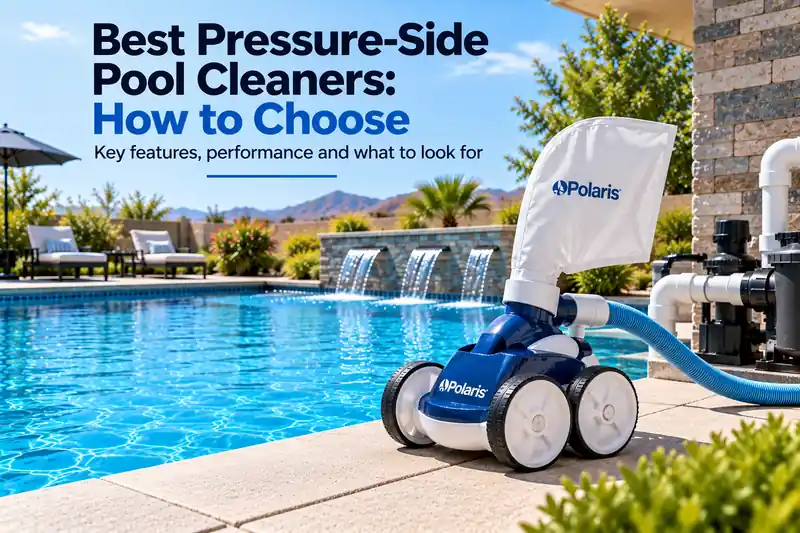
Pressure-side pool cleaners are especially useful for pools that collect leaves and larger debris because many models capture debris in their own onboard bags instead of sending it through the pool filter. But some require a dedicated booster pump, and the cleaner must match the pool's plumbing, size, surface, and debris conditions.
This guide explains what to compare when choosing a pressure-side pool cleaner, including booster-pump requirements, debris capacity, navigation, hose setup, wall climbing, maintenance, and replacement parts.
Quick Answer: How Do You Choose a Pressure-Side Pool Cleaner?
Choose a pressure-side pool cleaner based on your pool's existing plumbing, booster-pump availability, size, surface and typical debris. First determine whether the cleaner requires a dedicated booster pump or can operate using pressure from your existing circulation system.
Pressure-side cleaners can be particularly useful for pools that collect leaves and other larger debris because they typically collect material in an onboard bag instead of sending it through the pool's main filter. However, navigation, hose length, pressure requirements and replacement-parts availability also matter.
Pressure-Side Pool Cleaners at a Glance
| Feature | What to Check | Why It Matters |
|---|---|---|
| Booster pump | Required or not required | Determines plumbing and equipment requirements |
| Pressure connection | Dedicated cleaner line or compatible return connection | Determines installation compatibility |
| Pool size | Manufacturer's supported dimensions | Affects coverage and hose requirements |
| Pool surface | Plaster, pebble, fiberglass, vinyl or tile | Determines tire and cleaner compatibility |
| Debris collection | Bag capacity and available bag types | Affects performance with leaves and fine debris |
| Navigation | Backup system, movement pattern and obstacle handling | Affects cleaning coverage |
| Hose length | Manufacturer's sizing requirements | Helps prevent missed areas and tangling |
| Maintenance | Replacement bags, tires, hoses and valves | Affects long-term ownership cost |
How Does a Pressure-Side Pool Cleaner Work?
A pressure-side cleaner uses pressurized water from the pool circulation system to create movement and collect debris.
Water entering the cleaner can power its drive mechanism while creating a venturi effect that draws debris into an attached filter bag.
Because much of the collected debris stays in the cleaner's bag, it does not have to travel through the pool's primary filter.
For a deeper explanation, see How Do Pressure-Side Pool Cleaners Work?.
Pressure-Side vs. Robotic vs. Suction-Side Cleaners
Each major automatic-cleaner design gets its cleaning power differently.
| Cleaner Type | Power Source | Debris Collection | Installation Consideration |
|---|---|---|---|
| Pressure-side | Pressurized pool water | Typically an onboard debris bag | Requires compatible pressure plumbing; some models need a booster pump |
| Suction-side | Suction from the circulation pump | Typically the pump basket or pool filter, unless an inline canister is used | Requires a compatible suction connection |
| Robotic | Independent electric motors | Internal filter basket or bag | Requires compatible electrical power but no pool plumbing connection |
See Robotic vs. Suction vs. Pressure Pool Cleaners for a complete comparison.
Start by Checking Whether You Have a Booster Pump
This is one of the most important differences between pressure-side cleaners.
Some models operate from a dedicated pressure line powered by a booster pump. Others can use pressure supplied by the pool's primary circulation system.
Do not purchase a cleaner until you know which type of installation you have and which configuration the manufacturer requires.
What Does a Booster Pump Do?
A booster pump is a separate pump that supplies pressurized water to a compatible pressure-side cleaner.
It typically operates only while the cleaner is running and must receive the water supply required by its manufacturer.
Traditional booster-pump installations often include a dedicated return line running from the equipment pad to the pool specifically for the cleaner.
Do All Pressure-Side Cleaners Need a Booster Pump?
No. Some pressure-side cleaners are designed to operate without a separate booster pump.
These models use water pressure from the existing pool circulation system. However, the primary pump must provide sufficient flow and pressure while meeting the requirements of the filter and other connected equipment.
Purchasing a booster-pump cleaner for a pool without appropriate plumbing can substantially increase installation complexity and cost.
Existing Plumbing Can Determine Your Options
If your pool already has a functioning booster pump and dedicated cleaner line, replacing an existing pressure-side cleaner with a compatible model may be relatively straightforward.
If the pool has no dedicated pressure line, adding one may require plumbing modifications.
That can change the cost comparison between a pressure-side cleaner and a robotic cleaner that does not require a pool plumbing connection.
Example: Two Different Pool Installations
| Pool | Existing Equipment | What to Evaluate |
|---|---|---|
| Pool A | Dedicated cleaner line and working booster pump | Replacement cleaners compatible with the existing installation |
| Pool B | Standard circulation system without a dedicated cleaner line | Non-booster pressure cleaners, plumbing modifications or robotic alternatives |
For Pool A, the existing infrastructure may reduce replacement costs. For Pool B, installation requirements may become a significant part of the purchasing decision.
Pressure-Side Cleaners and Large Debris
One traditional strength of pressure-side cleaners is their ability to collect larger debris in an onboard bag.
This can make them useful for pools surrounded by trees or exposed to leaves, seed pods, flowers and other coarse debris.
However, cleaning performance varies by model and bag design. A cleaner designed primarily for larger debris may not retain very fine dust as effectively as another cleaner with finer filtration.
The Debris Bag Matters
Pressure-side cleaner bags vary in capacity and filtration characteristics.
A larger bag may allow longer operation between cleanings when the pool collects substantial debris.
However, a bag loaded with leaves or other material can affect cleaner performance. Inspect and empty it according to the manufacturer's instructions.
Fine Debris vs. Large Debris
| Typical Debris | What to Look For |
|---|---|
| Large leaves | Suitable bag opening and debris capacity |
| Seed pods | Compatible collection bag and reliable debris pickup |
| Flowers and small leaves | Appropriate bag mesh and collection capacity |
| Fine dust | Manufacturer-supported fine-debris filtration |
| Mixed debris | Available alternative bags and convenient bag replacement |
Some manufacturers offer different bag options for leaves, general debris or finer material.
If your pool primarily accumulates fine dust rather than leaves, pay particular attention to the manufacturer's filtration specifications.
Navigation Design
A cleaner needs to move through the pool without repeatedly becoming trapped in the same areas.
Pressure-side cleaners use mechanical systems to change direction and improve coverage.
Some Polaris cleaners, for example, use backup valves or related navigation mechanisms that periodically redirect the cleaner to help free it from obstacles and change its cleaning path.
Compare the navigation design and any manufacturer-stated limitations for your pool's shape.
Pool Shape and Obstacles Matter
Automatic cleaner performance can be affected by:
- Tight corners.
- Curved walls.
- Main drains.
- Steps.
- Benches.
- Baja shelves.
- Sharp floor transitions.
- Water features.
No pressure-side cleaner should be assumed to clean every step, shelf or unusual pool feature.
Example: A Pool With a Baja Shelf
Consider a pool with a large shallow Baja shelf, several entry steps and a deeper main swimming area.
A pressure-side cleaner may cover much of the main pool floor but may not consistently reach the shelf or clean every step.
Before buying, check the cleaner's stated depth requirements, navigation capabilities and surface limitations. Plan for occasional manual cleaning of areas the cleaner cannot reliably reach.
Wall Climbing
Some pressure-side cleaners can travel up pool walls, depending on cleaner design, available pressure, pool surface and wall geometry.
Wall climbing does not necessarily mean a cleaner will scrub the waterline as thoroughly as a robotic cleaner specifically designed for waterline cleaning.
Check whether the manufacturer specifies floor cleaning, wall climbing or waterline cleaning for the exact model.
Pool Surface Compatibility
Verify compatibility with your pool's surface before purchasing.
Common surfaces include:
- Plaster.
- Pebble finishes.
- Tile.
- Fiberglass.
- Vinyl.
Some cleaner families use different tires or components for particular surfaces.
Using the appropriate components can help the cleaner maintain traction and operate as intended.
Hose Length Must Be Correct
The pressure hose needs enough length for the cleaner to reach the farthest point of the pool from its wall fitting.
Incorrect hose length can reduce coverage or contribute to tangling and navigation problems.
Follow the manufacturer's hose-sizing instructions for your specific pool rather than assuming the factory configuration is automatically correct.
Pressure and Flow Adjustment
A pressure-side cleaner needs the correct water pressure and flow to operate as intended.
Too little pressure may result in slow movement or poor debris pickup. Excessive pressure can also create performance problems.
Manufacturers provide setup procedures for checking cleaner operation and adjusting flow or pressure where necessary.
Use the specified testing procedure rather than adjusting the system based only on how fast the cleaner appears to move.
What About Variable-Speed Pool Pumps?
The interaction with a variable-speed pump depends on the cleaner's design.
A cleaner with a dedicated booster pump receives its cleaning pressure from that separate pump while the primary circulation system provides the necessary water supply.
A cleaner that relies directly on the primary pump may require a higher programmed pump speed during cleaning.
See What RPM Should I Run My Variable-Speed Pool Pump? for more information about establishing pump speeds.
Booster Pumps Add Operating Costs
A dedicated booster pump uses electricity whenever it operates.
The total ownership cost of a pressure-side cleaning system can include:
- Cleaner purchase price.
- Booster-pump purchase and installation, if required.
- Booster-pump electricity.
- Replacement debris bags.
- Tires and wheels.
- Hoses.
- Other wear components.
Example: Estimating Booster-Pump Electricity Cost
Suppose a booster pump draws 800 watts and operates for two hours per day at an electricity rate of $0.18 per kWh.
| Measurement | Example Value |
|---|---|
| Power draw | 800 watts |
| Daily runtime | 2 hours |
| Daily electricity use | 1.6 kWh |
| Electricity rate | $0.18 per kWh |
| Daily electricity cost | $0.29 |
| 30-day electricity cost | $8.64 |
Daily Cost = (800 ÷ 1,000) × 2 × $0.18 = $0.288
This is an illustrative calculation, not measured consumption for a specific booster pump. Actual costs depend on the pump's power draw, runtime and electricity rate. The primary circulation pump's electricity use is not included.
Pressure Cleaners Reduce Debris Load on the Main Filter
Because a pressure cleaner typically collects debris in its own bag, leaves and other material do not need to pass through the pool's main filter.
This differs from many suction-side cleaners, which direct collected debris toward the pump basket and filtration system.
For pools with substantial leaf debris, separate debris collection can reduce the amount of larger material entering the main filtration system.
Pressure-Side Cleaner Maintenance
Routine maintenance may include:
- Emptying and cleaning the debris bag.
- Inspecting tires.
- Checking wheels and bearings.
- Inspecting hoses.
- Cleaning jets.
- Checking the wall fitting.
- Inspecting the backup valve.
- Checking booster-pump operation.
Wear components should be replaced when they begin affecting movement or cleaning performance.
Common Pressure-Side Cleaner Problems
| Problem | Possible Cause | Initial Check |
|---|---|---|
| Cleaner stops moving | Insufficient pressure, blocked jet or drive problem | Water supply, accessible jets and cleaner wheels |
| Cleaner moves slowly | Incorrect pressure, debris buildup or worn components | Manufacturer's operating test and debris bag |
| Cleaner repeatedly gets stuck | Hose length, navigation or obstacle problem | Hose sizing, backup system and pool geometry |
| Poor debris pickup | Full bag, blocked intake or insufficient pressure | Debris bag, intake and specified pressure settings |
| Hose tangles | Incorrect hose length, damaged swivels or hose condition | Manufacturer's hose-sizing procedure and swivel movement |
| Booster pump does not operate | Electrical, control or mechanical issue | Controller status and manufacturer troubleshooting instructions |
Turn off equipment and follow the manufacturer's instructions before disconnecting hoses or servicing the cleaner. Electrical and booster-pump repairs should be performed by qualified professionals where required.
See Why Is My Pool Cleaner Not Moving? before assuming the entire cleaner has failed.
Replacement Parts Are Important
Pressure-side cleaners contain several components that can wear over time.
Common replacement items include:
- Debris bags.
- Tires.
- Wheels.
- Bearings.
- Hose sections.
- Backup valves.
- Sweep hoses.
- Wall fittings.
Established cleaner families with readily available replacement components can be easier to maintain over multiple swimming seasons.
Polaris Pressure-Side Pool Cleaners
Polaris is closely associated with the pressure-side cleaner category and offers several pressure-cleaner configurations.
Its product line includes models designed for booster-pump installations as well as other pressure-side configurations.
When comparing Polaris models, verify booster-pump requirements, pool-surface compatibility, debris-bag design and included hose configuration for the exact cleaner.
Check Polaris Pool Cleaners on Amazon
Compare Pressure-Side Pool Cleaners
Before buying, compare the complete system requirements rather than just the cleaner's purchase price.
A pool that already has the correct dedicated plumbing and booster pump may be a suitable candidate for a pressure-side cleaner. A pool without that infrastructure may have different installation costs.
Compare Pressure-Side Pool Cleaners on Amazon
Pressure-Side Pool Cleaner Buying Checklist
- Booster-pump requirement.
- Existing dedicated pressure line.
- Recommended pool size.
- Pool-shape compatibility.
- Surface compatibility.
- Navigation system.
- Wall-climbing capability.
- Debris-bag capacity.
- Fine-debris capability.
- Required hose length.
- Pressure requirements.
- Variable-speed pump considerations.
- Replacement-parts availability.
- Warranty.
Frequently Asked Questions
Do all pressure-side pool cleaners need a booster pump?
No. Some require a dedicated booster pump, while others use pressure supplied by the existing circulation system. Check the manufacturer's requirements for the exact model.
Are pressure-side cleaners good for pools with leaves?
Many pressure-side cleaners are designed to collect larger debris in an onboard bag. Actual performance depends on the cleaner's intake, bag design and the type and amount of debris.
Can a pressure-side cleaner pick up fine dust?
Some models offer bags or filtration options designed for finer debris. Check the manufacturer's specifications because a bag intended for large leaves may not retain very fine particles effectively.
Can a pressure-side cleaner climb pool walls?
Some models can climb walls, depending on cleaner design, available pressure, pool surface and wall geometry. Check the exact model's stated cleaning capabilities.
Will a pressure-side cleaner clean my pool steps?
Not necessarily. Steps, benches, Baja shelves and unusual floor transitions can limit coverage. Some areas may still require manual cleaning.
Can I use a pressure-side cleaner with a variable-speed pump?
Yes, when the cleaner and circulation system are compatible. A non-booster model may require a particular primary-pump speed, while a booster-pump model has separate pressure requirements.
How often should I empty the debris bag?
Inspect it regularly and empty it according to the manufacturer's instructions. Pools with heavy leaf debris may require more frequent cleaning.
Why does my pressure-side cleaner keep getting stuck?
Possible causes include incorrect hose length, navigation-system problems, pool obstacles or inadequate operating pressure. Follow the manufacturer's setup and troubleshooting procedures.
Bottom Line
A pressure-side pool cleaner should match the pool's existing plumbing, size, surface, shape and typical debris.
Start by determining whether the cleaner requires a booster pump and whether the pool already has the appropriate pressure line. Then compare debris capacity, navigation, hose requirements, wall climbing, maintenance, replacement parts and warranty.
For pools that collect substantial leaves and already have compatible pressure-side plumbing, this cleaner type can provide automatic cleaning while keeping much of the collected debris out of the main pool filter.
How We Research
Pool Equipment Lab evaluates pool equipment using manufacturer specifications, documentation, compatibility requirements, operating costs, warranty information, and owner feedback when relevant. We do not claim hands-on testing unless we actually performed it.