
Best Pool Filters for Above-Ground Pools: How to Choose
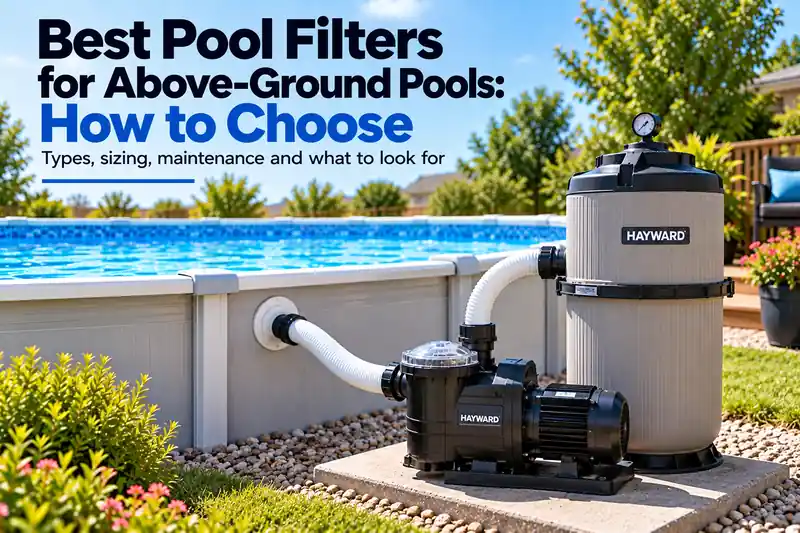
The filter on an above-ground pool needs to handle the pool's circulation flow while providing enough filtration capacity to keep the water clear without creating unnecessary maintenance. Choosing between cartridge, sand, and DE filtration is only part of the decision—the filter also needs to be properly sized for the pump and pool.
This guide explains what to compare when choosing an above-ground pool filter, including filter type, filtration area, flow capacity, maintenance, backwashing, water use, pump compatibility, and long-term operating cost.
Quick Answer: How Do You Choose an Above-Ground Pool Filter?
Choose an above-ground pool filter based on your pool's water volume, your pump's actual flow rate, the filter's rated capacity and the type of maintenance you prefer. Cartridge filters avoid routine backwashing, sand filters are cleaned by backwashing, and diatomaceous earth (DE) filters provide very fine filtration but require additional media handling.
For many above-ground pools, cartridge and sand filters are practical options. Whichever type you choose, the filter must safely accommodate the pump's flow and provide enough capacity for the pool's debris load.
Above-Ground Pool Filters Compared
| Feature | Cartridge | Sand | DE |
|---|---|---|---|
| Filtration media | Pleated cartridge elements | Sand or approved alternative media | DE-coated grids or elements |
| Routine cleaning | Remove and rinse cartridges | Backwash as directed | Backwash or internal cleaning, depending on design |
| Water used for cleaning | Relatively little during routine rinsing | Pool water discharged during backwashing | Varies by cleaning procedure |
| Replacement media | Replacement cartridges | Periodic media service or replacement | DE replenishment and eventual element service |
| Maintenance consideration | Requires access to remove elements | Requires a suitable wastewater discharge | Requires proper DE handling |
See Cartridge vs. Sand vs. DE Pool Filters for our full comparison.
What Does an Above-Ground Pool Filter Do?
A pool filter removes suspended dirt and debris from water as the circulation pump moves it through the filtration system.
The pump provides water flow, while the filter captures material carried by that water. Choosing a filter therefore requires evaluating the pool and pump together rather than treating the filter as an isolated piece of equipment.
A filter does not replace water sanitation, proper chemical balance, brushing or other routine maintenance.
Cartridge Filters for Above-Ground Pools
A cartridge filter passes pool water through pleated filter material that captures debris.
When the filter becomes dirty, the cartridge is removed and rinsed according to the manufacturer's instructions rather than backwashed.
Advantages of Cartridge Filters
- No routine backwashing required.
- Relatively low water loss during cleaning.
- Simple plumbing arrangements.
- Effective filtration when properly sized.
- Available in sizes suitable for many above-ground pools.
Potential Disadvantages
- Cartridges eventually require replacement.
- Cleaning requires opening the filter.
- Undersized cartridges may need frequent cleaning.
- Enough clearance is needed to remove and service the elements.
Compare Cartridge Pool Filters on Amazon
Sand Filters for Above-Ground Pools
Sand filters move water through a tank containing filtration media. Dirt is trapped as water passes through the media.
When accumulated debris increases filter resistance to the manufacturer's specified cleaning point, the filter is normally cleaned by reversing water flow through the tank in a process called backwashing.
Advantages of Sand Filters
- Established and widely used technology.
- Routine cleaning through backwashing.
- No filter cartridges to replace.
- Suitable capacity for routine residential use when properly sized.
Potential Disadvantages
- Backwashing consumes pool water.
- A suitable wastewater discharge location is needed.
- Filter media eventually requires service or replacement.
- Valves and internal components may require maintenance.
Compare Sand Pool Filters on Amazon
DE Filters for Above-Ground Pools
DE filters use a fine filtration medium applied to internal grids or elements.
They can provide very fine filtration, but maintenance is generally more involved than with cartridge or sand filters.
Advantages of DE Filters
- Very fine filtration.
- Excellent water clarity when properly maintained.
- Established technology for residential pools.
Potential Disadvantages
- More involved maintenance.
- DE media must be handled and replenished correctly.
- Backwashing or internal cleaning may be required, depending on design.
- Additional filtration complexity compared with many basic above-ground systems.
Follow the manufacturer's instructions for handling, adding and disposing of DE media.
Compare DE Pool Filters on Amazon
Which Filter Type Fits Your Pool?
The type of filter you choose should reflect your pool's size, debris conditions, maintenance preferences, water availability, pump flow and budget.
| Your Priority | Filter Type to Consider | Reason |
|---|---|---|
| Avoiding routine backwashing | Cartridge | Elements are removed and rinsed |
| Cleaning without removing filter elements | Sand | Routine cleaning uses a backwash cycle |
| Very fine filtration | DE | Uses fine DE-coated filtration media |
| Limited wastewater discharge options | Cartridge | Does not require routine backwash discharge |
| Heavy debris accumulation | Any properly sized type | Additional filtration capacity can reduce cleaning frequency |
Filter Size Is Critical
Once you choose a filter type, proper sizing becomes one of the most important decisions.
An undersized filter may become dirty quickly, increase system resistance and require frequent cleaning.
A larger filter generally provides additional filtration or debris-holding capacity and may extend the interval between cleanings.
See How Big Should My Pool Filter Be? for a detailed explanation.
Start With Pool Volume
Pool volume helps establish how much water needs to be circulated and filtered.
If you do not know your pool's volume, use our Pool Volume Calculator.
Once you have that figure, estimate circulation requirements and compare the manufacturer's filter and pump specifications.
Example: Choosing a Filter for a 12,000-Gallon Pool
Suppose you have a 12,000-gallon above-ground pool and are evaluating its circulation equipment.
If you use an eight-hour turnover period for an initial calculation, the theoretical average flow would be:
12,000 gallons ÷ 480 minutes = 25 GPM
| Step | What to Evaluate |
|---|---|
| 1. Pool volume | 12,000 gallons |
| 2. Example circulation estimate | 25 GPM for an eight-hour theoretical turnover |
| 3. Pump performance | Actual flow at the expected system resistance |
| 4. Filter compatibility | Maximum rated flow and appropriate filtration capacity |
| 5. Installation | Plumbing, space and maintenance requirements |
This calculation is a starting example, not a universal turnover requirement or a complete equipment-sizing recommendation. Actual flow depends on pump performance, plumbing resistance and operating conditions.
Use our Pool Filter Sizing Calculator as a starting point when evaluating filter capacity.
Match the Filter to the Pump
The filter must safely handle the water flow produced by the pump.
Manufacturers specify maximum or recommended flow rates for their filters. A pump capable of producing more flow than the filter can safely handle should not be paired with that filter simply because the connection sizes fit.
Check the pump's performance curve at the expected system resistance and compare the resulting flow with the filter's specifications.
Do Not Size the Filter by Horsepower Alone
A statement such as "this filter works with a 1.5 HP pump" does not provide enough information by itself.
Actual pump flow depends on:
- Pump design.
- Motor speed.
- Plumbing diameter and length.
- Fittings and valves.
- Filter condition.
- Overall system resistance.
Compare actual flow requirements and manufacturer specifications instead of relying solely on horsepower.
Variable-Speed Pumps and Above-Ground Filters
A variable-speed pump can reduce flow during routine filtration while providing higher flow when another pool function requires it.
This can allow longer filtration periods at lower pump speeds. However, every programmed speed must satisfy the operating requirements of the filter and any connected equipment.
See Variable-Speed vs. Single-Speed Pool Pumps.
Filter Pressure and Cleaning
Many pool filters include a pressure gauge.
When the filter is clean, note the normal operating pressure for your system. As debris accumulates, resistance through the filter increases and filter pressure typically rises.
Your own system's clean-filter pressure is generally more useful than comparing its reading with another pool.
When Should You Clean the Filter?
Filter-cleaning recommendations vary by manufacturer and filter type.
Rather than cleaning solely according to a fixed calendar, monitor filter pressure and water flow along with the manufacturer's instructions.
See How Often Should You Clean a Pool Filter?.
What Causes High Filter Pressure?
Common causes include:
- Dirty filter media.
- Blocked return plumbing.
- Closed or incorrectly positioned valves.
- Obstructions in the circulation system.
- Excessive pump flow.
If pressure rises unexpectedly, see Why Is My Pool Filter Pressure High?.
Cartridge Filter Size
Cartridge filters are commonly rated by square feet of filtration area.
More filtration area generally provides greater debris-holding capacity and can allow longer intervals between cleanings.
Choosing a larger cartridge filter than the absolute minimum may therefore reduce maintenance frequency, provided it is compatible with the rest of the circulation system.
How Long Do Filter Cartridges Last?
Cartridge life depends on operating conditions and maintenance.
Important factors include filter sizing, daily runtime, debris load, water chemistry, cleaning methods and cartridge construction.
See How Long Do Pool Filter Cartridges Last? for more detail.
Sand Filter Size
Sand filters are commonly specified by tank diameter, filtration area, media capacity and maximum flow rate.
A larger sand filter generally contains more media and provides additional dirt-holding capacity.
Do not choose the smallest filter simply because it can technically handle the expected flow. Consider debris load, cleaning frequency and available installation space.
Backwashing and Water Consumption
Cleaning a sand or traditional DE filter by backwashing sends pool water to waste.
The amount depends on flow rate and backwash duration.
For example, a backwash cycle operating at 40 GPM for three minutes would discharge approximately 120 gallons. Actual cleaning procedures and water use depend on the filter and manufacturer instructions.
This water loss matters in areas where water is expensive, restricted or difficult to discharge.
Cartridge Filters Avoid Routine Backwashing
Cartridge filters are cleaned by removing and rinsing the cartridge elements.
This avoids sending a continuous high-flow stream of pool water to waste during a backwash cycle.
That can be particularly useful for above-ground pools where replacing lost water significantly affects water level.
Consider the Debris Around Your Pool
A pool exposed to heavy debris may benefit from more filter capacity than a similar pool in a protected environment.
Consider leaves, dust, pollen, grass, nearby construction, wind and heavy swimmer use.
Additional filtration area or media capacity can reduce how quickly the filter reaches its cleaning point, although actual performance depends on filter design and operating conditions.
Plumbing Connections
Above-ground pools may use flexible hose, rigid PVC or a combination of both.
Check:
- Filter inlet and outlet sizes.
- Pump connection size.
- Pool-wall fittings.
- Hose or PVC diameter.
- Required adapters and unions.
Adapters can solve some connection differences, but unnecessary restrictions should be avoided.
Equipment Space and Service Clearance
Filter dimensions vary considerably.
Before purchasing, check the filter's tank diameter, overall height, required service clearance, valve location and drain location.
Cartridge filters need enough vertical or side clearance to remove their elements. Sand filters need room to access the multiport valve and service the media.
Common Above-Ground Pool Filter Problems
| Symptom | Possible Cause | Initial Check |
|---|---|---|
| High filter pressure | Dirty media or return-side restriction | Compare with clean-filter pressure and inspect accessible return components |
| Weak return flow | Dirty filter, blocked basket or circulation restriction | Check pressure, pump operation and accessible baskets |
| Frequent cleaning required | Heavy debris load or insufficient filter capacity | Review filter sizing and debris conditions |
| Sand entering the pool | Damaged filter internals or incorrect media configuration | Follow manufacturer diagnostics for laterals and internal components |
| Water leaking around the filter | Seal, fitting or component problem | Shut down equipment and follow manufacturer inspection procedures |
Always turn off the pump and follow the manufacturer's pressure-release instructions before opening or servicing a filter. Never loosen a pressurized filter clamp or lid.
Winterization
Above-ground pools in freezing climates may require seasonal winterization.
The filter should be drained and protected according to manufacturer instructions.
Consider how easy the drain plugs, pressure gauge, valve, cartridges and other service components are to access.
Replacement Parts Matter
Filter ownership continues long after installation.
Depending on filter type, eventual replacement items may include:
- Cartridges.
- O-rings.
- Pressure gauges.
- Air-relief assemblies.
- Multiport valves.
- Laterals.
- DE grids.
- Drain assemblies.
Choosing a filter with readily available replacement components can make long-term maintenance easier.
Compare Above-Ground Pool Filters
When comparing filters, focus on the entire circulation system.
The filter should provide enough filtration capacity for the pool while safely handling pump flow and fitting the available equipment area.
Compare Above-Ground Pool Filters on Amazon
Above-Ground Pool Filter Buying Checklist
- Filter type.
- Pool volume.
- Filtration area or media capacity.
- Maximum flow rate.
- Actual pump flow.
- Plumbing connections.
- Filter pressure gauge.
- Cleaning method.
- Backwashing requirements.
- Water consumption.
- Service clearance.
- Winterization.
- Replacement media cost.
- Replacement-parts availability.
- Warranty.
Frequently Asked Questions
What type of filter should I use for an above-ground pool?
Cartridge, sand and DE filters can all be suitable when properly sized. Compare their cleaning methods, water consumption, filtration characteristics and maintenance requirements.
How do I know what size filter my above-ground pool needs?
Start with pool volume and circulation requirements. Then compare the pump's expected flow with the filter's rated capacity and consider the pool's debris load.
Can I use a larger filter with my existing pump?
Often, but the replacement filter must be compatible with the pump's flow, plumbing and operating conditions. Verify manufacturer specifications before changing equipment.
Does a bigger filter improve water clarity?
A larger filter can provide more filtration or debris-holding capacity, but water clarity also depends on filtration media, circulation, water chemistry and routine maintenance.
Do cartridge filters waste less water than sand filters?
Cartridge filters avoid routine backwashing, which can reduce water loss during filter cleaning. Actual water consumption depends on cleaning methods and operating conditions.
How often should I backwash a sand filter?
Follow the manufacturer's instructions and monitor pressure relative to your system's normal clean-filter reading. Do not rely solely on a fixed calendar schedule.
Why does my filter pressure keep rising?
Accumulated debris is a common cause, but return-side restrictions, valve settings and excessive flow can also contribute. Follow the manufacturer's troubleshooting procedures.
Can I use an inground pool filter on an above-ground pool?
Only if the filter is appropriate for the pump's flow, plumbing configuration and installation requirements. Check the manufacturer's specifications rather than relying on the product's marketing category alone.
Bottom Line
An above-ground pool filter must provide sufficient filtration capacity while remaining compatible with the pump, plumbing, available space and maintenance preferences.
Start by comparing cartridge, sand and DE filtration. Then evaluate filter capacity, maximum flow, pump compatibility, cleaning requirements, water consumption, replacement costs and warranty.
Where practical, additional filtration capacity can reduce cleaning frequency and make the system easier to maintain.
How We Research
Pool Equipment Lab evaluates pool equipment using manufacturer specifications, documentation, compatibility requirements, operating costs, warranty information, and owner feedback when relevant. We do not claim hands-on testing unless we actually performed it.