
How Often Should You Clean a Pool Filter?
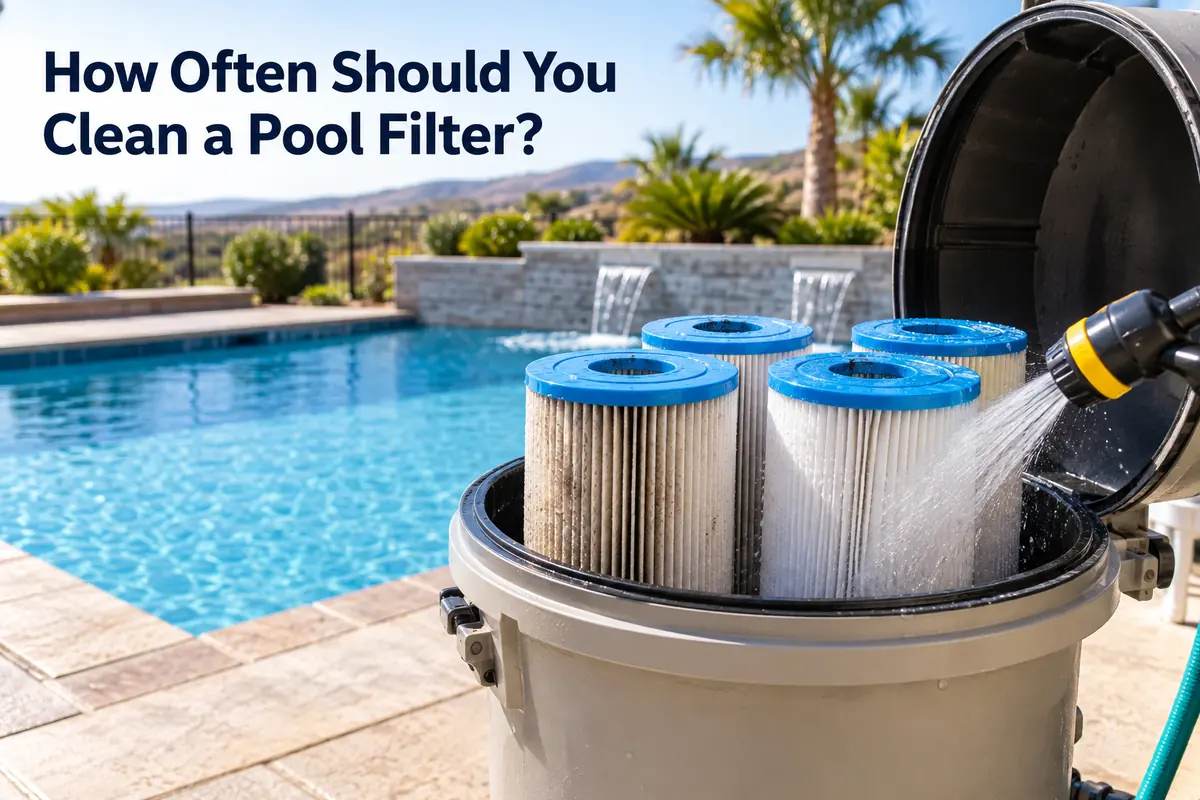
Pool filters should not necessarily be cleaned on a fixed weekly or monthly schedule. How quickly a filter becomes dirty depends on the filter type, filter size, pool use, landscaping, weather, water chemistry and the amount of debris entering the pool.
A better approach is to establish the filter's clean operating pressure and watch for changes in pressure and water flow.
Quick Answer: How Often Should You Clean a Pool Filter?
Clean your pool filter when its pressure or flow indicates that maintenance is needed, following the manufacturer's instructions for your exact filter model. There is no universal weekly or monthly cleaning schedule that works for every swimming pool.
For many cartridge filters, a specified pressure increase above the clean starting pressure is the main cleaning indicator. Sand and DE filters also commonly use pressure rise to determine when backwashing or other maintenance is required.
The most useful habit is to record your clean-filter pressure, check it regularly under consistent operating conditions and monitor changes in return flow.
Pool Filter Cleaning at a Glance
| Filter Type | Common Cleaning Method | When to Clean |
|---|---|---|
| Cartridge | Remove and clean the cartridge elements. | When the manufacturer's pressure-rise threshold is reached or performance indicates cleaning is needed. |
| Sand | Backwash according to the filter's instructions. | When the manufacturer's pressure or flow criteria indicate backwashing is necessary. |
| DE | Backwash or perform the specified cleaning procedure, then replenish DE as required. | When the manufacturer's pressure or maintenance criteria are reached. |
These are general maintenance principles. The correct procedure and cleaning threshold depend on the specific filter.
Don't Clean a Pool Filter Just Because the Calendar Says To
There is no universal cleaning interval that works for every swimming pool. A heavily used pool surrounded by trees may load a filter much faster than a lightly used pool with little surrounding debris.
Filter size matters too. A larger filter with greater dirt-holding capacity may operate much longer between cleanings than a smaller filter serving the same pool.
Other factors include seasonal pollen, windblown dust, algae, pool usage, water chemistry and recent storms.
A calendar reminder can be useful for checking filter pressure and inspecting equipment, but it should not replace the manufacturer's maintenance criteria.
For a broader explanation of cartridge, sand and DE filtration and their maintenance requirements, see our Complete Guide to Pool Filters.
Use Clean-Filter Pressure as Your Baseline
After the filter is thoroughly cleaned and the system is operating normally, note the pressure-gauge reading at your normal filtration pump speed.
This is your clean or original starting pressure.
For several Pentair cartridge filters, the manufacturer calls for cleaning when pressure rises approximately 8 to 10 PSI above that clean starting pressure. Pentair's Clean & Clear Plus guidance uses a 10-PSI increase.
Always follow the instructions for your specific filter rather than treating 10 PSI as a universal rule for every model.
Example: Calculating Your Cleaning Threshold
Suppose your filter reads 12 PSI immediately after cleaning and its manufacturer specifies cleaning when pressure increases by 10 PSI.
12 PSI + 10 PSI = 22 PSI
In this example, the manufacturer's cleaning threshold would be 22 PSI, assuming the pump speed and system configuration remain unchanged.
| Clean Starting Pressure | Illustrative 8-PSI Increase | Illustrative 10-PSI Increase |
|---|---|---|
| 8 PSI | 16 PSI | 18 PSI |
| 10 PSI | 18 PSI | 20 PSI |
| 12 PSI | 20 PSI | 22 PSI |
| 15 PSI | 23 PSI | 25 PSI |
| 18 PSI | 26 PSI | 28 PSI |
This table illustrates how pressure-rise calculations work. It does not establish cleaning thresholds for every filter.
If pressure remains unusually high or rises rapidly after cleaning, see Why Is My Pool Filter Pressure High? Causes and Fixes for other possible causes.
Variable-Speed Pump Owners Need to Compare Pressure at the Same RPM
Filter pressure changes when pump speed changes. A pressure reading at 1,500 RPM cannot be meaningfully compared with a clean-filter reading recorded at 3,000 RPM.
If you use a variable-speed pump, record the clean pressure and pump RPM together. Compare future readings at the same speed.
Example: Why Pump Speed Changes the Reading
Consider the following hypothetical pressure readings from one clean filtration system.
| Pump Speed | Illustrative Clean-Filter Pressure |
|---|---|
| 1,500 RPM | 5 PSI |
| 2,000 RPM | 9 PSI |
| 2,500 RPM | 15 PSI |
| 3,000 RPM | 22 PSI |
These values are hypothetical. Actual pressure depends on the pump, plumbing, filter and equipment configuration.
The example demonstrates why a higher pressure reading at a higher RPM does not necessarily mean the filter has become dirty.
Our Complete Guide to Pool Pumps explains how pump speed and flow interact with filters and the rest of the circulation system.
When to Clean a Cartridge Filter
Cartridge filters collect debris on pleated elements. As the cartridges load with debris, system resistance generally increases and return flow may decrease.
Clean the cartridges when the manufacturer's pressure threshold is reached or when significant flow reduction indicates that the filter is becoming restricted.
How Cartridge Filter Cleaning Works
- Shut off the pump and prevent automatic equipment from restarting.
- Follow the manufacturer's procedure for relieving pressure.
- Open the filter only after confirming that it is fully depressurized.
- Remove the cartridges according to the manufacturer's instructions.
- Inspect the pleats, end caps and support bands for damage.
- Rinse the cartridges using the manufacturer's approved cleaning method.
- Perform any additional approved cleaning treatment if necessary.
- Reassemble the filter according to its instructions.
- Follow the manufacturer's air-release and startup procedure.
- Record the clean-filter pressure at a consistent pump speed.
Never use aggressive cleaning methods or unapproved chemicals that could damage the filtration media.
Cleaning vs. Replacing Cartridges
Cleaning removes accumulated debris from otherwise serviceable filtration media.
Replacement becomes appropriate when the media is damaged or proper cleaning no longer restores acceptable performance.
For example, a cartridge with intact pleats that returns to normal clean-filter pressure after rinsing may still have useful service life.
A cartridge with torn media, cracked end caps or persistent restriction after proper cleaning may require replacement.
See How Long Do Pool Filter Cartridges Last? for signs that a cartridge may be worn out rather than simply dirty.
If you're comparing cartridge filter systems or replacement options, you can see cartridge pool filters below.
Compare Cartridge Pool Filters on Amazon
When to Backwash a Sand Filter
Sand filters are normally cleaned by backwashing. During backwashing, water flows through the filter in the direction specified by its design to carry accumulated debris out through the waste line.
Jandy's sand-filter instructions, for example, advise using pressure rather than an arbitrary monthly schedule and identify a pressure increase over the clean starting pressure as a cleaning indicator.
Backwashing too frequently is not necessarily beneficial. Follow the filter manufacturer's pressure and flow guidance.
Sand Filter Backwashing Considerations
- Record the clean starting pressure after the appropriate cleaning procedure.
- Monitor pressure under consistent operating conditions.
- Follow the manufacturer's backwashing instructions when cleaning is indicated.
- Use the specified rinse procedure if your filter requires one.
- Return the valve to its correct filtration position before normal operation.
- Verify that pressure and circulation return to expected levels.
Never change a multiport valve position while the pump is operating unless the manufacturer specifically permits that operation.
If pressure remains unusually high after backwashing, investigate other restrictions and possible media or equipment problems.
If you're comparing sand filtration systems, you can see sand pool filter options below.
Compare Sand Pool Filters on Amazon
When to Clean a DE Filter
Diatomaceous earth (DE) filters capture fine suspended particles using DE media supported by internal grids or other filter elements.
As debris accumulates, resistance can increase and filter pressure may rise.
Depending on the design, maintenance can include backwashing and periodic internal cleaning, followed by replenishing the correct amount of DE media.
Follow the exact procedure for your filter because DE filter designs differ.
Why the Correct DE Quantity Matters
DE filters are designed to operate with a specified amount of filter media.
Too little or too much DE can interfere with proper filtration or system performance.
Follow the manufacturer's instructions for replenishment after backwashing and for recharging after a complete internal cleaning, as the required quantities may differ.
Do not assume that all DE filters use the same amount of media.
If you're comparing DE filtration systems, you can see DE pool filter options below.
Compare DE Pool Filters on Amazon
Other Signs a Pool Filter May Need Attention
Pressure is a useful maintenance indicator, but it is not the only information worth monitoring.
- Return flow is noticeably lower at the same pump speed.
- Pressure has risen substantially above the clean baseline.
- Cleaning cycles are becoming unusually short.
- Water clarity deteriorates despite appropriate sanitation and circulation.
- A variable-speed pump needs to run faster than usual to produce comparable flow.
These symptoms do not automatically mean the filter needs cleaning. Some can also result from problems elsewhere in the circulation system.
Example: Reduced Return Flow
Suppose your pool returns normally produce strong circulation at a particular pump speed.
Over several weeks, return flow gradually weakens while filter pressure increases above its clean baseline.
This combination may indicate that the filter is accumulating debris.
If proper cleaning restores both pressure and flow, the filter was likely contributing to the restriction.
If the symptoms remain, investigate other causes rather than repeatedly cleaning the filter.
Why a Pool Filter May Become Dirty Quickly
Short cleaning intervals are not always caused by an undersized filter.
Algae, heavy debris, construction dust, storms, pollen and poor water chemistry can rapidly load filtration media.
Algae Blooms
An algae problem can produce substantial amounts of suspended material that accumulate in the filter.
If the filter becomes restrictive unusually quickly during an algae bloom, address the underlying sanitation problem as well as the accumulated debris.
Windblown Dust and Construction Debris
Pools near construction, landscaping work or dusty open areas may receive unusually high debris loads.
Fine particles can accumulate rapidly in filtration media, shortening the interval between cleanings.
Seasonal Pollen and Falling Leaves
Seasonal debris can temporarily increase the workload on a filtration system.
Keep skimmer and pump baskets clear, and use appropriate debris-removal methods to reduce unnecessary loading.
Undersized Filtration
A filter with limited filtration area may require more frequent cleaning than a larger compatible filter serving the same pool.
However, filter sizing must also account for the pump's flow rate and the manufacturer's operating limits.
If frequent cleaning appears related to limited filtration capacity, see How Big Should My Pool Filter Be? for more about filter area, flow capacity and sizing.
If you're considering replacing the filter rather than continuing with frequent cleaning, see Best Pool Filters: How to Choose for the major factors to compare when selecting a new filtration system.
What If Pressure Rises Immediately After Cleaning?
A filter that becomes restrictive almost immediately after cleaning may be encountering an unusually heavy debris load or another system problem.
Possible causes include:
- An active algae problem.
- Heavy suspended debris.
- Embedded deposits that normal cleaning did not remove.
- Incorrect valve positions.
- Changes in pump speed.
- Restrictions elsewhere in the circulation system.
Confirm that the filter was cleaned correctly and compare pressure under the same operating conditions as your baseline.
If pressure remains abnormal, investigate the system rather than assuming that another cleaning will resolve the problem.
Keep a Simple Pool Filter Maintenance Log
A maintenance log makes it easier to identify changes in cleaning frequency and filtration performance.
| What to Record | Why It Helps |
|---|---|
| Cleaning date | Tracks the interval between maintenance sessions. |
| Clean-filter pressure | Establishes a reference for future readings. |
| Pump RPM | Allows consistent comparisons on variable-speed systems. |
| Valve configuration | Identifies changes that may affect pressure. |
| Reason for cleaning | Shows whether maintenance was triggered by pressure, flow or another symptom. |
| Visible cartridge or filter condition | Helps identify wear, damage or persistent deposits. |
| Unusual pool conditions | Provides context for storms, algae or heavy debris. |
Example: Identifying a Change in Cleaning Frequency
Suppose your filter typically reaches its manufacturer's cleaning threshold every six weeks.
After a major storm, it reaches the same threshold in only one week.
That shorter interval does not automatically mean the filter is undersized or worn out. The storm may have introduced an unusually heavy debris load.
Continue monitoring after the pool returns to normal conditions to determine whether the shorter cleaning interval persists.
Safety Matters
Pool filters operate under pressure. Improper opening or reassembly can cause serious injury.
Never loosen a clamp, lid, locking ring or other pressure-containing component while the system is running or pressurized.
Before servicing the filter:
- Shut off the circulation pump.
- Prevent automatic controls or timers from restarting it.
- Follow the manufacturer's pressure-relief procedure.
- Verify that the filter is fully depressurized.
- Follow the specified opening, cleaning and reassembly instructions.
- Use the manufacturer's air-release and startup procedure before returning the system to service.
If you are unfamiliar with the procedure or cannot safely relieve pressure, have a qualified pool-service professional perform the maintenance.
Frequently Asked Questions
How often should I clean my pool filter?
Clean it when the manufacturer's pressure or flow criteria indicate maintenance is needed. Actual intervals depend on filter type, size, debris load, water conditions and pool usage.
Should I clean my pool filter every month?
Not necessarily. A monthly reminder can be useful for checking pressure and inspecting equipment, but cleaning should follow the manufacturer's maintenance criteria and actual filter condition.
How many PSI above clean pressure should trigger cleaning?
Follow the instructions for your exact filter. Several Pentair cartridge filters specify cleaning at approximately 8 to 10 PSI above clean starting pressure, but this is not a universal rule.
Can I clean my pool filter too often?
Unnecessary cleaning can increase maintenance work and, if performed improperly, may damage filtration media. Follow the manufacturer's cleaning criteria and approved procedures.
Does a variable-speed pump affect filter pressure?
Yes. Pressure changes with pump speed. Compare current and clean-filter readings at the same RPM and with the same system configuration.
When should I backwash a sand filter?
Use the manufacturer's specified pressure or flow criteria. Avoid relying solely on an arbitrary weekly or monthly backwashing schedule.
Does a DE filter need new DE after backwashing?
DE filters generally require replenishment according to the manufacturer's instructions after backwashing. Follow the specified quantity and procedure for your exact model.
Why does my pool filter need cleaning so frequently?
Possible causes include algae, heavy debris, construction dust, seasonal pollen, embedded deposits or limited filtration capacity. Identify the underlying cause before assuming the filter needs replacement.
Should I clean the filter if pool water looks cloudy?
Cloudy water can result from several conditions, including inadequate sanitation, insufficient circulation and filtration problems. Check water chemistry, filter pressure and system performance before deciding what maintenance is needed.
Should I replace filter cartridges instead of cleaning them?
Replace cartridges when their media or structural components are damaged or proper cleaning no longer restores acceptable performance. Age or dirt accumulation alone does not necessarily mean replacement is required.
Bottom Line
Instead of asking how many weeks should pass between filter cleanings, learn your system's clean pressure and monitor how the filter changes as it collects debris.
Pressure rise, reduced flow and the manufacturer's instructions provide a more useful maintenance schedule than an arbitrary date on the calendar.
Keep a record of clean pressure and pump speed, investigate unusually short cleaning intervals and always follow the manufacturer's pressure-release and servicing procedures.
How We Research
Pool Equipment Lab evaluates pool equipment using manufacturer specifications, documentation, compatibility requirements, operating costs, warranty information, and owner feedback when relevant. We do not claim hands-on testing unless we actually performed it.