
Variable-Speed Pool Pump vs. Single-Speed Pump: What’s the Difference?
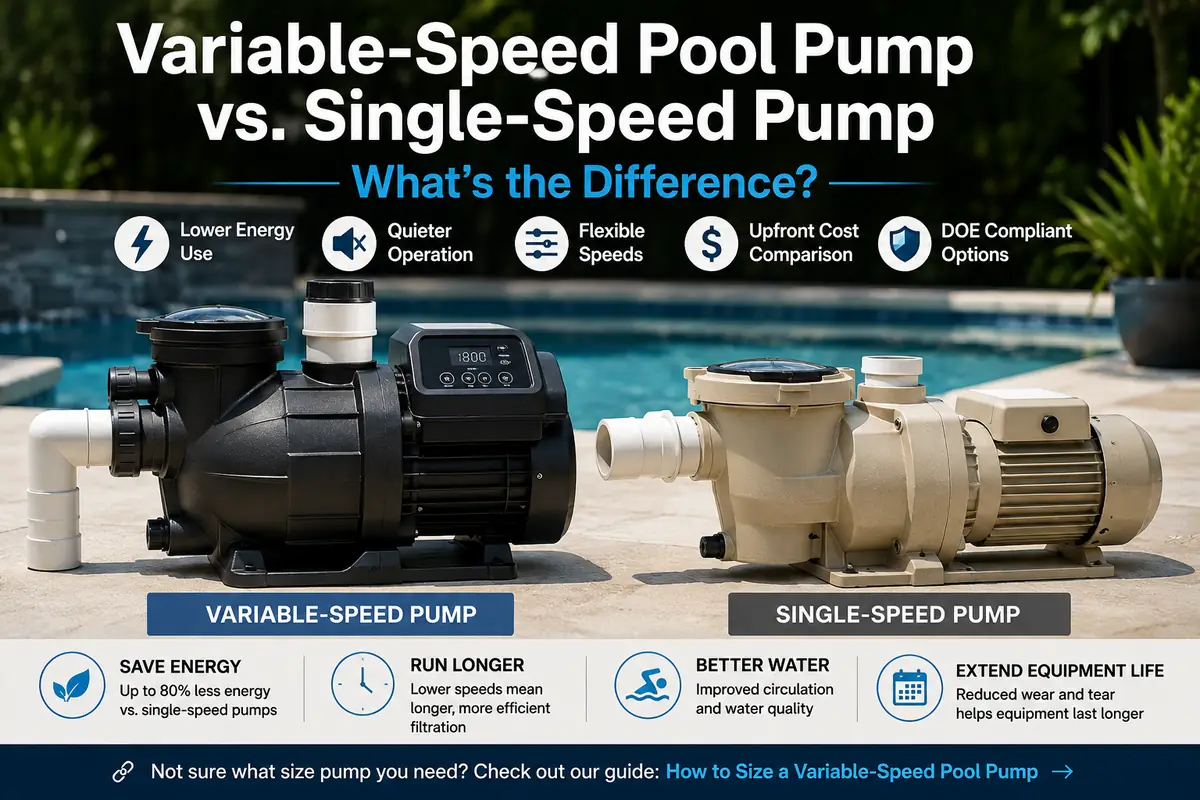
Variable-speed and single-speed pool pumps perform the same basic job, but they do it very differently. A single-speed pump operates at one fixed motor speed whenever it's running, while a variable-speed pump can reduce or increase its speed to match different pool functions. That difference can have a major effect on energy use, noise, operating flexibility, and how you schedule your pool equipment.
Quick Answer: Variable-Speed vs. Single-Speed Pool Pumps
A single-speed pool pump operates at essentially one fixed motor speed whenever it is turned on. A variable-speed pump allows you to program different speeds for routine filtration, skimming, heating, cleaning, spas and water features.
The main advantage of variable speed is that many routine circulation tasks can be performed at reduced RPM, potentially using substantially less electricity and producing less noise. Higher speeds remain available when additional flow is required.
However, energy savings are not automatic. Actual savings depend on the pump, plumbing, operating schedule, electricity rate and equipment requirements. If you already own a functioning single-speed pump, compare the cost of replacing it against realistic energy savings before making a decision.
Variable-Speed vs. Single-Speed Pool Pumps at a Glance
| Feature | Variable-Speed Pump | Single-Speed Pump |
|---|---|---|
| Motor speed | Adjustable across a supported operating range | One primary operating speed |
| Daily scheduling | Can use different speeds and runtimes | Primarily on/off scheduling |
| Electricity consumption | Can be substantially lower during reduced-speed operation | Operates at its fixed speed whenever running |
| Noise | Typically quieter at reduced speeds | Operates at its normal fixed-speed noise level |
| Surface skimming | Can use a dedicated higher-flow period | Uses the same pump speed as filtration |
| Heater and salt-system operation | Can adjust speed to meet equipment flow requirements | Must meet requirements at its fixed operating speed |
| Spa and water features | Can provide separate higher-flow operating modes | Uses its fixed operating speed |
| Initial purchase price | Generally higher than basic single-speed designs | Generally lower where compliant models are available |
| Programming complexity | Requires appropriate speed and schedule settings | Relatively straightforward operation |
| Operating cost | Depends on programmed speeds, wattage and runtime | Depends on fixed-speed wattage and runtime |
For a broader explanation of pump types, hydraulic performance, efficiency and sizing, see our Complete Guide to Pool Pumps.
How a Single-Speed Pool Pump Works
A single-speed pool pump uses a motor designed to operate at one primary speed.
When a timer or control system turns the pump on, it runs at that speed until it shuts off.
This straightforward operating method was common in residential pool installations for many years.
Advantages of Single-Speed Operation
- Simple on/off scheduling.
- No need to program multiple motor speeds.
- Relatively straightforward operation and controls.
- Potentially lower purchase cost where compliant models remain available.
Limitations of Single-Speed Operation
The primary limitation is that the pump cannot reduce its motor speed when the pool requires less flow.
For example, a pump selected to provide sufficient flow for a demanding operating mode may run at that same speed during ordinary filtration, even when substantially less flow would be adequate.
That can increase electricity consumption and noise compared with an appropriately programmed variable-speed system.
How a Variable-Speed Pool Pump Works
A variable-speed pool pump uses electronic motor controls to operate across a range of supported speeds.
Rather than running at one fixed RPM whenever the pump is on, you can create different operating modes.
For example, a pool might use:
- Lower speed for routine filtration and circulation.
- Moderate speed for surface skimming.
- A dedicated speed for salt chlorine generator operation.
- Higher flow when a heater requires it.
- A separate operating mode for a suction-side cleaner.
- Higher speed for an attached spa.
- Dedicated settings for waterfalls or other water features.
The appropriate speeds depend on the pool's plumbing, actual water flow and equipment requirements.
There is no universal RPM schedule that works for every installation.
Our guide to variable-speed pool pump RPM explains how to establish different speeds for filtration and higher-flow functions.
Why Variable-Speed Pumps Can Use Less Electricity
The main efficiency advantage of variable-speed technology comes from reducing motor speed when maximum hydraulic output is unnecessary.
For centrifugal pumps, reducing speed can significantly reduce the electrical power required to circulate water.
As a result, a variable-speed pump may consume less electricity while operating for a longer period at reduced speed than a single-speed pump operating for fewer hours at its fixed speed.
Actual energy savings depend on the hydraulic system and the operating schedule.
Example: Comparing Two Pump Schedules
Consider the following hypothetical operating schedules at an electricity rate of $0.16 per kWh.
| Operating Detail | Single-Speed Example | Variable-Speed Example |
|---|---|---|
| Average electrical draw | 1,500 watts | 300 watts |
| Daily runtime | 6 hours | 12 hours |
| Daily electricity consumption | 9 kWh | 3.6 kWh |
| Daily electricity cost | $1.44 | $0.58 |
| 30-day electricity cost | $43.20 | $17.28 |
| Annual electricity cost | $525.60 | $210.24 |
In this example, the variable-speed schedule consumes 60% less electricity despite operating twice as long.
These are illustrative power-consumption figures, not measurements of specific pumps.
The schedules may also circulate different volumes of water. Before treating them as equivalent, verify that both satisfy the pool's circulation and connected-equipment requirements.
For a detailed explanation of operating costs, see How Much Does a Variable-Speed Pool Pump Cost to Run?. You can also enter your own numbers into our Pool Pump Operating Cost Calculator.
What Determines Your Actual Energy Savings?
The difference in electricity consumption between two pumps depends on more than motor technology.
| Factor | Why It Matters |
|---|---|
| Pump model | Different pumps have different hydraulic performance and electrical efficiency. |
| Programmed RPM or flow | Operating speed affects flow and electrical consumption. |
| Daily runtime | Determines how long the pump consumes electricity. |
| Plumbing resistance | Affects the pump's operating point and required speed. |
| Filter condition | Accumulated debris can increase resistance and reduce flow. |
| Heater and salt system | May establish minimum operating-flow requirements. |
| Spas and water features | May require higher-flow operating periods. |
| Electricity rate | Determines the cost of each kilowatt-hour consumed. |
| Existing pump | Its power consumption and schedule establish the starting point for calculating savings. |
Manufacturer savings claims often rely on particular comparison conditions.
For example, Pentair has advertised energy-consumption savings of up to 90% for its IntelliFlo3 variable-speed and flow pump compared with a specified single-speed operating scenario.
That figure is a manufacturer claim under its stated assumptions, not a guarantee of savings for every installation.
Estimate potential savings using the existing pump's actual electrical consumption and a realistic replacement schedule.
Can a Variable-Speed Pump Run Longer and Still Save Money?
Yes, if its lower electrical draw more than offsets the additional operating hours.
However, longer operation does not automatically provide better circulation or lower costs.
Example: Comparing Daily Energy Use
| Schedule | Average Power | Runtime | Daily Energy |
|---|---|---|---|
| Shorter high-speed schedule | 1,200 watts | 6 hours | 7.2 kWh |
| Longer low-speed schedule | 250 watts | 12 hours | 3 kWh |
At $0.16 per kWh, the shorter high-speed schedule costs approximately $1.15 per day, while the longer low-speed schedule costs $0.48 per day.
These hypothetical schedules are not necessarily equivalent in terms of total water circulated.
See How Long Should You Run a Variable-Speed Pool Pump Each Day? for guidance on balancing speed and runtime.
Which Pump Is Quieter?
A variable-speed pump will often produce less noise during reduced-speed operation than a comparable pump running continuously at high speed.
Lower motor speed can reduce both motor and water-flow noise.
This can matter when pool equipment is installed near:
- Patios and outdoor seating areas.
- Bedrooms.
- Neighboring properties.
- Outdoor kitchens and entertainment areas.
However, variable-speed pumps are not silent.
Noise levels vary by model, installation, operating speed, plumbing configuration and surrounding surfaces.
For an accurate comparison, review manufacturer sound measurements where available and consider the speeds at which the pump will actually operate.
Variable Speed Provides More Operating Flexibility
One of the most practical differences between these pump types is the ability to assign different speeds to different operating requirements.
Example: A Pool With an Attached Spa
Consider a hypothetical pool with the following flow requirements.
| Operating Mode | Illustrative Required Flow |
|---|---|
| Routine filtration | 35 GPM |
| Heating | 45 GPM |
| Attached spa jets | 90 GPM |
These figures are hypothetical and are not specifications for a particular pool.
A properly sized variable-speed pump may be programmed to provide lower flow during routine filtration and higher flow when the spa operates.
A single-speed pump cannot independently change its motor speed for these different functions.
However, a variable-speed pump still needs sufficient hydraulic capacity to meet the installation's highest required operating point.
For more on matching pump capacity to the pool, see How to Size a Variable-Speed Pool Pump.
What About Filters, Heaters and Salt Systems?
Different pieces of pool equipment can have different flow requirements.
A filter has a specified operating-flow range or maximum flow limit. A heater may require minimum water flow before it will operate. A salt chlorine generator may also require a minimum flow rate.
A variable-speed pump allows operating speed to be adjusted for these requirements.
However, the lowest available RPM is not automatically the correct setting.
The pump must provide adequate flow for every piece of equipment operating during that period.
Example: Why Minimum Flow Matters
Suppose a hypothetical pool circulates adequately at 30 GPM during routine filtration, but its heater requires at least 40 GPM.
The pump could potentially use a lower-flow filtration program when the heater is off and switch to a higher-flow program during heating.
The exact settings must be established from the equipment manufacturers' specifications and the pool's actual hydraulic performance.
Our guide to how many GPM a variable-speed pool pump should run explains why actual flow depends on the complete system rather than RPM alone.
What About Spas and Water Features?
Attached spas, waterfalls, deck jets and other water features may require substantially more flow than ordinary filtration.
A properly sized variable-speed pump can operate at reduced speed during routine circulation and increase speed when a higher-flow feature is activated.
That flexibility can reduce the need to operate at a high speed throughout the entire filtration schedule.
However, pump selection must account for the actual flow and system head required by these features.
Do not assume that every variable-speed pump can provide sufficient flow for every spa or water feature.
Do Variable-Speed Pumps Work With Pool Automation?
Many modern variable-speed pumps support compatible automation systems.
Automation can coordinate pump speed with other equipment and operating modes.
For example, activating spa mode may change valve positions, activate the heater and command the pump to a programmed speed.
Some variable-speed pumps also provide their own scheduling and connectivity features.
Before purchasing, verify compatibility using the exact pump and automation model numbers.
Our Complete Guide to Pool Automation explains how pumps, heaters, valves, lights and other equipment can operate together.
Which Pump Costs More Up Front?
Variable-speed pumps generally have higher purchase prices than basic single-speed designs where compliant single-speed models are available.
However, the full ownership cost includes more than the initial purchase price.
| Cost Category | What to Consider |
|---|---|
| Purchase price | Exact pump model and configuration |
| Installation | Labor, plumbing and equipment-pad modifications |
| Electrical work | Voltage compatibility and any required circuit modifications |
| Annual electricity | Expected wattage, runtime and electricity rate |
| Maintenance | Manufacturer requirements and anticipated service costs |
| Utility incentives | Available rebates and eligibility requirements |
| Expected ownership period | How long you expect to operate the replacement equipment |
A higher purchase price may be offset by lower electricity consumption, but the payback period depends on the individual installation.
If you're comparing replacement options, browse available variable-speed models below. Verify the exact model's voltage, hydraulic performance, plumbing and automation compatibility before purchasing.
Compare Variable-Speed Pool Pumps on Amazon
How to Calculate the Payback Period
If you are comparing a variable-speed pump with another replacement option, calculate the additional installed cost and divide it by the estimated annual electricity savings.
Additional Upfront Cost = Installed Variable-Speed Pump Cost − Installed Alternative Cost
Simple Payback = Additional Upfront Cost ÷ Annual Energy Savings
Example: Different Annual Savings
Suppose choosing variable speed adds $800 to the installed cost.
| Estimated Annual Energy Savings | Additional Installed Cost | Simple Payback |
|---|---|---|
| $150 | $800 | 5.3 years |
| $250 | $800 | 3.2 years |
| $400 | $800 | 2 years |
| $500 | $800 | 1.6 years |
These are hypothetical calculations, not estimates for a particular installation.
Simple payback also excludes financing, maintenance differences, future electricity-rate changes and differences in expected equipment life.
Are Single-Speed Pool Pumps Still Legal?
Federal energy-efficiency regulations do not establish a universal prohibition on every single-speed pool pump.
The U.S. Department of Energy regulates dedicated-purpose pool pumps through equipment classifications and applicable energy-conservation standards.
These requirements affect which new pumps can be manufactured and distributed, and the applicable requirements depend on the equipment category.
Dedicated-purpose pool pump motors are also subject to separate federal requirements.
Because standards, compliance dates and enforcement guidance can change, verify the current requirements for the exact pump or replacement motor before purchasing or installing equipment.
State and local requirements may also apply.
Do You Have to Replace a Working Single-Speed Pump?
Federal efficiency standards for newly manufactured and distributed equipment do not automatically require every homeowner to remove an existing functioning single-speed pump.
If your existing pump operates properly, you can evaluate replacement based on energy consumption, remaining service life, performance and the complete installed cost of a new pump.
Example: Replacing a Working Pump Early
Suppose your existing pump costs $400 per year in electricity and a suitable variable-speed replacement is estimated to cost $180 per year.
The hypothetical annual savings would be:
$400 − $180 = $220
If the replacement costs $1,400 installed and the existing pump does not otherwise need replacing:
$1,400 ÷ $220 = approximately 6.4 years
This simplified calculation excludes maintenance, future electricity prices, rebates and the existing pump's remaining service life.
If your existing pump fails and must be replaced anyway, compare the additional cost of the variable-speed option against the cost of a compliant alternative rather than assigning the entire replacement cost to the upgrade.
When Variable-Speed Operation Offers Practical Benefits
The ability to change pump speed can be particularly useful under the following conditions:
- The pool requires many hours of daily circulation.
- The existing pump consumes substantial electricity.
- Local electricity rates are high.
- The pool has different flow requirements throughout the day.
- An attached spa requires higher flow than routine filtration.
- Water features operate only during certain periods.
- Heating and sanitation equipment have specific flow requirements.
- Equipment noise is a concern.
- The owner wants more precise scheduling or compatible automation.
The actual benefit depends on how much of the daily schedule can operate at reduced speed while maintaining adequate circulation and equipment performance.
When Keeping an Existing Single-Speed Pump May Be Reasonable
If your existing single-speed pump is functioning, immediate replacement may not produce a short financial payback in every situation.
Factors to examine include:
- The pump's age and condition.
- Current electrical consumption.
- Daily runtime.
- Local electricity prices.
- Expected remaining service life.
- Replacement installation costs.
- Available rebates.
- Any other equipment upgrades you are planning.
Use actual operating measurements and installation quotes rather than assuming every replacement will achieve the same percentage of energy savings.
How to Compare Two Pumps for Your Pool
Whether you are choosing a new variable-speed pump or comparing it with an existing single-speed model, the selection process should begin with your pool's hydraulic requirements.
- Calculate pool volume. Establish a starting point for circulation planning.
- Determine routine flow requirements. Estimate the flow needed for filtration and sanitation.
- Identify high-flow operating modes. Include spas, water features and other demanding equipment.
- Estimate system head. Account for plumbing and equipment resistance.
- Review pump performance curves. Verify that the candidate pump can meet the required operating points.
- Check filter and heater limits. Confirm that expected flow remains within equipment specifications.
- Verify voltage. Check electrical compatibility and installation requirements.
- Check automation compatibility. Confirm exact pump and controller model numbers.
- Estimate operating cost. Use realistic wattage, runtime and electricity rates.
- Compare installed prices. Include labor, plumbing and electrical modifications.
- Check incentives. Verify utility rebate eligibility before purchasing.
- Review warranty requirements. Confirm any installation or registration conditions.
Common Mistakes When Comparing Variable-Speed and Single-Speed Pumps
| Mistake | Why It Matters | Better Approach |
|---|---|---|
| Comparing horsepower alone | Horsepower does not establish actual flow through your plumbing. | Use manufacturer performance curves and system head. |
| Assuming advertised maximum savings | Manufacturer comparisons use specific operating assumptions. | Calculate savings from your own pump and schedule. |
| Ignoring connected equipment | Heaters, salt systems and cleaners may have minimum-flow requirements. | Verify each operating mode. |
| Choosing the largest pump available | Additional capacity may not be useful for the installation. | Match the pump to actual hydraulic demand. |
| Running variable speed at maximum RPM all day | Can reduce the energy-saving benefit of adjustable speed. | Use reduced-speed circulation when appropriate. |
| Comparing purchase price alone | Electricity and installation costs affect total ownership cost. | Estimate complete installed and operating costs. |
| Assuming an existing pump must be replaced immediately | Replacement economics depend on its condition and operating costs. | Evaluate remaining life and realistic savings. |
Frequently Asked Questions
What is the main difference between variable-speed and single-speed pool pumps?
A single-speed pump operates at one primary motor speed. A variable-speed pump can be programmed to operate at different speeds for different circulation and equipment requirements.
Do variable-speed pool pumps use less electricity?
They can, particularly when routine circulation can be performed at reduced speed. Actual savings depend on the pump, plumbing, schedule and existing equipment.
Are variable-speed pumps quieter?
They are often quieter during reduced-speed operation. Actual noise depends on the pump model, installation and operating conditions.
Can a variable-speed pump run longer and still cost less?
Yes. A longer schedule at substantially lower wattage can consume less electricity than a shorter high-speed schedule. Both schedules must still satisfy the pool's circulation requirements.
Is a variable-speed pump suitable for an attached spa?
It can be, provided the selected pump has sufficient hydraulic capacity to meet the spa's required flow at the system's operating head.
Do variable-speed pumps work with salt chlorine generators?
Yes, when the pump provides the flow required by the chlorinator. Establish an appropriate operating margin so normal changes in filter resistance do not interrupt chlorine production.
Can a variable-speed pump work with existing pool automation?
Many models support compatible automation, but features vary. Verify the exact pump and controller model numbers before purchasing.
Are all single-speed pool pumps banned?
No. Federal regulations establish energy-efficiency requirements for defined equipment categories rather than a universal prohibition on every single-speed pump.
Do I have to replace my existing single-speed pump immediately?
Federal efficiency standards for newly manufactured and distributed equipment do not automatically require immediate removal of an existing functioning pump. Consider its condition, operating cost and applicable replacement requirements.
How do I calculate whether upgrading will pay for itself?
Estimate the difference in annual electricity cost and compare it with the additional installed cost of the replacement. Account for any relevant rebates, installation work and differences in expected equipment life.
Bottom Line
The fundamental difference between variable-speed and single-speed pool pumps is operating control.
A single-speed pump runs at essentially one fixed motor speed. A variable-speed pump can use lower speeds for routine circulation and higher speeds when the pool or connected equipment requires additional flow.
That flexibility can reduce electricity consumption and noise while providing more control over different operating modes. However, actual savings depend on proper pump sizing, programming and the hydraulic characteristics of the installation.
If you're considering a specific replacement, continue with our guide to sizing a variable-speed pool pump.
One variable-speed option discussed in this guide is the Pentair IntelliFlo3 1.5 HP. The affiliate listing below was identified for Pentair model 011065. Confirm the exact model, specifications and installation compatibility before ordering.
How We Research
Pool Equipment Lab evaluates pool equipment using manufacturer specifications, documentation, compatibility requirements, operating costs, warranty information, and owner feedback when relevant. We do not claim hands-on testing unless we actually performed it.
Sources
- U.S. Department of Energy — Dedicated-Purpose Pool Pumps — current federal energy-conservation standards, test procedures, and regulatory information for dedicated-purpose pool pumps.
- U.S. Department of Energy — Dedicated-Purpose Pool Pump Motors — current federal standards and compliance dates applicable to dedicated-purpose pool pump motors.
- U.S. Department of Energy — Dedicated-Purpose Pool Pump Motors Enforcement Policy — 2026 DOE enforcement guidance concerning portions of the dedicated-purpose pool pump motor standards.
- Pentair — IntelliFlo3 Variable Speed & Flow Pool Pump — manufacturer specifications and information regarding variable-speed operation, energy consumption, noise, automation, and available pump sizes.
Energy savings vary by pump, operating speed, runtime, utility rate, pool plumbing, equipment and other site-specific conditions. Product specifications and regulations can also change. Verify current manufacturer documentation and applicable requirements before purchasing or installing equipment.