
How Long Do Salt Chlorinator Cells Last?
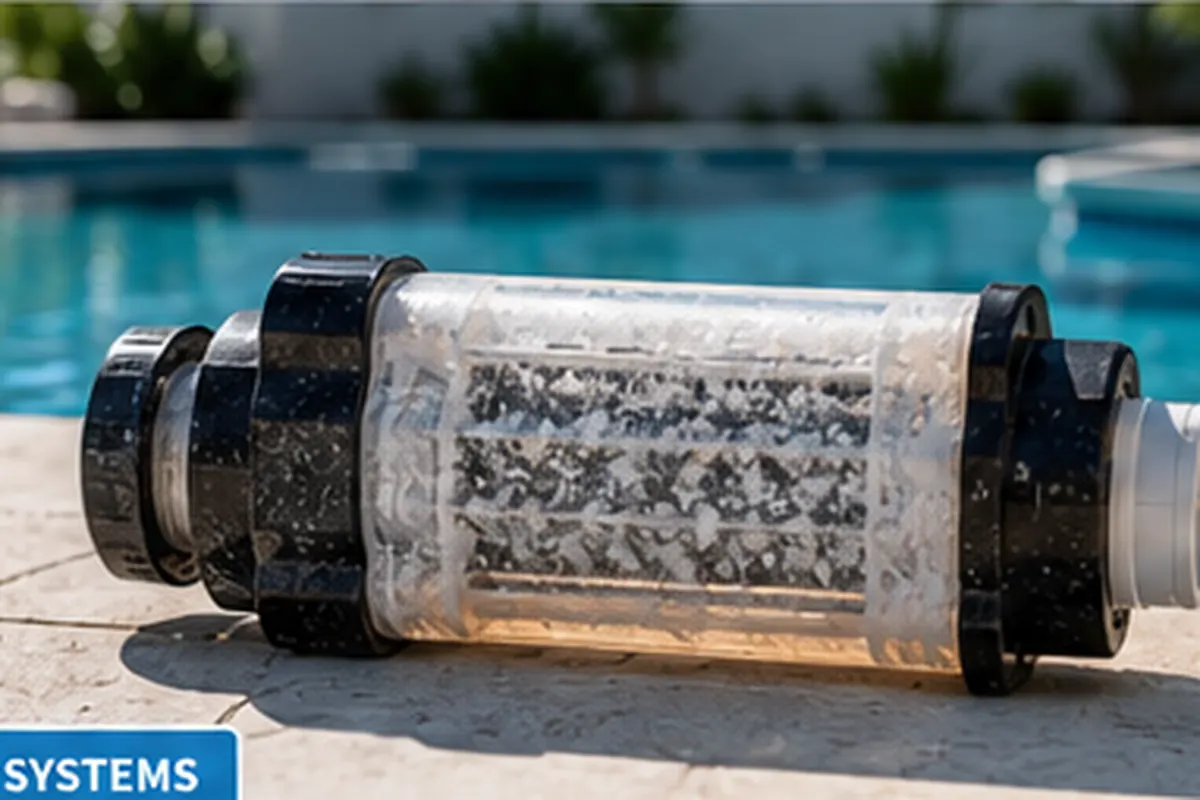
A salt chlorine generator cell is a wear component. The coated metal blades inside the cell gradually lose their ability to produce chlorine and eventually require replacement.
Operating hours are more useful than calendar age alone because two identical salt cells can accumulate dramatically different amounts of use.
Quick Answer: How Long Do Salt Chlorinator Cells Last?
Many residential salt chlorinator cells have an expected service life of approximately three to five years, although actual lifespan varies considerably by model, operating hours, water chemistry and maintenance. Some cells are designed around an estimated 10,000 operating hours, but that figure does not apply to every manufacturer or model.
A cell that is several years old does not automatically need replacement. Before purchasing a new one, check salinity, water flow, generator settings, operating time, cell cleanliness and the manufacturer's diagnostic information.
Salt Cell Lifespan at a Glance
| Factor | What to Know |
|---|---|
| Typical residential lifespan | Often approximately 3–5 years, depending on the system and operating conditions |
| Operating-hour reference | Some cells are designed around an estimated 10,000 hours |
| Main wear mechanism | Gradual deterioration of the cell's electrode coating |
| Important operating factors | Production hours, output settings, water chemistry and salinity |
| Important maintenance factors | Scale control, appropriate inspection and manufacturer-approved cleaning |
| Possible replacement indicators | Persistent diagnostic warnings, failed manufacturer tests or inadequate production after other causes are eliminated |
| Replacement requirement | Exact compatibility with the installed generator and controller |
Typical Salt Cell Lifespan
Pentair has described approximately 10,000 operating hours, or roughly three to five years, as a general lifespan reference for certain residential salt cells.
That should be treated as general guidance rather than a guaranteed lifespan. Other manufacturers and individual cell models may have different expected operating lives.
Actual service life depends on how frequently the cell produces chlorine, the conditions in which it operates and how it is maintained.
For a broader explanation of salt chlorine generators, sizing, salinity, maintenance and operation, see our Complete Guide to Saltwater Pool Systems.
Why Operating Hours Matter More Than Calendar Age
A salt cell produces chlorine when the generator energizes its electrodes under appropriate operating conditions.
The electrode coating gradually wears as the cell operates. Consequently, two cells installed on the same date may have very different remaining service lives.
A cell operating for extended periods at high output can accumulate production hours faster than one operating less frequently.
Example: How Long Would 10,000 Operating Hours Last?
The following calculations assume a hypothetical cell with a 10,000-hour service-life reference and continuous chlorine production during the stated daily hours.
| Daily Production Hours | Annual Production Hours | Time to 10,000 Hours |
|---|---|---|
| 4 hours | 1,460 | Approximately 6.8 years |
| 6 hours | 2,190 | Approximately 4.6 years |
| 8 hours | 2,920 | Approximately 3.4 years |
| 10 hours | 3,650 | Approximately 2.7 years |
| 12 hours | 4,380 | Approximately 2.3 years |
These figures illustrate the relationship between production hours and calendar time. They are not predictions of actual cell failure. Water chemistry, cell design, maintenance and operating conditions can change the outcome.
Also, pump runtime and cell production hours are not necessarily the same. A pump may operate for 12 hours while the generator produces chlorine for only part of that period.
How Does Output Percentage Affect Cell Life?
On many salt generators, the output percentage determines the proportion of available operating time during which the cell produces chlorine.
For example, a generator operating for 10 hours at a 50% output setting may energize its cell for approximately five hours during that period.
The exact control method varies by manufacturer.
Example: Comparing Two Output Schedules
Consider a hypothetical salt generator with a 10,000-hour cell-life reference.
| Schedule | Pump Runtime | Generator Output | Approximate Daily Production |
|---|---|---|---|
| A | 10 hours | 100% | 10 hours |
| B | 10 hours | 50% | 5 hours |
| C | 8 hours | 75% | 6 hours |
Schedule B accumulates fewer production hours per day than Schedule A in this simplified example.
However, lower output is not automatically the correct operating choice. The generator must still produce enough chlorine to meet the pool's actual demand.
Do not reduce chlorine production simply to extend cell life if doing so prevents the pool from maintaining an appropriate sanitizer residual.
What Shortens Salt Cell Life?
Several operating and maintenance conditions can affect a cell's useful life.
| Factor | Potential Effect | Practical Response |
|---|---|---|
| Long production hours | Accumulates electrode use more quickly | Match output and runtime to measured chlorine demand |
| High output settings | Can increase energized production time | Use settings appropriate for the pool's actual requirements |
| Incorrect salinity | May interfere with normal generator operation | Test independently and follow the manufacturer's range |
| Unbalanced water chemistry | Can encourage scale or other operating problems | Maintain appropriate water balance |
| Calcium scale | Can interfere with cell operation | Inspect and clean only as directed |
| Excessive acid cleaning | May damage the electrode coating | Avoid unnecessary or overly aggressive cleaning |
| High chlorine demand | May require extended production time | Identify demand and ensure adequate cell capacity |
Maintaining the correct salinity is important for proper operation. See How Much Salt Does My Pool Need? for calculating salt additions, or use our Pool Salt Calculator.
How Calcium Scale Affects a Salt Cell
Mineral scale can accumulate on salt-cell plates, particularly when water chemistry encourages calcium scaling.
Significant deposits can interfere with the cell's ability to operate properly.
Scale buildup does not necessarily mean the cell has reached the end of its useful life. However, repeated scaling and improper cleaning can create additional maintenance problems.
What to Look for During Inspection
- Visible mineral deposits between or on the cell plates.
- Debris obstructing the cell housing.
- Visible damage or deterioration.
- Model-specific inspection or cell-service warnings.
Some modern generators periodically reverse electrical polarity to help limit scale accumulation.
Automatic polarity reversal reduces maintenance requirements in some operating conditions but does not eliminate the need to maintain balanced pool water or inspect the cell.
Why You Shouldn't Overclean a Salt Cell
Cleaning should follow the manufacturer's procedure.
Unnecessary or overly aggressive acid cleaning can damage the coating on the cell plates and potentially shorten useful life.
Inspect the cell and follow the specific manufacturer's cleaning instructions rather than automatically acid-washing it on a fixed schedule.
Practical Inspection and Cleaning Sequence
- Review the generator manufacturer's shutdown and cell-removal instructions.
- Disconnect power as required before performing permitted maintenance.
- Inspect the cell for visible scale or debris.
- Use the manufacturer's approved cleaning method only if cleaning is necessary.
- Reinstall the cell according to the manufacturer's instructions.
- Restore normal operation and review the generator's status.
Never mix acid with chlorine products or other pool chemicals. If you are uncomfortable handling the cleaning chemicals or removing the cell, use a qualified pool-service professional.
Signs a Salt Cell May Be Wearing Out
Possible signs include:
- Reduced chlorine production despite appropriate operating settings.
- Increasing difficulty maintaining free chlorine.
- Cell warnings that remain after other operating problems have been addressed.
- Diagnostic indicators showing reduced remaining cell life.
- Visible blade damage.
- Failure to pass the manufacturer's specified cell diagnostic procedure.
However, low chlorine does not automatically mean the cell has failed.
If chlorine production has dropped, see Why Is My Salt System Not Producing Chlorine? before assuming the cell needs replacement.
Rule Out Other Causes Before Replacing the Cell
Replacing a salt cell without diagnosing the rest of the system can be an expensive mistake.
Several operating problems can produce symptoms similar to a worn cell.
| What to Check | Why It Matters |
|---|---|
| Current salt concentration | Low salinity may reduce or prevent production |
| Water flow | Flow protection may disable chlorine generation |
| Output percentage | Low output may not meet current demand |
| Pump and generator runtime | Short production periods limit daily chlorine output |
| Water temperature | Some generators reduce or stop production in cold water |
| Cell cleanliness | Scale and debris may interfere with operation |
| Pool chemistry | Water balance and stabilizer levels affect sanitation management |
| Chlorine demand | Heavy swimming activity, sunlight, algae or organic debris can consume chlorine rapidly |
Example: Low Chlorine Does Not Always Mean a Bad Cell
Suppose a pool maintained its free-chlorine level during spring but begins testing low during hot summer weather.
The owner notices that the generator is several years old and assumes the cell needs replacement.
However, the pump still runs on the same schedule, while sunlight exposure and swimming activity have increased.
Before purchasing a new cell, the owner should test the water, confirm salinity and flow, review generator output and runtime, and investigate the higher chlorine demand.
If those checks show that the generator is operating correctly but daily production is insufficient, the issue may be the operating schedule or cell capacity rather than cell failure.
Modern Cell-Life Tracking and Diagnostic Systems
Some generators monitor operating hours, provide cell-status information or display maintenance and replacement warnings.
Depending on the model, available diagnostics may include:
- Accumulated operating hours.
- Cell-life estimates.
- Cell current or voltage readings.
- Salt-related warnings.
- Flow and temperature status.
- Inspection or replacement indicators.
Not every generator provides all these measurements, and their meanings vary by model.
A remaining-life estimate is a diagnostic aid, not a guarantee of how many calendar months or years the cell will continue working.
Follow the manufacturer's interpretation of each warning and its recommended diagnostic procedure.
Can a Larger Salt Cell Last Longer?
A larger-capacity cell may be able to satisfy a pool's chlorine demand at a lower output percentage or shorter production duration than a smaller cell operating near maximum output.
That can reduce the larger cell's accumulated production hours under otherwise comparable conditions.
However, a larger cell does not automatically last longer. Cell design, coating durability, operating conditions and maintenance still matter.
Example: Comparing Two Hypothetical Cell Sizes
Consider a pool that requires approximately 0.6 pounds of chlorine equivalent per day.
Compare two hypothetical salt cells operating for eight hours daily:
| Specification | Cell A | Cell B |
|---|---|---|
| Rated output at full production | 1.2 lb/day | 2.4 lb/day |
| Daily available operating time | 8 hours | 8 hours |
| Maximum theoretical production in 8 hours | 0.4 lb | 0.8 lb |
| Pool's required daily production | 0.6 lb | 0.6 lb |
| Can meet the example demand in 8 hours? | No | Yes, theoretically |
In this example, Cell A cannot meet the assumed daily demand within the eight-hour operating period, even at full output.
Cell B could theoretically meet that demand at approximately 75% output over the same period.
These are illustrative calculations, not specifications for actual products. Real production depends on the generator and operating conditions.
Whether a larger cell provides better lifetime value depends on purchase cost, chlorine demand, runtime, water chemistry and the manufacturer's design.
See What Size Salt Cell Do I Need? for more about matching cell capacity to pool volume and chlorine demand, or use our Salt Cell Sizing Calculator.
How to Estimate the Cost of Salt Cell Ownership
Replacement price alone does not show the complete cost of owning a salt cell.
One useful comparison is the approximate replacement cost divided by the number of years the cell remains in service.
Hypothetical Replacement-Cost Comparison
| Example | Replacement Cell Cost | Assumed Service Life | Approximate Annualized Cost |
|---|---|---|---|
| A | $600 | 3 years | $200/year |
| B | $800 | 5 years | $160/year |
| C | $1,000 | 5 years | $200/year |
These are hypothetical prices and service lives used only to demonstrate the calculation. They are not current product quotes or guaranteed replacement intervals.
Actual ownership costs may also include installation, maintenance and other generator components.
When comparing replacements, consider exact compatibility, warranty terms, rated chlorine production and expected operating requirements alongside price.
When Should You Replace a Salt Cell?
Replacement becomes appropriate when the manufacturer's diagnostic procedure indicates that the cell has failed or reached the end of its useful life and other causes of poor production have been ruled out.
Before ordering, verify:
- The generator's manufacturer and exact model.
- The installed controller and its compatibility requirements.
- The correct replacement cell or approved alternative.
- The required chlorine-production capacity.
- Plumbing and connection compatibility.
- Warranty and installation requirements.
If troubleshooting confirms that the existing cell has reached the end of its service life, compare replacement options carefully and verify compatibility with your exact salt system before ordering.
Compare Replacement Salt Cells on Amazon
When to Call a Pool Professional
Professional diagnosis is appropriate when the generator reports persistent faults, electrical components are involved, the controller or power supply may be defective, or the cell fails to operate after routine checks.
A qualified technician can help distinguish a failed cell from a controller, sensor, wiring or circulation problem.
Do not bypass flow switches, electrical protections or other safety features to test a suspected cell failure.
Frequently Asked Questions
How many years does a salt cell usually last?
Many residential salt cells are described as lasting approximately three to five years, although actual service life depends on the specific model, production hours, water chemistry and maintenance.
Do all salt cells last 10,000 hours?
No. Approximately 10,000 operating hours is a reference associated with some salt-cell designs, not a universal specification. Check the documentation for your exact model.
Can a salt cell last longer than five years?
It is possible, particularly when a cell accumulates relatively few production hours and operates under appropriate conditions. However, calendar age alone does not establish remaining life.
Does running a salt generator at 100% shorten cell life?
On systems where output percentage controls energized production time, higher output settings can accumulate operating hours more quickly. The generator must still run long enough to meet the pool's actual chlorine demand.
Does a dirty salt cell need to be replaced?
Not necessarily. Mineral deposits may interfere with operation, but an otherwise functional cell may recover after appropriate manufacturer-approved cleaning. Do not assume that every warning or visible deposit means the cell has failed.
Can acid cleaning shorten salt cell life?
Yes. Unnecessary or overly aggressive acid cleaning can damage the cell's electrode coating. Follow the manufacturer's inspection and cleaning procedure.
Will a larger salt cell last longer?
A larger compatible cell may meet the same chlorine demand with fewer production hours. Whether that results in longer service life depends on the cell's design, operating conditions and maintenance.
Why is my salt cell not producing enough chlorine?
Possible causes include insufficient salinity, low water flow, short runtime, low output settings, cold water, scale, high chlorine demand or cell wear. Diagnose these conditions before purchasing a replacement.
Can I replace a salt cell with a different brand?
Only if the replacement is explicitly compatible with the installed generator and controller. Similar appearance or pool-capacity ratings do not establish compatibility.
Should I replace my salt cell just because it is five years old?
No. If the cell still operates correctly and passes the manufacturer's diagnostic checks, calendar age alone is not a sufficient reason to replace it.
Bottom Line
Salt chlorinator cells are consumable components rather than lifetime equipment. Around 10,000 operating hours is a useful reference point for some systems, but actual service life depends on cell design, production hours, maintenance and water chemistry.
Do not replace a cell solely because it is several years old. Diagnose salinity, water flow, chemistry, runtime and cell condition first.
Once replacement is necessary, match the new cell to the exact manufacturer, system and controller requirements rather than choosing by pool capacity alone.
How We Research
Pool Equipment Lab evaluates pool equipment using manufacturer specifications, documentation, compatibility requirements, operating costs, warranty information, and owner feedback when relevant. We do not claim hands-on testing unless we actually performed it.