
How Much Salt Does My Pool Need?
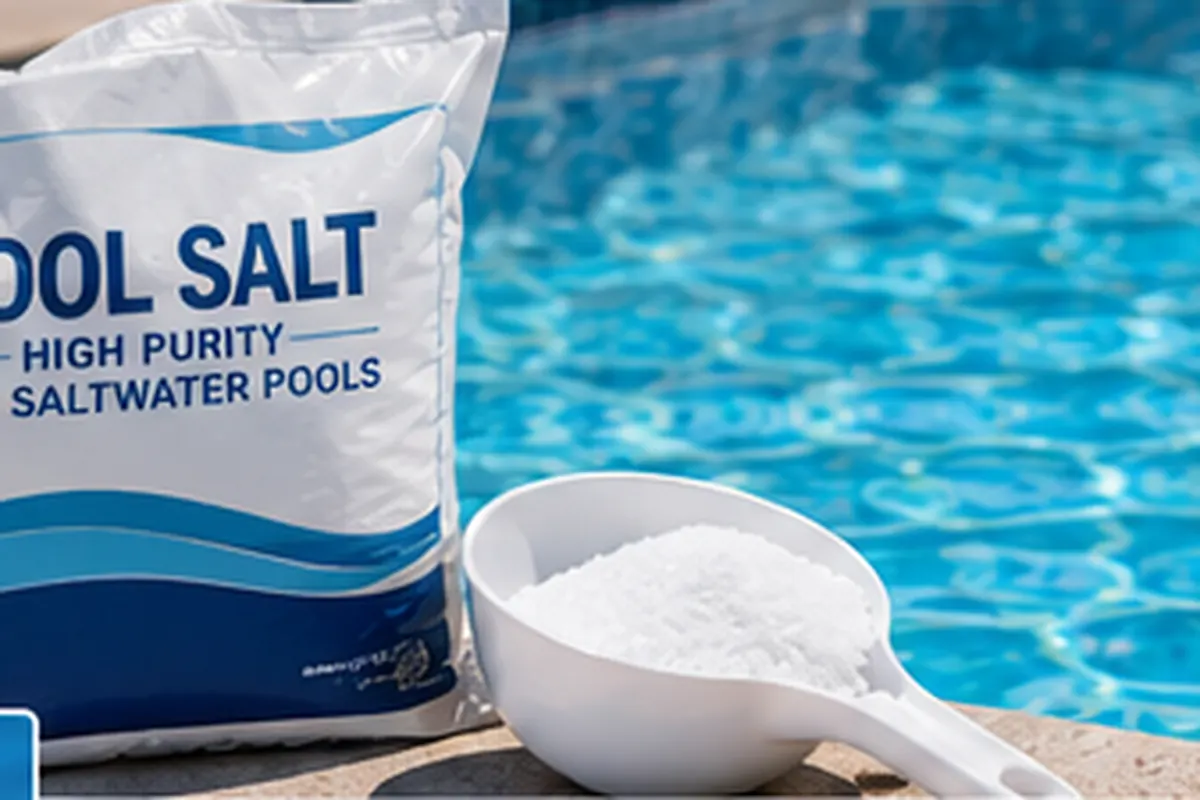
The amount of salt your pool needs depends on three numbers: pool volume, current salt concentration, and the target salt level specified by your salt chlorine generator manufacturer.
Always test the existing water before adding salt. Pools can already contain a meaningful amount of salt even when no salt has been intentionally added recently.
Quick Answer: How Much Salt Does Your Pool Need?
The amount of salt your pool needs depends on three measurements: pool volume, current salinity and the target salt concentration specified by your salt chlorine generator manufacturer.
Many residential salt systems operate around 3,000–4,000 parts per million (ppm), but there is no universal target. Test your pool's existing salt level before adding more.
For example, a 15,000-gallon pool with a current salt level of 1,000 ppm and a target of 3,600 ppm needs a theoretical addition of approximately 325 pounds of salt. Confirm the result against your generator manufacturer's salt-addition table before proceeding.
Pool Salt Requirements at a Glance
| Measurement | Why It Matters |
|---|---|
| Pool volume | Determines how much water needs a salinity adjustment |
| Current salt level | Identifies how much salt is already dissolved in the pool |
| Target salt level | Establishes the concentration required by your generator |
| Required ppm increase | Target salinity minus current salinity |
| Calculated salt addition | Estimated weight of salt needed to reach the target |
What Salt Level Does a Saltwater Pool Need?
There is no universal target for every salt chlorine generator.
Many residential systems operate in the neighborhood of 3,000–4,000 ppm, but the correct target and acceptable operating range are specified by the manufacturer of your particular equipment.
Some systems have a relatively narrow recommended range. Others permit a broader range or use different target concentrations.
Check your exact generator model rather than using a salt target from another manufacturer's equipment.
For a broader explanation of salinity, chlorine generation, cell sizing, maintenance and troubleshooting, see our Complete Guide to Saltwater Pool Systems.
Test Your Pool Water Before Adding Salt
Never assume the starting salt concentration is zero.
Pool water may already contain salt from previous salt additions, chlorine products, source water and other chemicals.
Test the current salinity before calculating an addition.
Why the Generator Display May Not Be Enough
Some salt generators estimate salinity using electrical measurements taken during operation.
The displayed reading may be affected by operating conditions or equipment problems and may differ from an independent water test.
If the generator reports low salt but an independent test indicates that salinity is already within the manufacturer's range, investigate the discrepancy before adding more salt.
Three Measurements You Need
- Pool volume: The approximate number of gallons in your pool.
- Current salinity: The salt concentration measured by an appropriate independent test.
- Target salinity: The concentration recommended for your exact salt chlorine generator.
Once you have these measurements, you can calculate the approximate amount of salt required.
The Basic Pool Salt Formula
Parts per million (ppm) expresses the concentration of salt in the pool water.
For typical pool calculations using U.S. gallons and pounds, a useful approximation is:
Salt Needed (lb) = Pool Gallons × Desired PPM Increase × 0.00000834
First, calculate the required increase:
Desired PPM Increase = Target PPM − Current PPM
Then multiply the increase by your pool volume and the conversion factor.
This calculation estimates the amount of salt required. Pool-volume uncertainty, testing differences and product specifications can affect the actual addition.
You can also enter your pool volume, current salt level and target salt level into our Pool Salt Calculator.
Worked Example: Adding Salt to a 15,000-Gallon Pool
Suppose a 15,000-gallon pool currently measures 1,000 ppm and its generator requires a target of 3,600 ppm.
Step 1: Calculate the Required Increase
3,600 − 1,000 = 2,600 ppm
Step 2: Calculate the Salt Addition
15,000 × 2,600 × 0.00000834 = 325.26 lb
The theoretical addition is approximately 325 pounds of salt.
Step 3: Convert the Result Into Bags
If the salt is packaged in 40-pound bags:
325.26 ÷ 40 = approximately 8.13 bags
This is a purchasing estimate, not an instruction to add every bag at once.
Confirm the amount against your generator manufacturer's salt-addition table and follow its recommended addition procedure.
Pool Salt Addition Reference Table
The following table shows approximate salt additions for different pool volumes and required salinity increases.
These are calculated examples, not recommended target salinities. Use your own independently measured starting level and manufacturer-specified target.
| Pool Volume | 500 PPM Increase | 1,000 PPM Increase | 2,000 PPM Increase | 3,000 PPM Increase |
|---|---|---|---|---|
| 5,000 gallons | 21 lb | 42 lb | 83 lb | 125 lb |
| 10,000 gallons | 42 lb | 83 lb | 167 lb | 250 lb |
| 15,000 gallons | 63 lb | 125 lb | 250 lb | 375 lb |
| 20,000 gallons | 83 lb | 167 lb | 334 lb | 500 lb |
| 25,000 gallons | 104 lb | 209 lb | 417 lb | 626 lb |
| 30,000 gallons | 125 lb | 250 lb | 500 lb | 751 lb |
Values are rounded to the nearest pound. Confirm additions using the salt-system manufacturer's instructions.
Example: A Pool That Only Needs a Small Salt Adjustment
Suppose a 12,000-gallon pool measures 3,200 ppm and its generator has a target of 3,600 ppm.
The required increase is:
3,600 − 3,200 = 400 ppm
The estimated addition is:
12,000 × 400 × 0.00000834 = 40.03 lb
The theoretical requirement is approximately 40 pounds.
However, the generator may already operate normally at the measured concentration if 3,200 ppm is within its acceptable range.
Check the manufacturer's instructions and actual operating status before deciding whether an adjustment is necessary.
Why You Shouldn't Add the Entire Calculated Amount Blindly
Pool-volume estimates and salt tests are not perfectly precise.
A pool described as holding 15,000 gallons may have a different actual volume because of its shape, depth, steps or Baja shelf.
Likewise, salt measurements can vary between testing methods.
It is generally easier to add more salt than to correct an excessively high salt concentration.
When appropriate under the manufacturer's directions, approach the target conservatively, allow the salt to dissolve and circulate, then retest before making the final adjustment.
What Happens if the Salt Level Is Too Low?
Low salt can reduce chlorine-generator performance.
Depending on the system, insufficient salinity may trigger a warning, reduce chlorine production or cause the generator to shut down.
The warning and shutdown thresholds vary by manufacturer and model.
If the salt level is correct but chlorine production remains low, see Why Is My Salt System Not Producing Chlorine? for other possible causes.
Why a Low-Salt Warning Does Not Always Mean Add More Salt
Some systems estimate salt concentration through measurements involving the cell.
Scale, cell wear, temperature or sensor-related problems may contribute to an inaccurate displayed reading.
When the displayed reading conflicts with an independent test, follow the manufacturer's diagnostic procedure before adding salt.
What Happens if the Salt Level Is Too High?
Excessive salinity can cause operating problems and may contribute to corrosion or deterioration of susceptible pool equipment and surrounding materials.
Some generators display a high-salt warning or stop producing chlorine when salinity exceeds their specified limits.
Unlike chlorine output, salt concentration cannot simply be turned down using the generator's controller.
Reducing excessive salinity generally requires removing some pool water and replacing it with lower-salt water, subject to local drainage rules and the pool manufacturer's instructions.
Example: Estimating a Partial Water Replacement
Consider a hypothetical pool with a salt concentration of 4,500 ppm that needs to be reduced to 3,600 ppm.
Assume the replacement water contains no salt and that the water mixes completely.
The approximate fraction of pool water to replace is:
(4,500 − 3,600) ÷ 4,500 = 0.20
That equals approximately 20% of the pool's water.
For a 15,000-gallon pool:
15,000 × 0.20 = 3,000 gallons
This is a simplified calculation. Actual replacement-water salinity, mixing and measurement uncertainty affect the result.
Do not drain a pool without checking the pool builder's instructions, groundwater conditions and applicable local requirements. Draining can damage some pools under certain conditions.
Does Salt Evaporate From a Swimming Pool?
No. Salt does not evaporate with pool water.
When water evaporates, dissolved salt remains behind. As the water level falls, the salt becomes concentrated in the remaining water.
Adding salt-free water to replace only the evaporated water generally returns the concentration toward its previous level.
Salt is primarily lost when salty water physically leaves the pool through:
- Splash-out.
- Backwashing.
- Draining.
- Leaks.
- Other water removal.
Example: Evaporation vs. Splash-Out
Consider two identical saltwater pools.
Pool A loses water primarily through evaporation. The dissolved salt remains in the pool, so replacing that evaporated water does not normally require a corresponding salt addition.
Pool B loses a substantial amount of salty water through splash-out or backwashing. Replacing that lost water with lower-salt water dilutes the pool and may require additional salt.
This is why salt additions should be based on testing rather than a fixed weekly or monthly schedule.
What Kind of Salt Should You Use?
Use salt that meets the requirements of your salt chlorine generator manufacturer.
Pool salt is commonly sold for use in saltwater chlorine-generation systems, but product purity and additives can vary.
Check the salt product's labeling and your generator manual before adding it.
Avoid products containing unnecessary additives unless specifically approved for the pool system.
Do not assume that every type of household, water-softener or deicing salt is suitable for swimming pools.
How to Add Salt to a Swimming Pool
- Test the current salt concentration independently.
- Determine the pool's approximate volume.
- Confirm the generator's required target and acceptable operating range.
- Calculate the required salinity increase.
- Check the result against the manufacturer's salt-addition table.
- Follow the manufacturer's instructions for adding salt, circulation and generator operation during the process.
- Allow the salt to dissolve and mix thoroughly.
- Retest before making additional adjustments.
If you do not know the approximate capacity of your pool, use our Pool Volume Calculator before calculating the salt addition.
How Long Does Pool Salt Take to Dissolve?
Dissolving and mixing time depends on the salt product, water temperature, circulation and the manufacturer's procedure.
Do not assume that salt is fully mixed simply because the granules are no longer visible.
Follow the salt-system manufacturer's instructions for circulation, retesting and when the generator may resume normal operation.
Some manufacturers require the generator to remain off while newly added salt dissolves and circulates.
Why Accurate Pool Volume Matters
Salt calculations depend directly on pool volume.
If the estimated pool volume is too high, the calculated salt addition will also be too high.
Example: A Pool Volume Estimation Error
Suppose you calculate a 2,000 ppm increase for a pool you believe holds 20,000 gallons.
The estimated salt addition would be:
20,000 × 2,000 × 0.00000834 = 333.6 lb
However, if the pool actually holds 16,000 gallons, the theoretical requirement would be:
16,000 × 2,000 × 0.00000834 = 266.88 lb
That is a difference of approximately 67 pounds.
Steps, benches, Baja shelves and variable-depth floors can all affect actual pool volume.
Use the most reliable volume estimate available and retest after the salt has circulated.
Salt Level and Cell Size Work Together
Correct salinity allows the generator to operate as designed, but the cell must also have enough chlorine-production capacity for the pool.
A generator with insufficient capacity may struggle to maintain free chlorine even when salinity is correct.
Similarly, adding more salt will not necessarily increase chlorine production if the generator is already operating within its specified range.
See What Size Salt Cell Do I Need? or use our Salt Cell Sizing Calculator when evaluating cell capacity.
If you're selecting or replacing a salt chlorine generator, compare pool-capacity ratings, chlorine output, flow requirements and equipment compatibility before purchasing.
Compare Saltwater Pool Chlorinators on Amazon
New Pool Surfaces Require Special Attention
Do not automatically add salt immediately after a new pool finish is installed.
Some pool-surface manufacturers require a curing period before salt is introduced.
Adding salt too early may conflict with the pool finish's startup requirements or warranty conditions.
Follow the pool-surface manufacturer's instructions and the salt-system manufacturer's startup requirements. If their directions differ, consult the installer and manufacturers before proceeding.
Common Pool Salt Mistakes to Avoid
| Mistake | Why It Matters | Better Approach |
|---|---|---|
| Assuming the pool contains no salt | Can lead to a substantial overaddition | Test existing salinity first |
| Using another generator's target | Operating ranges vary | Check the exact model's manual |
| Guessing pool volume | Salt additions scale directly with gallons | Use a reliable volume estimate |
| Adding salt solely because of a warning | The displayed reading may be inaccurate | Confirm with an independent test |
| Adding the entire estimate without retesting | Testing and volume estimates have uncertainty | Follow the manufacturer's addition procedure |
| Adding salt to fix every low-chlorine problem | Low chlorine has multiple possible causes | Check chemistry, flow, runtime and cell condition |
| Adding salt too soon after resurfacing | May conflict with finish-curing requirements | Follow the surface manufacturer's startup instructions |
Frequently Asked Questions
How much salt does a 10,000-gallon pool need?
It depends on the current and target salt concentrations. For example, raising a 10,000-gallon pool by 1,000 ppm requires approximately 83 pounds of salt. Test the water and use your generator's specified target before calculating an addition.
How much salt does a 15,000-gallon pool need?
A 15,000-gallon pool increasing from 1,000 ppm to 3,600 ppm needs a theoretical addition of approximately 325 pounds of salt. The actual amount depends on the measured starting level and the generator's requirements.
How much salt does a 20,000-gallon pool need?
For every 1,000 ppm increase, a 20,000-gallon pool requires approximately 167 pounds of salt. Calculate the difference between your measured level and the manufacturer's target.
Is 3,000 ppm enough salt for a saltwater pool?
It depends on the generator. Some systems can operate at that concentration, while others have different recommended targets or minimum operating limits. Check the manual for your exact model.
Should I add salt when my generator says low salt?
First confirm salinity with an independent test. If the measured concentration is already within the specified range, investigate the generator's reading before adding more salt.
Can too much salt damage a pool?
Excessive salinity may cause generator operating problems and contribute to corrosion or deterioration of susceptible materials. Maintain the range specified for your equipment.
Does salt disappear when pool water evaporates?
No. Salt remains in the pool when water evaporates. Salt is lost primarily when salty water physically leaves the pool.
How often should I add salt?
Add salt when testing shows that the concentration is below the appropriate range and an addition is required. There is no universal weekly or monthly salt-addition schedule.
Will adding more salt make my pool produce more chlorine?
Not necessarily. Correcting genuinely low salinity may restore normal operation, but adding salt above the recommended range does not provide a reliable way to increase chlorine production and may cause problems.
Can I add salt immediately after resurfacing my pool?
Not without checking the pool-surface manufacturer's curing and startup requirements. Some finishes require a waiting period before salt can be introduced.
Bottom Line
Do not calculate pool salt from gallons alone. You need the current salt reading and the target required by your generator.
Test first, calculate the required increase, confirm the amount against the manufacturer's instructions and retest after the salt has dissolved and circulated.
How We Research
Pool Equipment Lab evaluates pool equipment using manufacturer specifications, documentation, compatibility requirements, operating costs, warranty information, and owner feedback when relevant. We do not claim hands-on testing unless we actually performed it.