
Best Saltwater Chlorine Generators: How to Choose
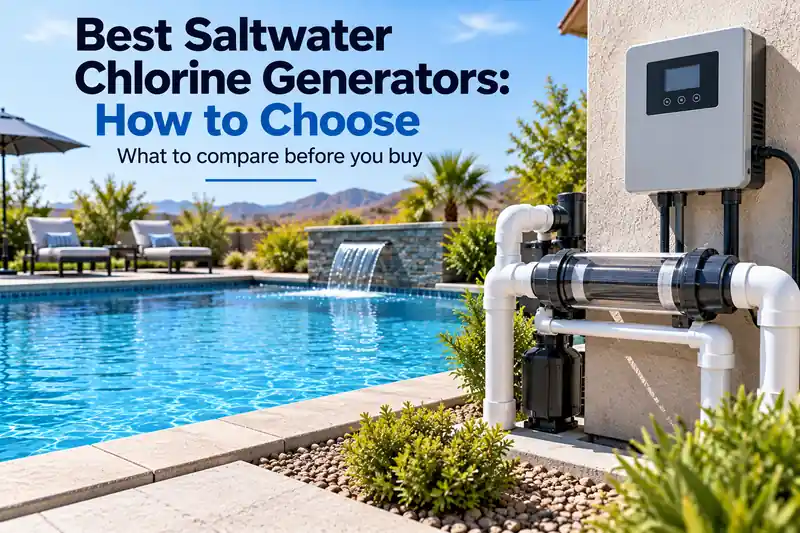
A saltwater chlorine generator can automate much of a pool's routine chlorine production, but choosing the right system requires more than matching a cell to the number of gallons in the pool. Chlorine output, cell capacity, operating salt range, water flow, controls, automation compatibility, replacement-cell cost, and local conditions all matter.
This guide explains the specifications worth comparing so you can choose a saltwater chlorine generator that fits your pool and how you actually operate it.
Quick Answer: How Do You Choose a Saltwater Chlorine Generator?
Choose a saltwater chlorine generator based on your pool's chlorine demand, not just the maximum gallon rating printed on the box. Compare the system's actual chlorine production, rated pool capacity, salt requirements, minimum water flow, automation compatibility and replacement-cell cost.
A system with additional chlorine-production capacity may provide more flexibility during hot weather and heavy pool use. However, the chlorinator must also work with your existing pump, plumbing and equipment controls.
Saltwater Chlorine Generator Buying Guide at a Glance
| Feature | What to Compare | Why It Matters |
|---|---|---|
| Pool capacity | Manufacturer's maximum gallon rating | Provides an initial sizing reference |
| Chlorine production | Pounds or grams produced per 24 hours | Shows the system's actual production capacity |
| Salt requirements | Recommended operating range | Determines the salinity you must maintain |
| Water flow | Minimum and maximum operating requirements | Determines compatibility with your circulation system |
| Output controls | Adjustment range and boost options | Allows production to respond to changing demand |
| Automation | Supported controllers and communication features | Determines integration with existing equipment |
| Maintenance | Scale management and diagnostic information | Helps identify operating problems |
| Ownership cost | Replacement-cell price, warranty and service support | Affects long-term expense |
How Does a Saltwater Chlorine Generator Work?
A saltwater chlorine generator uses dissolved salt in pool water to produce chlorine through electrolysis.
As water passes through the electrolytic cell, the system generates chlorine to sanitize the pool. Chlorine production continues according to the chlorinator's output setting, operating conditions and circulation schedule.
A saltwater pool is therefore still sanitized with chlorine. The difference is that the chlorine is generated by equipment installed in the pool's circulation system rather than relying entirely on manually added chlorine products.
For a broader comparison, see our Saltwater Pool vs. Chlorine Pool guide.
Start With the Correct Cell Size
Salt chlorine generators are commonly marketed according to the maximum pool volume they are designed to serve.
For example, Pentair's IntelliChlor Plus and LT product family includes models with different rated pool capacities.
However, the maximum pool-volume rating should not be the only sizing specification you examine.
Use our Salt Cell Sizing Calculator for an initial estimate, then read What Size Salt Cell Do I Need? for a deeper explanation of sizing.
Why Additional Salt Cell Capacity Can Be Useful
A salt cell does not necessarily have to be sized exactly to the pool's volume.
Choosing additional chlorine-production capacity may allow the system to meet chlorine demand without operating at maximum output throughout the entire circulation schedule.
This can be useful for pools exposed to:
- Strong sunlight.
- Warm water.
- Heavy swimming loads.
- Long swimming seasons.
- Debris and organic contamination.
The goal is not simply to buy the largest cell available. It is to provide enough chlorine-production capacity for your pool's realistic operating conditions while maintaining compatibility with the rest of the system.
Compare Chlorine Output, Not Just Gallon Ratings
Two systems marketed for similar pool sizes may not produce the same amount of chlorine.
When available, compare the manufacturer's maximum chlorine-production specification in pounds or grams per 24 hours.
Compare specifications measured over the same operating period and under the manufacturer's stated conditions.
Example: Comparing Two Hypothetical Salt Systems
Consider a 20,000-gallon pool and two hypothetical chlorinators.
| Specification | System A | System B |
|---|---|---|
| Advertised pool capacity | 25,000 gallons | 40,000 gallons |
| Maximum chlorine production | 0.9 lb per 24 hours | 1.4 lb per 24 hours |
| Production at 50% over 24 hours | 0.45 lb | 0.70 lb |
System B has greater maximum production capacity. Depending on the pool's actual chlorine demand and circulation schedule, it may be able to meet that demand at a lower output setting.
These figures are illustrative and are not specifications for particular products.
Pool Conditions Affect Chlorine Demand
The amount of chlorine a pool needs is not fixed throughout the year.
Demand can increase because of:
- Hot weather.
- High ultraviolet exposure.
- Heavy swimmer use.
- Rain and contaminants.
- Organic debris.
- Inadequate stabilizer levels.
A system that produces enough chlorine during mild weather may require a higher output setting or longer operating time during periods of greater demand.
Regular water testing remains necessary even when chlorine production is automated.
Check the Recommended Salt Level
Salt chlorine generators operate within manufacturer-specified salinity ranges. Those ranges are not identical across every system.
Follow the specification for the exact chlorinator rather than assuming every saltwater pool should be maintained at one universal salt concentration.
Use our Pool Salt Calculator to estimate how much salt is required to reach your target concentration.
Do Not Add Salt Without Testing First
Salt generally remains in the pool until water is removed through draining, splash-out, leaks, backwashing or similar water loss.
Before adding salt, independently test the existing concentration. Then calculate the amount required to reach the chlorinator manufacturer's target.
Our guide How Much Salt Does My Pool Need? explains the calculation.
Example: Calculating a Salt Addition
Suppose a 15,000-gallon pool tests at 2,500 ppm and the chlorinator manufacturer recommends 3,200 ppm.
The required increase is 700 ppm.
Using an approximate conversion of 8.34 pounds of salt per 1,000 gallons for each 1,000 ppm increase:
Salt Needed = 15 × 0.7 × 8.34 = approximately 88 pounds
This is an estimate. Confirm the pool volume, test result and manufacturer's recommended salinity before adding salt. Follow the manufacturer's instructions for distributing and dissolving it.
Minimum Water Flow Matters
A salt cell should generate chlorine only when sufficient water is moving through the system.
Flow requirements are particularly important when using variable-speed pumps at low operating speeds.
Compare the chlorinator's specified minimum flow, maximum recommended flow and any required bypass arrangements.
Do not assume that a chlorinator will produce chlorine at every pump speed simply because water is visibly moving through the plumbing.
Variable-Speed Pump Compatibility
Variable-speed pumps can reduce circulation energy use, but very low pump speeds can become a problem if flow falls below the salt system's required threshold.
The solution is not necessarily to run the pump at high speed all day. Instead, establish a schedule that provides adequate flow whenever chlorine production is required.
See How Long Should You Run a Variable-Speed Pool Pump Each Day? for more information about circulation schedules.
Example: Matching Chlorine Production to Pump Runtime
Suppose a chlorinator can produce 1.2 pounds of chlorine in 24 hours at full output.
At 100% output for eight hours, its theoretical production would be:
1.2 × (8 ÷ 24) = 0.4 pound
At 50% output for the same eight-hour period, theoretical production would be approximately 0.2 pound.
These calculations assume the system operates normally throughout the scheduled period. Actual production depends on flow, salinity, temperature, equipment controls and other operating conditions.
The pump must provide the required water flow whenever the chlorinator is producing chlorine.
Compare Chlorine-Output Controls
A salt system should allow chlorine production to be adjusted as pool conditions change.
Some systems provide broad output steps, while others allow finer adjustments.
Selected systems also offer a temporary boost mode intended to increase chlorine production for a defined period.
Fine adjustment can be useful because chlorine demand changes with weather, season, pool use and circulation time.
However, boost mode does not replace water testing or proper treatment when the pool requires corrective sanitation.
Automation Compatibility
If your pool already has automation, verify ecosystem compatibility before purchasing a chlorinator.
Some salt systems integrate with compatible pool controllers, allowing chlorine-output settings and operating information to be managed alongside other equipment.
Compatibility may depend on the chlorinator model, controller generation, communication connections and software.
Check the manufacturer's supported-equipment list for the exact combination you intend to install.
If automation is part of your equipment plan, see our How Does Pool Automation Work? guide.
Cell Life Matters Because the Cell Is a Wear Item
The electrolytic cell does not last forever. Its coated electrodes gradually wear as chlorine is produced.
That makes replacement-cell cost and availability important parts of long-term ownership.
For more detail, see How Long Do Salt Cells Last?.
Scale Management Is Important
Calcium scale can accumulate on cell surfaces and interfere with chlorine production.
Some systems automatically reverse cell polarity to help reduce buildup.
Automatic polarity reversal can reduce maintenance requirements, but it does not eliminate the need to maintain appropriate water chemistry and inspect the cell.
Follow the manufacturer's cleaning instructions. Unnecessary or overly aggressive acid cleaning can damage the cell's electrode coatings.
Cold Water Can Reduce or Stop Chlorine Production
Salt systems may reduce output or stop producing chlorine when pool water becomes cold.
The temperature threshold varies by manufacturer and model.
If you operate your pool during winter, check the exact system's temperature limitations and maintain an appropriate sanitation plan when the salt cell cannot produce enough chlorine.
Diagnostics Can Make Troubleshooting Easier
Salt systems monitor several operating conditions. Clear diagnostic information can help distinguish a maintenance issue from a component failure.
Useful information may include:
- Salt level.
- Water temperature.
- Flow status.
- Chlorine-output setting.
- Cell condition.
- Error or warning messages.
Compare which information is available directly on the chlorinator, through its controller or through a compatible automation system.
Common Salt Chlorine Generator Problems
| Problem | Possible Cause | Initial Check |
|---|---|---|
| Low chlorine reading | Insufficient production, high demand or water-chemistry issue | Water test results, output setting and circulation time |
| Low-salt warning | Low salinity or inaccurate system reading | Independent salt test and manufacturer diagnostics |
| Flow warning | Insufficient flow or flow-sensing problem | Pump operation, filter condition and specified flow requirements |
| Check-cell warning | Scale, worn electrodes or another cell-related problem | Manufacturer-approved inspection and diagnostic procedure |
| No production in cold weather | Low-temperature operating limit | Water temperature and manufacturer specifications |
| Frequent scale buildup | Water-chemistry conditions or maintenance issue | Water balance and approved cleaning procedure |
Do not bypass flow switches or open electrical equipment to troubleshoot a salt system unless you are qualified to perform that work.
Consider Serviceability, Not Just Initial Price
The initial system price is only one ownership cost.
Before purchasing, investigate:
- Replacement-cell price.
- Availability of replacement sensors.
- Power-supply replacement cost.
- Warranty duration.
- Dealer or service availability.
- Whether individual components can be replaced.
A system with readily available replacement components may be easier to maintain over time than one requiring larger assemblies to be replaced when a single component fails.
Example: Comparing Long-Term Ownership Costs
Consider two hypothetical chlorinators with different initial prices and replacement-cell costs.
| Cost | System A | System B |
|---|---|---|
| Initial equipment purchase | $1,000 | $1,300 |
| One future replacement cell | $700 | $500 |
| Combined equipment cost | $1,700 | $1,800 |
These figures are hypothetical and exclude installation, electricity, salt, maintenance and other replacement components.
They illustrate why the initial purchase price does not provide a complete picture of ownership costs. Actual comparisons should also account for warranty coverage, expected service requirements and the availability of replacement parts.
Popular Salt Chlorine Generator Families
Major pool-equipment manufacturers offer several saltwater chlorination platforms.
Pentair's IntelliChlor family, Hayward's AquaRite platform and Jandy's TruClear products are examples of established product families.
Rather than choosing by brand name alone, compare the exact model's chlorine production, cell capacity, flow requirements, controls, automation integration, warranty and replacement-cell cost.
Compare Saltwater Chlorine Generators on Amazon
Pentair IntelliChlor
IntelliChlor is an established Pentair salt-chlorination platform.
Pentair has introduced newer IntelliChlor Plus and LT products with multiple residential capacity options and a more modular design.
If you are comparing Pentair equipment or shopping for replacement components, check carefully whether a listing is for a complete system, power center, cell only or a particular generation of IntelliChlor.
Verify the current manufacturer's specifications and compatibility information for the exact product before ordering.
Check Pentair IntelliChlor on Amazon
Hayward AquaRite
Hayward AquaRite is another established salt-chlorination platform.
As with any salt system, confirm the exact controller and cell combination rather than purchasing based only on the AquaRite name.
Replacement-cell compatibility is particularly important when working with an existing installation.
Check Hayward AquaRite on Amazon
Salt Chlorine Generator Buying Checklist
- Pool-volume rating.
- Chlorine production per 24 hours.
- Recommended salt concentration.
- Minimum flow requirement.
- Maximum recommended flow.
- Output adjustment range.
- Boost mode.
- Cold-water operation.
- Polarity reversal or other scale-management features.
- Diagnostic information.
- Automation compatibility.
- Replacement-cell price and availability.
- Warranty.
- Local service support.
Frequently Asked Questions
Does a saltwater chlorine generator eliminate the need for chlorine?
No. A saltwater chlorine generator produces chlorine from dissolved salt. The pool is still sanitized with chlorine, but the equipment generates it rather than relying entirely on manually added chlorine products.
Should I choose a salt system rated for more gallons than my pool?
Additional capacity may provide more flexibility during periods of high chlorine demand. Compare actual chlorine production and confirm the system is compatible with your equipment rather than relying on the gallon rating alone.
Can a salt chlorine generator work with a variable-speed pump?
Yes, provided the pump supplies the chlorinator's required water flow whenever chlorine production is enabled. Very low pump speeds may not satisfy the system's minimum-flow requirement.
Do all salt chlorine generators use the same salt level?
No. Recommended salinity varies by manufacturer and model. Follow the specification for your exact chlorinator.
Can a salt system produce chlorine in cold water?
Cold-water operation depends on the model. Some systems reduce output or stop chlorine production below a specified temperature.
Do salt chlorine generators require maintenance?
Yes. Routine maintenance includes water testing, maintaining appropriate salinity and water balance, inspecting the cell and following the manufacturer's cleaning instructions when necessary.
How often does a salt cell need replacement?
Replacement frequency depends on cell design, operating hours, chlorine demand, water chemistry and maintenance. Review the manufacturer's specifications and diagnostic procedures rather than assuming a fixed replacement interval.
Will a salt system automatically maintain the correct chlorine level?
A conventional salt chlorine generator produces chlorine according to its settings and operating schedule. It does not necessarily measure free chlorine or automatically adjust production to maintain a target level. Some compatible automation systems offer additional chemical-control capabilities.
Is a boost mode necessary?
Boost mode can be convenient when temporarily increasing production, but it is not a substitute for testing the water or providing appropriate corrective treatment when needed.
What should I check before buying a replacement cell?
Confirm the exact chlorinator and controller models, manufacturer-approved replacement, pool capacity, chlorine output, plumbing compatibility, warranty and replacement cost.
Bottom Line
Choose a saltwater chlorine generator with enough chlorine-production capacity for your pool's realistic operating conditions.
Then compare salt requirements, water-flow limits, output controls, automation compatibility, diagnostics, cell serviceability, replacement cost and warranty.
Evaluating the complete system and its long-term maintenance requirements provides a more useful comparison than choosing solely by the maximum pool-volume rating printed on the box.
How We Research
Pool Equipment Lab evaluates pool equipment using manufacturer specifications, documentation, compatibility requirements, operating costs, warranty information, and owner feedback when relevant. We do not claim hands-on testing unless we actually performed it.