
Best Gas Pool Heaters: How to Choose
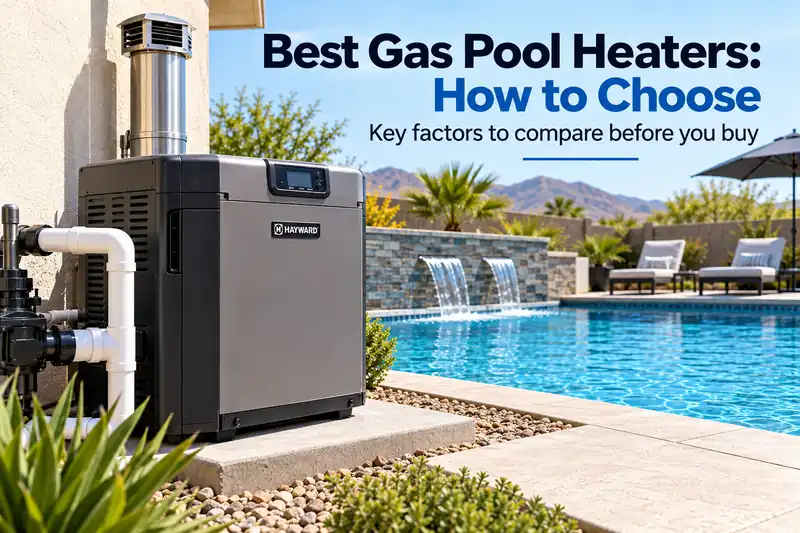
Gas pool heaters are popular when fast heating and dependable performance across a wide range of weather conditions are priorities. But BTU output alone does not determine which heater makes sense for a particular pool.
This guide explains how to compare gas pool heaters by capacity, efficiency, fuel type, heat exchanger construction, emissions requirements, controls, installation needs, and long-term operating considerations.
Quick Answer: How Do You Choose a Gas Pool Heater?
Choose a gas pool heater by calculating the heating capacity your pool or spa needs, then confirming that the heater is compatible with your available fuel supply, plumbing, installation location and local emissions requirements. Compare usable BTU output, thermal efficiency, heat exchanger construction, automation compatibility, warranty and service availability.
A larger gas heater can raise water temperature faster when other conditions are comparable, but the highest BTU rating is not automatically the right choice. Gas-line capacity, venting, equipment clearances and installation costs can affect which models are practical.
Gas Pool Heater Buying Guide at a Glance
| Factor | What to Check | Why It Matters |
|---|---|---|
| Heating capacity | BTU/h input and thermal efficiency | Determines usable heating output |
| Pool and spa size | Water volume and desired temperature increase | Affects heating time |
| Fuel | Natural gas or propane configuration | Determines fuel-supply requirements |
| Gas supply | Meter, regulator, pressure and pipe sizing | Determines whether the installation can support the heater |
| Heat exchanger | Material and water-chemistry requirements | Affects maintenance and service considerations |
| Emissions | Applicable Low-NOx requirements | May limit which models can be installed |
| Water flow | Manufacturer's required operating range | Determines circulation-system compatibility |
| Installation | Venting, clearances and equipment-pad space | Affects safety and installation cost |
| Ownership | Fuel cost, warranty and local service | Affects long-term expense |
How Gas Pool Heaters Work
A gas pool heater burns natural gas or propane and transfers the resulting heat into water flowing through the heater's heat exchanger.
Unlike a heat pump, it does not depend on extracting useful heat from the surrounding outdoor air.
That allows gas heaters to deliver relatively high heating output and makes them useful when fast temperature increases are important.
If you are still deciding between heating technologies, start with our Gas Pool Heater vs Heat Pump comparison.
Start With BTU Output
Gas pool-heater capacity is normally expressed in British thermal units per hour, or BTU/h.
Pay attention to the difference between fuel input and usable heating output.
A heater's input rating describes how much fuel energy it consumes. Its thermal efficiency determines how much of that energy is transferred into the pool water.
Usable Heating Output = BTU/h Input × Thermal Efficiency
For example, a hypothetical 300,000 BTU/h heater operating at 84% thermal efficiency delivers approximately 252,000 BTU/h of useful heat under its rated conditions.
Use our Pool Heater Sizing Calculator for an initial estimate, then read What Size Pool Heater Do I Need? for the factors that affect sizing.
Does a Larger Gas Heater Heat the Pool Faster?
When other conditions are comparable, additional usable heating output can reduce the time required to raise water temperature.
That can make higher-output gas heaters useful for spas and pools that are heated on demand rather than maintained continuously at a high temperature.
However, heating time also depends on pool volume, starting temperature, weather, evaporation and heat loss.
Example: Heating a 15,000-Gallon Pool
Consider a hypothetical 15,000-gallon pool that needs a 10°F temperature increase.
Using approximately 8.34 pounds per gallon for the weight of water:
Required Heat = 15,000 × 8.34 × 10 = 1,251,000 BTU
Now compare two hypothetical gas heaters, both operating at 84% thermal efficiency.
| Specification | Heater A | Heater B |
|---|---|---|
| Fuel input | 250,000 BTU/h | 400,000 BTU/h |
| Thermal efficiency | 84% | 84% |
| Usable output | 210,000 BTU/h | 336,000 BTU/h |
| Ideal heating time | Approximately 6.0 hours | Approximately 3.7 hours |
These calculations assume no heat loss and continuous operation at rated output. Actual heating will generally take longer because pools lose heat while the heater operates.
The larger heater also requires an installation capable of supplying its rated fuel input.
Our guide to how long it takes to heat a pool explains the additional factors.
Natural Gas vs Propane
Many gas pool-heater families are available in natural-gas and propane configurations.
The practical choice usually depends on which fuel is available at the property, the cost of that fuel and the installation requirements.
| Consideration | Natural Gas | Propane |
|---|---|---|
| Fuel source | Utility gas service | On-site storage tank |
| Availability | Requires an existing or new utility connection | Can serve properties without natural-gas service |
| Installation | Meter, regulator and gas-piping capacity must be checked | Tank, regulator and gas-piping capacity must be checked |
| Ongoing cost | Depends on local utility rates | Depends on delivered propane pricing |
| Refueling | Continuous utility supply | Tank requires refilling |
Do not assume a heater configured for one fuel can simply be connected to the other. Purchase the correct configuration and follow the manufacturer's installation requirements.
Compare Thermal Efficiency
Thermal efficiency describes how much of the fuel's energy becomes useful heat in the pool water rather than being lost through combustion and exhaust.
Efficiency varies by heater design and model.
For example, when comparing hypothetical heaters with identical 300,000 BTU/h input ratings:
| Specification | Heater A | Heater B |
|---|---|---|
| Fuel input | 300,000 BTU/h | 300,000 BTU/h |
| Thermal efficiency | 82% | 90% |
| Usable heating output | 246,000 BTU/h | 270,000 BTU/h |
At the same fuel input, the higher-efficiency heater transfers more heat into the pool water.
However, purchase price, installation requirements and expected runtime should also be considered when evaluating efficiency.
Use our Pool Heater Operating Cost Calculator to estimate how heater efficiency, fuel cost and runtime affect operating expenses.
Estimate Fuel Cost Before Buying
Gas-heater operating cost depends on fuel price, heater input and runtime.
Natural gas is commonly billed in therms. One therm equals 100,000 BTU of fuel energy.
Example: Natural-Gas Heating Cost
Suppose a hypothetical heater has a 300,000 BTU/h input rating and natural gas costs $1.50 per therm.
The heater consumes approximately three therms per hour at rated input.
Hourly Fuel Cost = 3 × $1.50 = $4.50
| Runtime | Illustrative Fuel Cost |
|---|---|
| 1 hour | $4.50 |
| 3 hours | $13.50 |
| 5 hours | $22.50 |
| 10 hours | $45.00 |
This example excludes utility fees, taxes, installation costs and other equipment electricity use. Actual costs depend on local fuel rates and how long the heater operates.
For a broader comparison, see How Much Does It Cost to Heat a Pool?.
Gas Heater vs Heat Pump Operating Cost
Gas heaters and heat pumps use fundamentally different heating methods, so purchase price alone is not a useful operating-cost comparison.
A heat pump may be suitable for maintaining pool temperature efficiently under favorable outdoor conditions, while a gas heater can provide relatively rapid heating when that is the priority.
Local fuel and electricity prices, weather, swimming-season length and heating frequency affect the comparison.
Our Pool Heat Pump vs Gas Heater Operating Cost guide examines these tradeoffs in more detail.
Pay Attention to the Heat Exchanger
The heat exchanger transfers combustion heat into the circulating pool water.
Materials and designs vary by manufacturer and model. Some residential heaters use copper heat exchangers, while other configurations use different materials or offer upgraded exchanger options.
When comparing models, consider:
- Heat exchanger material.
- Manufacturer's water-chemistry requirements.
- Saltwater-system compatibility.
- Warranty terms.
- Replacement cost and serviceability.
Saltwater pools still require proper water chemistry. A heater described as suitable for saltwater should not be assumed immune to corrosion or damage from improperly maintained water.
Low-NOx Requirements Can Determine Which Heater You Can Buy
Gas appliances produce combustion emissions, and some jurisdictions impose nitrogen-oxide emission requirements.
These requirements can affect which heaters are legal to sell or install in a particular location.
A model available in one state or county may not be approved for installation elsewhere.
Before ordering, confirm the applicable requirements with the local permitting authority or a qualified installer. Verify that the exact heater model meets those requirements.
Check the Gas Supply Before Buying
A high-output pool heater requires an adequate fuel supply.
The existing gas meter, regulator, pipe diameter, pipe length, pressure and other connected appliances can affect whether the current installation can supply the heater correctly.
This should be evaluated before purchasing equipment. A larger heater may require gas-line upgrades or other installation work.
Example: Why Gas-Line Capacity Matters
Suppose a homeowner replaces a 200,000 BTU/h heater with a 400,000 BTU/h model.
The new heater's rated fuel demand is twice as high. That does not establish whether the existing gas line is adequate.
A qualified installer must evaluate the actual gas supply, piping arrangement, pressure requirements and other connected appliances using the applicable installation standards.
Do not select gas-pipe diameter from heater BTU rating alone.
Venting and Equipment Clearances Matter
Gas heaters produce combustion exhaust and must be installed according to the manufacturer's instructions and applicable codes.
Requirements differ depending on the heater, whether the installation is indoors or outdoors and the venting configuration.
Installation considerations include:
- Approved venting configuration.
- Combustion-air requirements.
- Clearances from walls and structures.
- Clearances from doors, windows and air intakes.
- Equipment-pad space.
- Service access.
- Electrical requirements.
Never choose an installation location solely because the heater physically fits there. Improper venting can create dangerous combustion-gas and carbon-monoxide hazards.
Water Flow Must Match the Heater
A gas heater has a manufacturer-specified operating flow range.
The circulation system must provide adequate flow whenever the heater operates. Compare the heater's requirements with the pump, filter, plumbing, valves and expected operating speeds.
If you use a variable-speed pump, see our guide to how many GPM a variable-speed pool pump should run.
Variable-Speed Pump Example
A variable-speed pump may operate at a low speed for routine filtration but need a higher speed while the heater is running.
If the pool uses automation, a heating program may be able to coordinate pump speed and heater operation.
Establish the correct speed using the heater's flow requirements and the actual hydraulic performance of the installation. Do not assume that one RPM setting works for every pool.
Automation Compatibility
If your pool has automation, verify how the heater integrates with it before buying.
Pool automation can coordinate heating with pump operation and provide centralized temperature control. Some heaters also offer their own connected controls.
Depending on the equipment, integration may involve a compatible communication connection or a supported heater-control interface.
Check the manufacturer's documentation for the exact heater and automation-controller combination.
See Pool Automation and Pool Heaters for more information.
Consider How You Actually Use the Pool
Two pools of similar size can have different heating requirements.
A homeowner who maintains a steady swimming temperature for months may prioritize operating efficiency differently from someone who occasionally heats a spa for a few hours.
| Usage Pattern | What to Evaluate |
|---|---|
| Occasional weekend swimming | Heating time, fuel cost per session and pool-cover use |
| Frequent swimming | Seasonal fuel cost, efficiency and temperature maintenance |
| Attached spa | Desired heating speed, plumbing configuration and automation |
| Extended swimming season | Heating performance, weather exposure and total operating cost |
| Cold-weather operation | Heat loss, freeze protection and installation requirements |
A Pool Cover Still Matters With a Large Gas Heater
A powerful heater does not eliminate heat loss.
Evaporation, wind, cool nighttime air and exposed surface area can remove heat from the pool.
A suitable pool cover can reduce heat loss and lower the amount of fuel required to reach and maintain the desired temperature.
When estimating heating cost, consider whether the pool will be covered when not in use.
Warranty and Local Service Matter
A gas pool heater contains combustion, water, electrical and control components. Service availability deserves consideration alongside performance specifications.
Before purchasing, compare:
- Manufacturer warranty.
- Heat-exchanger coverage.
- Parts and labor terms.
- Professional-installation requirements.
- Authorized service availability.
- Replacement-parts availability.
Check whether warranty coverage differs by installation type, sales channel or installer qualifications.
Common Gas Pool Heater Problems
| Problem | Possible Cause | Initial Check |
|---|---|---|
| Heater will not start | Control setting, insufficient flow or equipment fault | Temperature setting, pump operation and displayed error messages |
| Heater starts and stops | Flow issue, control problem or safety shutdown | Manufacturer's diagnostic information and circulation-system condition |
| Pool heats slowly | High heat loss, insufficient output or operating issue | Pool-cover use, weather, heater rating and operating status |
| Heater displays a flow error | Insufficient circulation or flow-sensing problem | Pump operation, filter condition and manufacturer flow requirements |
| Unexpectedly high fuel bill | Long runtime, heat loss or fuel-price changes | Heating schedule, cover use and fuel rates |
Never bypass a heater's safety switches or attempt combustion-system repairs without appropriate qualifications. If you smell gas, leave the area and follow your gas utility's emergency instructions.
Popular Gas Pool Heater Brands
Major residential gas pool-heater manufacturers include Pentair, Hayward and Raypak.
Each offers multiple capacities and configurations, so the brand name alone should not determine the purchase.
Compare the exact model's capacity, efficiency, fuel configuration, emissions compliance, heat exchanger, controls, warranty and installation requirements.
Compare Gas Pool Heaters on Amazon
Specific Heater Families to Compare
Depending on the required capacity and installation, common product families include Pentair MasterTemp, Hayward Universal H-Series and Raypak residential gas heaters.
Check the exact model's fuel type, capacity, installation requirements and applicable emissions compliance before ordering.
Check Pentair MasterTemp on Amazon
Check Hayward Universal H-Series on Amazon
Check Raypak Pool Heaters on Amazon
Gas Pool Heater Buying Checklist
- Required BTU input and usable heating output.
- Pool and spa heating requirements.
- Natural-gas or propane configuration.
- Thermal efficiency.
- Expected heating time.
- Heat exchanger construction.
- Applicable Low-NOx requirements.
- Available gas-supply capacity.
- Water-flow requirements.
- Venting requirements.
- Equipment-pad clearances.
- Automation compatibility.
- Warranty terms.
- Authorized local service.
Frequently Asked Questions
What size gas pool heater do I need?
Heater sizing depends on pool volume, desired temperature increase, expected heating time and heat loss. Calculate the required heating output and confirm that your fuel supply and installation can support the selected model.
Does a 400,000 BTU heater heat a pool faster than a 250,000 BTU heater?
When other conditions are comparable, the heater with greater usable output can raise water temperature faster. Actual heating time depends on efficiency, pool volume and heat loss.
Is natural gas or propane better for a pool heater?
The practical choice depends on fuel availability, local prices and installation requirements. Purchase a heater configured for the fuel you intend to use.
How much does it cost to run a gas pool heater?
Operating cost depends on the heater's fuel-input rating, local fuel price and runtime. For natural gas, divide the BTU/h input by 100,000 to estimate therms consumed per hour at rated input.
Can I install a gas pool heater myself?
Gas supply, combustion, venting, electrical connections and applicable permits create significant safety requirements. Installation should be performed by appropriately qualified professionals in accordance with manufacturer instructions and local requirements.
Can a gas heater work with a variable-speed pool pump?
Yes, provided the pump supplies the heater's required water flow whenever it operates. The appropriate pump speed depends on the actual plumbing and equipment configuration.
Do gas pool heaters work in cold weather?
Gas heaters do not depend on extracting heat from outdoor air in the same way heat pumps do. However, cold weather increases pool heat loss and can extend heating time or increase fuel consumption.
Does a saltwater pool require a special gas heater?
Check the manufacturer's saltwater compatibility and water-chemistry requirements. Proper water balance remains essential regardless of heat exchanger material.
What is a Low-NOx gas pool heater?
A Low-NOx heater is designed to meet specified nitrogen-oxide emission limits. The exact requirements vary by jurisdiction, so verify local rules and the selected model's compliance before purchasing.
Will a pool cover reduce gas-heater costs?
A suitable cover can reduce evaporation and other heat losses, lowering the amount of heating required to maintain the desired pool temperature.
Bottom Line
Choose a gas pool heater with enough usable heating output for your pool or spa and the way you intend to use it.
Then confirm that the available fuel supply, plumbing, venting, equipment-pad space and local emissions requirements support the installation.
Compare thermal efficiency, heat exchanger construction, operating cost, automation compatibility, warranty and local service availability before making a purchase.
How We Research
Pool Equipment Lab evaluates pool equipment using manufacturer specifications, documentation, compatibility requirements, operating costs, warranty information, and owner feedback when relevant. We do not claim hands-on testing unless we actually performed it.