
Best Pool Heat Pumps: How to Choose
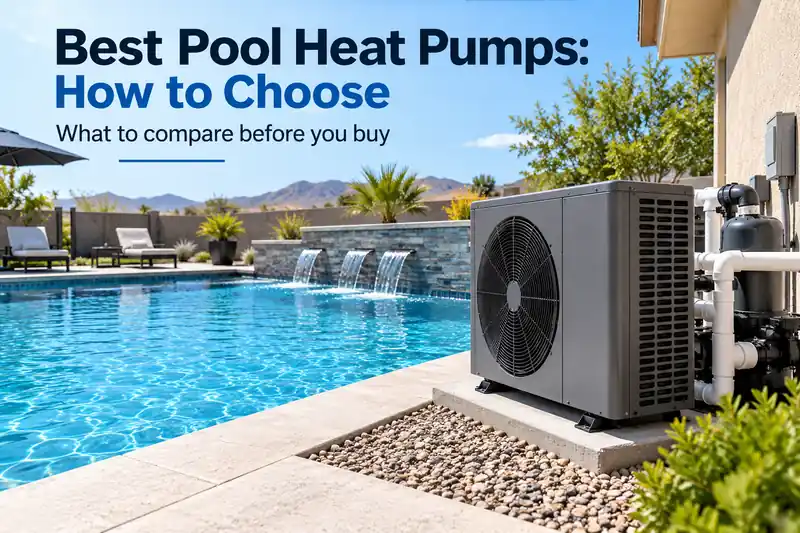
Pool heat pumps can provide efficient, steady pool heating, but choosing one involves more than comparing the largest BTU number on the specification sheet. Climate, pool size, desired temperature, efficiency, airflow, noise, automation compatibility, and installation conditions can all affect how well a heat pump performs.
This guide explains the most important specifications and practical considerations to compare before choosing a pool heat pump.
Quick Answer: How Do You Choose a Pool Heat Pump?
Choose a pool heat pump based on your pool's heating requirements, local climate and intended swimming season. Compare heating capacity and efficiency under the same test conditions, then evaluate cold-weather performance, electrical requirements, water flow, installation clearances, noise and warranty coverage.
A heat pump that performs well in warm weather may deliver less heat during cooler conditions. Pool surface area, wind exposure, nighttime temperatures and whether you use a pool cover can be just as important as the advertised BTU rating.
Pool Heat Pump Buying Guide at a Glance
| Factor | What to Compare | Why It Matters |
|---|---|---|
| Heating capacity | BTU/h output under stated test conditions | Determines how quickly heat can be added to the pool |
| Efficiency | Coefficient of performance (COP) | Indicates heat delivered relative to electricity consumed |
| Climate | Capacity and COP at different air temperatures | Shows how performance may change throughout the season |
| Cold-weather operation | Minimum operating temperature and defrost features | Affects shoulder-season heating |
| Heat exchanger | Material and water-chemistry requirements | Affects corrosion resistance and maintenance |
| Noise | Published sound rating and installation location | Affects nearby patios, bedrooms and neighboring properties |
| Installation | Electrical supply, water flow and airflow clearances | Determines whether the unit fits the existing equipment setup |
| Ownership | Warranty, service support and expected operating cost | Affects long-term expense |
How Pool Heat Pumps Work
A pool heat pump uses electricity to operate a refrigeration cycle that captures heat from the surrounding outdoor air and transfers it into the pool water.
Rather than generating most of its heat directly through electrical resistance, it moves existing heat from one place to another.
This operating principle explains why heat pumps can be efficient for maintaining pool temperature over extended periods. It also explains why outdoor air temperature and humidity affect performance.
If you are still deciding between heating technologies, start with our gas pool heater vs heat pump comparison.
Start With Heating Capacity
Pool heat-pump output is normally expressed in BTUs per hour. Higher output allows the unit to transfer more heat into the water under its specified test conditions.
However, pool volume alone does not determine the required heater size.
Surface area, desired temperature increase, nighttime temperature, wind exposure, humidity, swimming-season length and pool-cover use can all affect heating requirements.
Use our Pool Heater Sizing Calculator for an initial estimate, and see What Size Pool Heater Do I Need? for a deeper explanation of heater sizing.
Should You Oversize a Pool Heat Pump?
Additional heating capacity can be useful because a larger heat pump may recover lost heat faster and provide more flexibility when outdoor conditions become less favorable.
However, buying the largest available unit is not automatically the right solution.
Electrical requirements, plumbing flow, equipment-pad space, airflow clearances, purchase price and the actual heating load should all be considered.
Proper sizing should be based on your pool and operating conditions rather than assuming that more advertised BTUs always produce a better result.
Compare Efficiency Using COP
Pool heat-pump efficiency is commonly expressed as coefficient of performance, or COP.
COP compares the heat delivered to the electrical energy consumed.
COP = Heat Delivered ÷ Electrical Energy Consumed
A COP of 5 means that, under the specified test conditions, the heat pump delivers five units of heat for every unit of electrical energy consumed.
The important qualification is that COP changes with outdoor temperature, humidity and water temperature. Ratings from different test conditions should not be treated as direct comparisons.
Look for efficiency and heating-capacity ratings produced under standardized conditions, including AHRI-certified performance data when available.
Example: Comparing Two Heat Pumps at the Same Test Conditions
Consider two hypothetical heat pumps, each delivering 100,000 BTU/h under identical test conditions.
| Specification | Heat Pump A | Heat Pump B |
|---|---|---|
| Heating output | 100,000 BTU/h | 100,000 BTU/h |
| COP | 4.0 | 5.0 |
| Approximate electrical input | 7.33 kW | 5.86 kW |
| Electricity used in 8 hours | 58.6 kWh | 46.9 kWh |
At an illustrative electricity rate of $0.18 per kWh, eight hours of operation would cost approximately $10.55 for Heat Pump A and $8.44 for Heat Pump B.
These figures are hypothetical. Actual electricity consumption depends on the equipment, operating conditions and any variable-capacity controls.
Climate Has a Major Effect on Performance
Because a heat pump extracts heat from outdoor air, its available heating capacity generally changes as outdoor conditions change.
Warm, humid conditions are favorable for pool heat pumps. Colder conditions make heat extraction more difficult and can reduce both heating capacity and efficiency.
This does not mean a heat pump cannot work in a cooler climate. It means climate should be considered when sizing the equipment and setting expectations for heating speed and swimming-season length.
Example: Why Your Location Matters
Consider two identical 15,000-gallon pools, one in a warm coastal climate and the other in a dry location with large day-to-night temperature changes.
Even if both pools start at the same water temperature, their heat pumps may operate differently because outdoor air temperature, humidity, wind and overnight heat loss differ.
Compare manufacturer performance data at conditions representative of your intended swimming season rather than relying only on the highest advertised output.
Minimum Operating Temperature Matters
If you plan to heat the pool during colder portions of the year, compare each manufacturer's stated operating range and cold-weather features.
Some models include automatic defrost systems designed to help the unit operate as outdoor temperatures fall.
A heat pump intended mainly for warm-season temperature maintenance may have different requirements than one expected to extend swimming well into colder weather.
Check both the minimum operating temperature and the heating capacity available at the temperatures you expect to encounter.
Heat Pumps Generally Favor Temperature Maintenance Over Rapid Heating
Heat pumps are particularly suited to pools where the owner establishes a target temperature and allows the system to maintain it.
They generally do not provide the same rapid temperature increase associated with a large gas heater.
See How Long Does It Take to Heat a Pool? for the variables that determine heating time.
Example: Estimating Heat-Up Time
Suppose a 12,000-gallon pool needs a 5°F temperature increase.
Using approximately 8.34 pounds per gallon for the weight of water:
Required Heat = 12,000 × 8.34 × 5 = 500,400 BTU
If a heat pump delivers 100,000 BTU/h under the actual operating conditions, the ideal heating time would be approximately five hours.
In practice, heat loss, changing outdoor conditions and equipment performance can extend that time.
Do not use the heat pump's maximum advertised output unless it applies to the conditions in which the pool will be heated.
Operating Cost Can Matter More Than Purchase Price
The least expensive heater to purchase is not necessarily the least expensive system to own.
Heat-pump operating cost depends on:
- Electricity rates.
- Heat-pump efficiency.
- Outdoor temperature.
- Desired water temperature.
- Pool surface area.
- Wind exposure.
- Pool-cover use.
- Daily and seasonal runtime.
Estimate operating expenses with our Pool Heater Operating Cost Calculator.
For a direct comparison of the two major heating technologies, see Pool Heat Pump vs Gas Heater Operating Cost.
Look for a Corrosion-Resistant Heat Exchanger
The heat exchanger transfers energy from the refrigeration system into the pool water, making its construction an important specification.
Titanium is widely used in pool heat pumps because of its corrosion resistance. This is particularly relevant for chemically treated and saltwater pools.
However, a titanium heat exchanger does not eliminate the need for proper water chemistry.
Check the manufacturer's water-chemistry requirements and warranty exclusions before choosing a model.
Noise Can Matter More Than You Expect
A pool heat pump contains a compressor and fan, so it produces operating noise.
This may be relatively unimportant on a remote equipment pad but much more noticeable when the equipment is close to a patio, bedroom, neighboring property or outdoor entertaining area.
When manufacturers publish sound ratings, compare them under similar operating conditions.
Also consider where the unit will be installed rather than evaluating the specification in isolation.
Airflow and Equipment-Pad Space Are Critical
A heat pump needs access to a large volume of outdoor air.
Restricted airflow can reduce performance and may cause operating problems.
Follow the manufacturer's required clearances rather than squeezing the unit into an enclosure simply because the plumbing connections fit.
Check the installation manual for the exact model before finalizing equipment-pad placement.
Check Electrical Requirements Before Buying
Pool heat pumps can represent substantial electrical loads.
Evaluate the required voltage, circuit capacity, wiring, disconnect and applicable electrical requirements before purchasing.
An attractive equipment price can become less attractive if the existing electrical service requires significant upgrades.
Have a qualified electrician evaluate the installation and follow the manufacturer's instructions and applicable electrical codes.
Make Sure Your Pump Can Provide the Required Water Flow
Heat pumps specify acceptable water-flow ranges.
Too little flow can prevent proper operation, while excessive flow may require plumbing changes or a bypass, depending on the equipment.
If your pool uses a variable-speed pump, its operating speed must provide enough flow whenever the heater is running.
Our variable-speed pump GPM guide explains why required flow should determine pump settings rather than choosing an arbitrary RPM.
Example: Variable-Speed Pump Scheduling
Suppose your pool pump normally runs at a low speed for filtration, but the heat pump requires more water flow than that setting provides.
A compatible automation system may be able to increase pump speed when heating is requested, then return to the normal filtration setting afterward.
The correct speed must be established from the heater's flow requirements and the actual hydraulic performance of your installation.
Automation Compatibility
If the pool already has automation, or you expect to add it, verify heater compatibility before buying.
Automation can coordinate heating with the circulation pump and other equipment. Some systems also provide remote temperature adjustment and operating information.
Check the manufacturer's supported equipment and communication requirements for the exact heat pump and automation-controller combination.
See our Pool Automation and Pool Heaters guide for more information.
Heat-Only vs Heat-and-Cool Models
Some pool heat pumps only heat the water. Others are reversible and can also cool it.
Cooling can be useful in very hot climates where pool water becomes uncomfortably warm during summer. It may also be useful for pools with dark finishes or limited nighttime cooling.
| Feature | Heat-Only | Heat-and-Cool |
|---|---|---|
| Raises pool temperature | Yes | Yes |
| Actively cools pool water | No | Yes |
| Equipment requirements | Heating system | Reversible heating and cooling system |
| What to evaluate | Heating performance and efficiency | Heating and cooling capacity, efficiency and controls |
If cooling is not useful in your climate, paying extra for a heat-and-cool model may provide little practical benefit.
What About Hybrid Pool Heaters?
Hybrid systems combine heat-pump technology with gas heating.
The objective is to combine the efficiency of heat-pump operation under suitable conditions with the faster temperature recovery available from gas.
Hybrid equipment may be useful where both operating efficiency and rapid heating are priorities, but equipment cost, installation complexity, fuel availability and maintenance should all be considered.
Compare Warranty and Service Availability
A pool heat pump is a major piece of equipment, so warranty terms deserve attention.
Compare:
- Overall warranty duration.
- Heat-exchanger coverage.
- Parts coverage.
- Labor coverage.
- Installation requirements.
- Whether professional installation is required for full coverage.
- Availability of authorized service in your area.
A strong specification sheet is less useful if qualified service and replacement parts are difficult to obtain locally.
Pool Cover Use Can Change the Heating Load
Evaporation is a major source of pool heat loss.
A pool cover can reduce that loss, especially overnight and during windy conditions.
That means heater performance should not be considered separately from how the pool is operated.
A correctly sized heat pump paired with effective heat retention may perform better than a larger heater on an uncovered pool experiencing substantial ongoing heat loss.
How Much Does a Pool Heat Pump Cost to Operate?
There is no universal operating-cost figure because electricity prices, weather, pool size, temperature settings, efficiency and runtime vary considerably.
Rather than relying on a generic monthly estimate, calculate expected costs using your local electricity rate and anticipated operating conditions.
Our guide to how much it costs to heat a pool explains the major variables.
Common Pool Heat Pump Problems
| Problem | Possible Cause | Initial Check |
|---|---|---|
| Pool heats slowly | High heat loss, reduced cold-weather capacity or insufficient heating time | Outdoor conditions, cover use and rated output |
| Low-flow warning | Insufficient circulation or flow-sensing problem | Pump operation, filter condition and required flow |
| Unit stops in cold weather | Low-temperature operating limit or defrost operation | Outdoor temperature and manufacturer documentation |
| Unexpectedly high electricity use | Long runtime, high temperature setting or unfavorable operating conditions | Heating schedule, electricity rate and cover use |
| Excessive operating noise | Installation issue, vibration or equipment fault | Manufacturer guidance and qualified service inspection |
| Water near equipment | Normal condensation or a plumbing problem | Manufacturer's condensate guidance and inspection for leaks |
Do not open electrical or sealed refrigeration components unless you are qualified to service them.
Pool Heat Pump Buying Checklist
- Required heating capacity.
- BTU output under comparable test conditions.
- COP under comparable test conditions.
- Cold-weather heating performance.
- Minimum operating temperature.
- Heat exchanger material.
- Heat-only or heat-and-cool capability.
- Published sound level.
- Electrical requirements.
- Required water flow.
- Installation and airflow clearances.
- Automation compatibility.
- Warranty terms.
- Local service availability.
For additional options, you can compare pool heat pumps on Amazon.
Compare Pool Heat Pumps on Amazon
Frequently Asked Questions
What size heat pump do I need for my pool?
Size depends on pool volume, surface area, desired temperature, local climate, wind exposure, swimming-season length and pool-cover use. Compare the unit's rated heating output under conditions representative of your location.
What does COP mean on a pool heat pump?
COP stands for coefficient of performance. It compares useful heat delivered with electrical energy consumed. Compare COP ratings only when they are measured under equivalent test conditions.
Will a pool heat pump work in cold weather?
Some models are designed to operate in cooler weather, but available heating capacity and efficiency generally decrease as outdoor temperatures fall. Check the exact model's operating range and cold-weather performance data.
How long does a heat pump take to warm a pool?
Heating time depends on pool volume, required temperature increase, actual heating output and ongoing heat loss. Manufacturer-rated output may differ from performance under your local conditions.
Can a pool heat pump cool the water?
Only models specifically designed with cooling capability can actively cool pool water. Check whether the product is heat-only or heat-and-cool.
Can I use a heat pump with a saltwater pool?
Many pool heat pumps use corrosion-resistant heat exchangers suitable for saltwater applications. Confirm the exact model's compatibility and maintain water chemistry within the manufacturer's specified limits.
Does a heat pump work with a variable-speed pool pump?
Yes, provided the circulation pump supplies the heater's required water flow whenever it operates. The correct pump speed depends on the actual equipment and plumbing configuration.
Does a pool heat pump need its own electrical circuit?
Electrical requirements vary by model. Have a qualified electrician verify the required circuit, wiring, protection and disconnect arrangements before installation.
Is a pool heat pump noisy?
Heat pumps produce compressor and fan noise. Compare published sound ratings under similar conditions and consider the distance from patios, bedrooms and neighboring properties.
Will a pool cover reduce heat-pump operating costs?
A suitable pool cover can reduce evaporation and heat loss, potentially shortening the time the heat pump must operate to maintain the desired temperature.
Bottom Line
Choose a pool heat pump with enough heating capacity for your pool, climate and intended swimming season.
Compare capacity and COP under equivalent test conditions, then evaluate cold-weather performance, electrical requirements, water flow, installation clearances, automation compatibility, warranty and local service support.
Consider the complete heating setup, including pool-cover use and expected operating conditions, rather than selecting a heat pump solely by its highest advertised BTU rating or purchase price.
How We Research
Pool Equipment Lab evaluates pool equipment using manufacturer specifications, documentation, compatibility requirements, operating costs, warranty information, and owner feedback when relevant. We do not claim hands-on testing unless we actually performed it.