
Why Is My Pool Filter Pressure High? Causes and Fixes
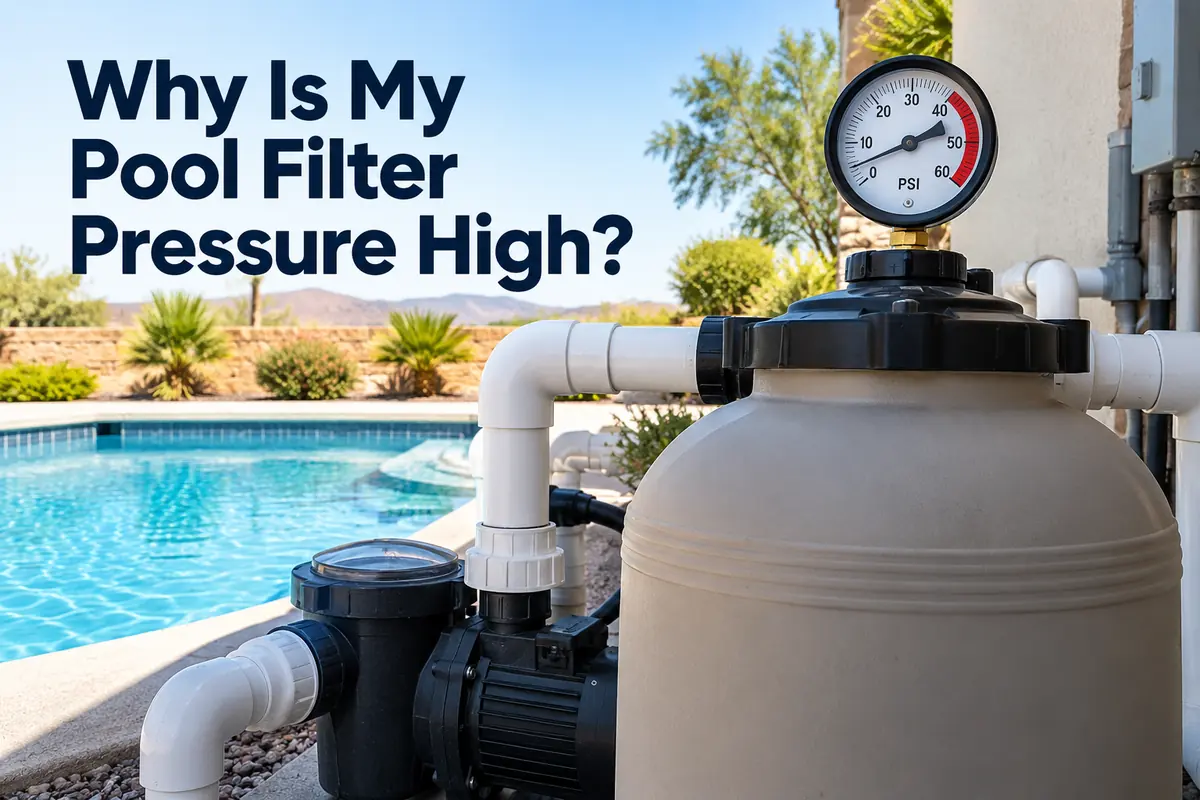
A high reading on the pool filter pressure gauge does not automatically mean the filter is failing. Pressure is a measurement of resistance in the circulation system, and the most useful comparison is usually your own filter's pressure when it is clean and operating at the same pump speed.
If pressure has climbed significantly above that baseline, the filter or another part of the return side of the system may be restricting flow.
Quick Answer: Why Is My Pool Filter Pressure High?
High pool filter pressure usually means the circulation system is encountering more resistance than it did under normal operating conditions. A dirty filter is a common cause, but restricted return plumbing, incorrect valve positions, excessive pump speed and other equipment problems can also increase pressure.
There is no single PSI reading that is normal for every swimming pool. The most useful reference is your own filter's clean starting pressure, recorded at a consistent pump speed and with the system configured normally.
If pressure has increased significantly above that baseline, check the filter manufacturer's cleaning criteria. If cleaning does not restore normal pressure, investigate the rest of the circulation system rather than repeatedly cleaning or replacing the filtration media.
High Pool Filter Pressure: Symptoms and Possible Causes
| Symptom | Possible Cause | What to Check |
|---|---|---|
| Pressure gradually rises over time | Normal debris accumulation in the filter. | Clean or backwash according to manufacturer instructions. |
| Pressure rises quickly after cleaning | Heavy debris, algae or embedded deposits. | Pool-water condition and filter media. |
| Pressure is high immediately after service | Incorrect valve position, assembly problem or changed operating conditions. | Review what changed during service. |
| Pressure is high and return flow is weak | Dirty filter or restriction downstream of the pump. | Filter condition, valves and return plumbing. |
| Pressure increases when pump RPM increases | Greater hydraulic resistance at higher flow. | Compare readings at the same pump speed. |
| Pressure is unusually low and flow is poor | Possible suction-side restriction, inadequate water supply or pump problem. | Skimmer baskets, pump basket, water level and pump operation. |
| Gauge reading is inconsistent or does not return to zero | Possible pressure-gauge problem. | Inspect or replace the gauge as appropriate. |
What Is Normal Pool Filter Pressure?
There is no single PSI number that is normal for every swimming pool. Plumbing layout, pipe diameter, filter type, heaters, valves, water features and pump speed all influence pressure.
The useful number is your system's clean starting pressure.
Record the pressure after the filter has been properly cleaned and the system is operating normally. If you have a variable-speed pump, record the RPM at the same time.
For a broader explanation of filter operation, sizing, maintenance and pressure, see our Complete Guide to Pool Filters.
Example: Establishing Your Clean-Filter Baseline
Suppose your filter reads 12 PSI immediately after a proper cleaning, with the pump operating at 2,400 RPM.
Record both measurements:
- Clean-filter pressure: 12 PSI.
- Pump speed: 2,400 RPM.
- System configuration: Normal filtration, with valves in their usual positions.
When checking pressure later, return the pump and valves to the same operating conditions before comparing readings.
Your filter's manufacturer may specify a pressure increase at which cleaning is required. Use that criterion rather than treating the example's 12 PSI as a universal target.
How Much Should Filter Pressure Rise Before Cleaning?
As filtration media captures dirt, resistance to water flow generally increases. Filter pressure therefore tends to rise as debris accumulates.
Several Pentair cartridge-filter instructions call for cleaning when pressure reaches approximately 8 to 10 PSI above the clean starting pressure. Other filters have their own criteria, so check the manual for your specific model.
Example: Applying a Manufacturer's Cleaning Threshold
Suppose your filter's clean starting pressure is 12 PSI and its manual specifies cleaning when pressure rises 10 PSI above that baseline.
12 + 10 = 22 PSI
Under those particular assumptions, 22 PSI is the specified cleaning point.
That does not mean 22 PSI is an appropriate target for every filter or that the system should continue operating if other signs of trouble appear.
| Clean Starting Pressure | Illustrative 8-PSI Rise | Illustrative 10-PSI Rise |
|---|---|---|
| 8 PSI | 16 PSI | 18 PSI |
| 10 PSI | 18 PSI | 20 PSI |
| 12 PSI | 20 PSI | 22 PSI |
| 15 PSI | 23 PSI | 25 PSI |
| 18 PSI | 26 PSI | 28 PSI |
This table illustrates how a pressure-rise criterion works. It is not a universal cleaning schedule or an operating-pressure recommendation.
Our guide to how often you should clean a pool filter explains why pressure rise is generally more useful than relying only on a fixed cleaning schedule.
1. A Dirty Filter Is a Common Cause of High Pressure
As a filter collects debris, resistance through the filtration media increases.
Depending on the filter design and pump operating conditions, the pressure gauge may show a progressively higher reading.
Cartridge, sand and diatomaceous earth (DE) filters all accumulate debris, but their cleaning procedures differ.
Cartridge Filters
Cartridge filters use pleated media to capture suspended particles.
When the manufacturer's cleaning criterion is reached, shut down and depressurize the system according to its instructions before removing the cartridges.
Inspect the media for accumulated debris, damage and deposits that may require an approved cleaning treatment.
Sand Filters
Sand filters typically use backwashing to remove accumulated debris.
Follow the manufacturer's procedure for the specific multiport valve or other valve arrangement.
Never change a multiport valve position while the pump is running unless the manufacturer explicitly permits that operation.
DE Filters
DE filters capture fine particles using a layer of diatomaceous earth on internal grids or other filter elements.
Follow the manufacturer's backwashing, cleaning and DE-replenishment instructions.
Incorrect DE quantities or damaged internal components can create additional filtration problems.
2. Why Comparing Pressure at the Same Pump Speed Matters
Increasing pump speed generally increases system flow and changes filter pressure.
If your clean-filter pressure was recorded at 1,800 RPM and you later check it at 3,000 RPM, the two readings do not provide a useful dirty-versus-clean comparison.
Always compare like with like.
Example: One Filter at Different Pump Speeds
Consider the following hypothetical readings from the same clean filter.
| Pump Speed | Illustrative Pressure |
|---|---|
| 1,500 RPM | 5 PSI |
| 2,000 RPM | 9 PSI |
| 2,500 RPM | 15 PSI |
| 3,000 RPM | 22 PSI |
These numbers are hypothetical. Actual readings depend on the pump, filter and plumbing system.
In this example, a reading of 22 PSI at 3,000 RPM does not establish that the filter is dirty simply because its pressure was previously 9 PSI at 2,000 RPM.
To evaluate debris accumulation, compare the current reading with the clean-filter baseline recorded at the same speed.
For more about how pump operation affects the entire circulation system, see our Complete Guide to Pool Pumps.
3. Restricted Return Plumbing
A restriction downstream of the filter can increase pressure at the filter gauge.
Potential causes include:
- A partially closed return valve.
- A blocked or restricted return line.
- A restrictive fitting.
- A problem with equipment installed downstream of the filter.
If high pressure appeared after plumbing work or changes to the equipment configuration, review what changed.
Do not attempt to open or disconnect pressurized plumbing to locate a restriction.
4. Small or Restricted Return Fittings
Return fittings direct water back into the swimming pool.
A restrictive return fitting can increase resistance in the circulation system.
Jandy identifies a small return eyeball fitting as one possible cause of high startup pressure in its cartridge-filter troubleshooting guidance.
If high pressure has been present since installation or began after return fittings were changed, have the return configuration evaluated.
Any adjustments should remain consistent with the circulation system's design and equipment requirements.
5. Incorrect Valve Positions
Pool systems often contain valves that direct water through heaters, water features, cleaners or other equipment.
A valve that is partially closed or incorrectly positioned can increase resistance.
If pressure changed after maintenance, check whether the valves were returned to their intended operating positions.
Do not operate the system against closed or incorrectly configured valves.
If you are uncertain about the correct circulation path, consult the equipment documentation or a qualified pool-service professional.
6. Oversized Pump or Excessive Pump Speed
Higher water flow generally creates greater hydraulic resistance in the circulation system.
Jandy includes an oversized pump among the conditions to investigate when startup pressure is high.
A variable-speed pump operating at unnecessarily high RPM may also produce a higher pressure reading than it does at a lower speed.
However, reducing pump speed is not automatically the correct solution.
The system must still provide sufficient flow for heaters, salt chlorinators, cleaners and other equipment, while remaining within the filter's maximum flow and pressure limits.
Proper filter sizing matters because the filter must safely handle the flow produced by the circulation system.
See How Big Should My Pool Filter Be? for more about matching filtration area and flow capacity to the pool.
7. High Pressure Immediately After Cleaning
If pressure remains unusually high immediately after a thorough filter cleaning, investigate the rest of the circulation system.
Start by checking whether the reading is being taken under the same operating conditions as the original clean-filter baseline.
Diagnostic Checklist
- Confirm that the pump is running at the same RPM used for the baseline reading.
- Verify that valves are in their normal operating positions.
- Confirm that the filter was cleaned and reassembled according to the manufacturer's instructions.
- Check for visible indications of restricted return flow.
- Review recent changes to plumbing, return fittings or other equipment.
- Consider whether the pressure gauge is functioning correctly.
- If pressure remains abnormal, have the system inspected before continued operation.
Persistent high pressure may indicate embedded material in the filter media or a restriction elsewhere in the circulation system.
Example: Pressure Changes After Equipment Service
Suppose your filter normally reads 14 PSI after cleaning at a particular pump speed.
Following equipment service, the same filter reads 23 PSI at that speed, even though the filtration media has just been cleaned.
Before replacing the cartridges, review the work performed and verify valve positions, plumbing configuration and correct filter assembly.
If the cause cannot be identified safely, stop troubleshooting and arrange a professional inspection.
8. High Pressure and Low Return Flow
High pressure combined with reduced return flow can indicate excessive resistance on the pressure side of the circulation system.
A dirty filter is a common possibility, but it is not the only one.
| Pressure and Flow Pattern | Possible Explanation | Initial Check |
|---|---|---|
| High pressure with weak returns | Dirty filter or downstream restriction. | Filter condition and return-side configuration. |
| High pressure immediately after valve adjustment | Incorrect or restrictive valve position. | Compare with the normal circulation configuration. |
| High pressure only at higher RPM | Increased resistance at higher flow. | Compare pressure at consistent pump speeds. |
| Low pressure with weak returns | Possible suction restriction, air entry or pump-related problem. | Water level, baskets and pump operation. |
| Normal pressure with unexpectedly weak returns | Possible flow restriction or measurement issue. | System configuration and actual circulation performance. |
Pressure readings are diagnostic clues, not a complete measurement of water flow.
For systems with multiple operating modes, compare readings only when the same equipment and plumbing paths are active.
9. Could the Pressure Gauge Be Wrong?
A pressure gauge can produce misleading readings if it is damaged, obstructed or no longer functioning correctly.
Before interpreting an unusual reading, check whether the gauge behaves as expected.
Potential warning signs include:
- The needle does not return to zero when the system is fully depressurized.
- The reading does not respond normally to changes in pump operation.
- The needle sticks or behaves erratically.
- The gauge is visibly damaged.
Follow the manufacturer's instructions for inspection or replacement.
Never remove a gauge while the filter is pressurized.
10. Don't Ignore Filter Pressure Limits
Pool filters have maximum working-pressure ratings.
Pentair's Clean & Clear RP documentation, for example, specifies a maximum working pressure of 50 PSI for that product.
That does not mean 50 PSI is an acceptable normal operating target or that the same limit applies to other filter models.
Always follow the operating limits and maintenance instructions for the exact equipment installed.
If pressure is abnormally high, do not continue operating the system simply because the gauge has not reached the filter's published maximum rating.
Pool Filter Pressure Safety
A pool filter is a pressurized vessel. Improper opening, assembly or operation can cause serious injury.
Before opening a filter:
- Turn off the circulation pump.
- Prevent automatic controls or timers from restarting the equipment.
- Follow the manufacturer's pressure-release procedure.
- Verify that the filter is fully depressurized.
- Follow the manufacturer's disassembly and reassembly instructions.
Never attempt to loosen the filter clamp, lid, pressure gauge or other pressure-retaining components while the system is pressurized.
If pressure is abnormally high and you are not confident about the cause, shut the system down safely and have the equipment inspected.
Don't Assume High Pressure Means the Cartridge Is Worn Out
High pressure alone does not necessarily mean a cartridge needs replacement.
If proper cleaning restores the system close to its normal clean-filter pressure and flow, the cartridge may still have useful service life.
Physical damage, persistent restriction after proper cleaning and filtration problems that cannot be traced to other components provide more useful evidence of cartridge deterioration.
See How Long Do Pool Filter Cartridges Last? for the signs that indicate replacement may be appropriate.
When to Consider Replacing the Entire Filter
Cleaning or replacing filtration media will not correct every pressure problem.
The complete filter may need evaluation if:
- The housing or internal components are damaged.
- The filter is not appropriately sized for the pump's flow.
- The system repeatedly experiences problems related to its filter configuration.
- The filter no longer meets the requirements of upgraded circulation equipment.
- Compatible replacement parts are unavailable for the exact model.
If troubleshooting shows that the existing filter is undersized, damaged or due for replacement, compare the specifications of potential replacements carefully before buying.
Compare Pool Filters on Amazon
A Practical Pool Filter Pressure Troubleshooting Sequence
Use the following sequence to narrow down the cause without assuming that the filter media is responsible for every unusual reading.
- Identify the baseline. Find your recorded clean-filter pressure and corresponding pump RPM.
- Match operating conditions. Use the same pump speed and normal valve configuration.
- Check the manufacturer's cleaning criterion. Determine whether the current pressure rise indicates that cleaning is due.
- Clean the filter if indicated. Follow the exact filter model's shutdown, pressure-release and cleaning instructions.
- Compare the new reading. Check whether proper cleaning restores normal pressure and circulation.
- Inspect for other restrictions. If pressure remains high, investigate valves, return fittings and recent equipment changes.
- Check the gauge. Consider whether the pressure reading itself is reliable.
- Arrange professional inspection if needed. Stop if pressure remains abnormal or the cause cannot be identified safely.
Keep a Filter Pressure Maintenance Log
A simple record can help identify gradual changes and distinguish normal debris accumulation from new circulation problems.
| What to Record | Why It Matters |
|---|---|
| Date | Shows how pressure changes over time. |
| Filter pressure | Provides a measurable comparison with the clean baseline. |
| Pump RPM | Allows meaningful comparisons on variable-speed systems. |
| Valve configuration | Identifies changes in the circulation path. |
| Cleaning or maintenance performed | Shows whether service restored normal performance. |
| Unusual pool conditions | Provides context for algae, debris or other changes. |
For example, if pressure begins rising much faster than usual, check whether the change coincides with an algae problem, heavy debris, altered pump settings or recent equipment work.
Frequently Asked Questions
What PSI should my pool filter run at?
There is no universal normal PSI. Use the clean starting pressure for your particular system, recorded at a consistent pump speed and valve configuration.
Is 20 PSI too high for a pool filter?
Not necessarily. A 20-PSI reading must be compared with the filter's clean baseline, current pump speed, manufacturer cleaning criteria and operating limits.
Is 30 PSI dangerous for a pool filter?
The significance of a 30-PSI reading depends on the exact filter model, its maximum working-pressure rating and its normal operating conditions. Do not treat a published maximum pressure as a normal operating target. If pressure is abnormally high, shut down safely and investigate.
How much should pool filter pressure increase before cleaning?
Follow the manufacturer's instructions. Several Pentair cartridge-filter instructions specify cleaning at approximately 8 to 10 PSI above clean starting pressure, but other models may have different criteria.
Why is my pool filter pressure high after cleaning?
Possible causes include embedded deposits, incorrect valve positions, changed pump speed, return-side restrictions or an assembly problem. Review recent changes and compare readings under consistent operating conditions.
Can a dirty filter cause high pressure?
Yes. As filtration media collects debris, resistance can increase and cause pressure to rise.
Can a variable-speed pump cause high filter pressure?
Operating a variable-speed pump at higher RPM generally increases flow and system resistance. Compare pressure readings taken at the same speed before concluding that the filter is dirty.
Why is my filter pressure high but the pool returns are weak?
This combination may indicate a dirty filter or another pressure-side restriction. Check the filter and normal valve configuration, then investigate other possible restrictions if cleaning does not restore performance.
Does high pressure mean I need new filter cartridges?
No. A dirty but otherwise functional cartridge may return to normal performance after proper cleaning. Replacement is more appropriate when the media is damaged or cleaning no longer restores acceptable performance.
Can a faulty pressure gauge show high pressure?
Yes. A damaged or malfunctioning gauge may produce misleading readings. Inspect it according to the manufacturer's instructions and never remove it while the system is pressurized.
Bottom Line
The important question is not whether your pool filter displays a particular PSI. It is how far the pressure has moved from its clean baseline under the same operating conditions.
If pressure has climbed significantly, check the manufacturer's cleaning criteria and inspect the filter first. If cleaning does not restore normal performance, investigate return-side restrictions, valve positions, pump operating conditions and the pressure gauge.
Always respect the filter's pressure limits and follow the manufacturer's shutdown and pressure-release procedures before performing maintenance.
How We Research
Pool Equipment Lab evaluates pool equipment using manufacturer specifications, documentation, compatibility requirements, operating costs, warranty information, and owner feedback when relevant. We do not claim hands-on testing unless we actually performed it.