
Best Robotic Pool Cleaners: How to Choose
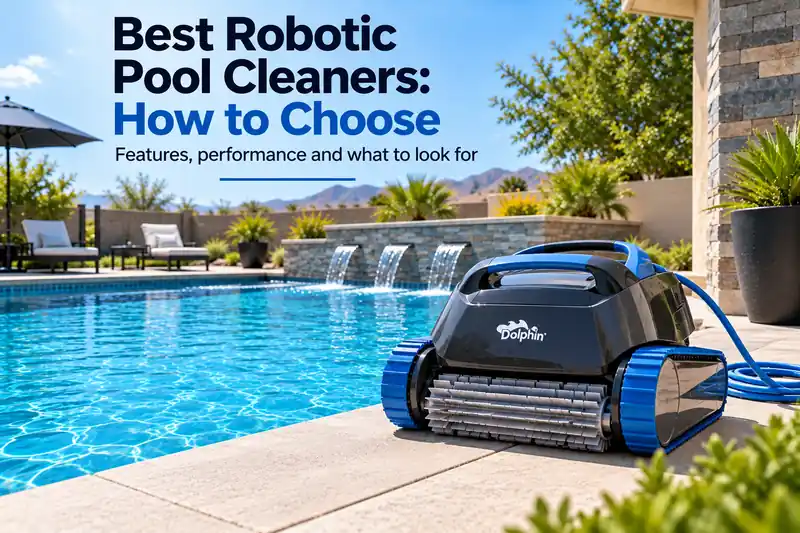
Robotic pool cleaners can clean a pool independently of the main circulation system, but the differences between models go far beyond price. Some clean only the floor, while others climb walls, scrub the waterline, provide finer filtration, offer app controls, or use cordless battery power.
This guide explains the specifications and features that matter most when comparing robotic pool cleaners so you can choose a cleaner that matches your pool rather than paying for features you may not need.
Quick Answer: How Do You Choose a Robotic Pool Cleaner?
Choose a robotic pool cleaner based on your pool's size, shape, surface and the areas you want it to clean. First decide whether you need floor-only cleaning, wall climbing or waterline scrubbing. Then compare navigation, filtration, brush design, corded versus cordless operation, maintenance and warranty.
Robotic cleaners use their own motors and internal filtration, so they do not rely on the pool's circulation pump for cleaning power. However, their capabilities vary significantly. A cleaner that handles a simple rectangular pool may not provide the same coverage in a pool with steps, benches and a Baja shelf.
Robotic Pool Cleaner Buying Guide at a Glance
| Feature | What to Check | Why It Matters |
|---|---|---|
| Pool size | Manufacturer's maximum recommended dimensions | Determines whether the cleaner can cover your pool |
| Cleaning coverage | Floor, walls and waterline | Determines how much manual cleaning remains |
| Navigation | Movement pattern, scanning and obstacle handling | Affects coverage in complex pools |
| Filtration | Coarse, fine or ultra-fine filters | Determines which debris the cleaner can retain |
| Power | Corded or rechargeable battery | Affects runtime, charging and cable management |
| Handling | Weight, retrieval and filter access | Affects everyday convenience |
| Service | Replacement parts and warranty | Affects long-term ownership |
How Do Robotic Pool Cleaners Work?
A robotic pool cleaner is a self-contained cleaning machine with its own motor, filtration system, brushes and drive system. It moves around the pool collecting debris without relying on the pool pump to create suction.
That makes robotic cleaners fundamentally different from suction-side and pressure-side cleaners.
For a detailed explanation of the technology, see How Do Robotic Pool Cleaners Work?.
Robotic vs. Suction vs. Pressure Pool Cleaners
The three major automatic pool-cleaner types use different sources of power.
| Cleaner Type | Power Source | Debris Collection | Main Installation Consideration |
|---|---|---|---|
| Robotic | Independent electric motors | Internal filter basket or cartridges | Compatible power supply or battery charging |
| Suction-side | Pool circulation pump | Usually the pump basket and main pool filter | Compatible suction connection and adequate flow |
| Pressure-side | Pressurized pool water | Typically an onboard debris bag | Compatible pressure connection; some require a booster pump |
If you have not decided which technology you want, start with our Robotic vs. Suction vs. Pressure Pool Cleaners comparison.
Start With Pool Size
Manufacturers normally specify the maximum pool size or length supported by each cleaner.
Maytronics, for example, publishes recommended pool lengths for individual Dolphin models. Its product range includes compact cleaners for smaller pools and models intended for larger installations.
A cleaner designed for a much smaller pool may not provide appropriate coverage, cable length or battery runtime for a larger installation.
Check the exact model's specifications rather than assuming all cleaners from one manufacturer support the same pool dimensions.
Floor-Only vs. Wall-Climbing vs. Waterline Cleaners
Not every robotic cleaner cleans the same surfaces.
| Cleaning Capability | What It Does | What May Still Need Attention |
|---|---|---|
| Floor-only | Collects debris from the pool floor | Walls, waterline, steps and shelves |
| Floor and walls | Cleans the floor and climbs compatible walls | Waterline and difficult pool features |
| Floor, walls and waterline | Includes programmed cleaning along the upper wall | Some steps, benches, shelves and obstacles |
Decide which surfaces you want automated before comparing prices.
If you already brush your walls regularly, a floor-focused robot may meet your needs. If your goal is to reduce manual brushing, check models that explicitly support wall and waterline cleaning.
What Does Waterline Cleaning Mean?
A robot capable of waterline cleaning can travel along the upper portion of the pool wall and scrub the area where the water surface meets the pool finish.
This area can accumulate oils and debris and often requires manual attention.
Do not assume a cleaner provides waterline scrubbing simply because it can climb walls. Verify that the exact model specifically lists waterline coverage.
Navigation Matters
A robotic cleaner needs to move through the pool efficiently rather than repeatedly cleaning the same small area.
Navigation systems range from relatively simple programmed movement patterns to systems that use sensors, scanning algorithms or other technologies to improve coverage.
Maytronics describes its CleverClean technology as using scanning and navigation to help compatible Dolphin cleaners determine cleaning routes.
Compare the navigation features of the exact model, particularly if your pool has an irregular shape or several obstacles.
Pool Shape Can Affect Cleaner Performance
Pool size is not the only factor affecting navigation.
Consider:
- Rectangular versus freeform design.
- Sharp corners.
- Curved walls.
- Steps.
- Benches.
- Baja shelves.
- Drains.
- Water features.
- Transitions between shallow and deep areas.
No automatic cleaner should be assumed to clean every step, shelf, bench or unusual feature perfectly.
Example: A Pool With a Baja Shelf and Deep End
Consider a pool with a shallow Baja shelf, entry steps, a sloping floor and a deeper swimming area.
A robotic cleaner may provide good coverage across the main floor and compatible walls while struggling to reach the shelf or navigate particular transitions.
Before purchasing, check the manufacturer's minimum operating depth, supported pool shapes and cleaning limitations. Plan for manual brushing or vacuuming of areas the cleaner cannot consistently reach.
Brush Design
The brushes loosen dirt, algae and other material from pool surfaces so the cleaner can capture it.
Some robotic cleaners use one active brush, while others use multiple brushes or different brush materials.
When comparing cleaners, consider your pool surface and the type of debris you commonly encounter.
Verify that the brush material is approved for your pool's finish.
Robotic Cleaner Filtration
A robotic cleaner carries its own filtration system. Debris collected by the robot therefore does not have to travel through the pool's main filter.
This can reduce the amount of debris reaching the circulation filter and allows the robot to collect smaller material when suitable filter media is installed.
Coarse vs. Fine vs. Ultra-Fine Filtration
Robotic cleaner filters vary in the size and type of debris they can retain.
| Filter Type | Typical Use | Tradeoff |
|---|---|---|
| Coarse | Leaves and larger debris | May allow finer particles to pass through |
| Fine | Smaller debris and general pool dirt | May require more frequent rinsing |
| Ultra-fine | Very small particles within the filter's rated capability | Can clog more quickly when collecting heavy debris |
Some cleaners offer interchangeable filtration options so you can adapt the filter setup to current conditions.
If your pool regularly collects both large leaves and fine dust, investigate whether the model supports multiple filter types and how easily they can be changed.
Filter Basket Capacity
Filter capacity affects how often you need to empty the cleaner.
A pool surrounded by trees may fill a small basket quickly during periods of heavy leaf drop.
Compare basket size, filter access and the manufacturer's cleaning instructions. A larger basket does not eliminate the need to empty it regularly.
Top-Load Filters Are Convenient
Filter access can make a noticeable difference in everyday ownership.
Many modern robotic cleaners use top-loading filter baskets, allowing the basket to be removed without turning the cleaner upside down.
When comparing models, look at how the basket opens, how easily debris can be emptied and whether the filter media can be rinsed quickly.
Corded vs. Cordless Robotic Pool Cleaners
Traditional robotic pool cleaners receive power through a low-voltage cable connected to a power supply outside the pool.
Cordless robots use rechargeable batteries instead.
| Feature | Corded | Cordless |
|---|---|---|
| Power | External power supply and cable | Rechargeable battery |
| Runtime | Determined by the cleaner's supported cycles and power supply | Limited by battery capacity and operating mode |
| Preparation | Position power supply and manage cable | Charge battery before use |
| Deck cable | Required | Not required during cleaning |
| Long-term maintenance | Cable and power-supply condition | Battery condition and replacement options |
| Retrieval | Follow manufacturer's removal instructions | Check retrieval method, including after battery depletion |
Neither design is automatically better for every pool. Compare the practical requirements of your installation.
If You Choose Cordless, Compare Battery Runtime
Battery runtime should be compared with the cleaner's normal cleaning-cycle length and your pool's size.
Also investigate:
- Recharge time.
- Battery replacement availability.
- Battery warranty.
- How the cleaner is retrieved if the battery is depleted.
- Whether the battery is user-replaceable.
A cordless cleaner's battery is another component that may eventually require replacement, so replacement cost matters for long-term ownership.
Example: Matching Battery Runtime to Pool Size
Suppose a cordless cleaner advertises a two-hour operating cycle.
That figure alone does not establish whether it will cover your pool. Coverage also depends on cleaning mode, navigation, pool geometry and the surfaces being cleaned.
Check the manufacturer's maximum recommended pool size and the runtime specified for the cleaning mode you expect to use. A floor-only cycle and a full floor-and-wall cycle may have different requirements.
Cable Length Matters With Corded Robots
For corded models, the cable must provide enough reach for the entire pool while allowing the power supply to remain safely positioned according to manufacturer instructions.
Do not assume every cleaner includes the same cable length.
Some corded cleaners also use swivel systems intended to reduce cable tangling.
Never use an extension cord or alter the power connection unless the manufacturer explicitly permits it. Follow all power-supply placement and electrical safety instructions.
Cleaning Cycle Options
Basic robots may provide one standard cleaning cycle. More advanced cleaners may allow different cycle durations or cleaning modes.
For example, one cycle might emphasize the floor while another performs complete floor, wall and waterline cleaning.
Multiple cycle options can be useful, but they are most valuable when you expect to use them regularly.
Wi-Fi and App Controls
Some robotic cleaners connect to a smartphone application.
Depending on the model, connected controls may provide:
- Starting a cleaning cycle.
- Selecting cleaning modes.
- Scheduling.
- Cycle status.
- Notifications.
- Manual steering.
Maytronics offers MyDolphin Plus connectivity on selected Dolphin models.
App control can be convenient, but it does not make a poorly matched cleaner appropriate for your pool. Cleaning coverage and filtration should remain central to the comparison.
Do You Need a Weekly Scheduler?
Some robotic cleaners allow recurring cleaning schedules.
This can be convenient if the robot remains in the pool between cycles, although manufacturer recommendations regarding storage and continuous water exposure should still be followed.
If you normally remove and rinse the robot after every use, a sophisticated scheduler may provide less practical value.
Cleaner Weight Matters
A robotic cleaner must be placed into and removed from the pool.
Dry weight does not tell the whole story. The cleaner may temporarily retain water when lifted, making removal more difficult than the specification suggests.
Consider who will handle the cleaner, how far it must be carried and whether the model offers a water-release or assisted-retrieval feature.
Is a Caddy Worth Having?
A caddy provides a place to store and transport the cleaner, power supply and cable.
It can be useful for heavier cleaners or when the storage location is some distance from the pool.
Some models include a caddy while others sell it separately, so include that cost when comparing packages.
Robotic Cleaners and Variable-Speed Pumps
One advantage of robotic cleaners is that their cleaning mechanism does not depend on suction from the main circulation pump.
This means the pool pump does not need to operate at a higher speed simply to power the cleaner.
That separates the cleaning schedule from the primary circulation schedule and can be useful in pools using variable-speed pumps.
Can a Robot Replace Manual Pool Cleaning?
A robotic cleaner can substantially reduce routine floor and wall cleaning, but it should not be assumed to eliminate every manual maintenance task.
Steps, tight corners, shelves, unusual transitions and areas around certain obstacles may still require brushing or vacuuming.
The pool's main filtration system, water chemistry, skimming and other maintenance also remain necessary.
Robotic Cleaner Maintenance
Routine maintenance generally includes:
- Emptying the debris basket.
- Rinsing filter media.
- Inspecting brushes.
- Checking tracks or wheels.
- Inspecting the power cable on corded models.
- Checking battery and charging connections on cordless models.
- Keeping the power supply dry as directed.
- Storing the cleaner properly.
Follow the manufacturer's cleaning and storage instructions. Do not service the cleaner while it is connected to electrical power or charging.
Common Robotic Pool Cleaner Problems
| Problem | Possible Cause | Initial Check |
|---|---|---|
| Cleaner will not start | Power, charging or control issue | Power supply, battery status and displayed errors |
| Cleaner stops moving | Blocked drive system, worn tracks or motor issue | Accessible tracks, wheels and manufacturer troubleshooting steps |
| Poor debris pickup | Full filter, blocked intake or worn brushes | Filter basket, accessible intake and brush condition |
| Cleaner misses areas | Navigation limitation or unsuitable cleaning mode | Selected cycle, pool-size rating and cleaner setup |
| Cable tangles | Cable condition or handling problem | Manufacturer's cable-management instructions |
| Cordless runtime is shorter than expected | Battery condition, operating mode or charging issue | Charging procedure and specified runtime for the selected mode |
| Cleaner does not climb walls | Model limitation, dirty filter or traction issue | Wall-cleaning capability, filter and approved contact components |
Disconnect power and follow manufacturer instructions before inspecting or cleaning the unit. Do not open sealed electrical or battery compartments unless the manufacturer explicitly permits user servicing.
See Why Is My Pool Cleaner Not Moving? before assuming the complete cleaner has failed.
Replacement Parts Matter
Robotic cleaners contain components that may wear over time, including:
- Brushes.
- Tracks.
- Wheels.
- Filter baskets.
- Filter panels.
- Cables.
- Power supplies.
- Batteries on cordless models.
Before buying, check whether common replacement parts are available for the exact model and whether the manufacturer requires authorized service for particular repairs.
Warranty and Service
Warranty terms can vary significantly between cleaner models.
Compare:
- Warranty duration.
- Parts coverage.
- Motor coverage.
- Cable coverage.
- Battery coverage on cordless models.
- Authorized service availability.
Check whether warranty service requires shipping the cleaner, visiting an authorized dealer or using another manufacturer-approved process.
Dolphin Robotic Pool Cleaners
Maytronics offers a broad Dolphin robotic-cleaner lineup with models spanning different pool sizes, cleaning coverage, filtration systems, navigation features and connected controls.
Because there are many Dolphin models, compare the exact cleaner rather than assuming every product carrying the Dolphin name has the same capabilities.
Compare Dolphin Pool Cleaners on Amazon
Compare Robotic Pool Cleaners
Robotic cleaners are available in both corded and cordless designs from multiple manufacturers.
When comparing products, focus on pool-size compatibility, surface coverage, filtration, navigation, power design, warranty and replacement-parts support rather than relying solely on star ratings or advertised feature counts.
Compare Robotic Pool Cleaners on Amazon
Robotic Pool Cleaner Buying Checklist
- Maximum recommended pool size.
- Floor coverage.
- Wall climbing.
- Waterline cleaning.
- Navigation technology.
- Brush configuration.
- Pool-surface compatibility.
- Filter type.
- Filter access.
- Debris capacity.
- Corded or cordless design.
- Cable length or battery runtime.
- Cleaning-cycle options.
- App connectivity.
- Scheduling.
- Cleaner weight.
- Caddy availability.
- Replacement-parts availability.
- Warranty.
Frequently Asked Questions
Do robotic pool cleaners work without the pool pump?
Yes. Robotic cleaners use their own motors and internal filtration, so they do not depend on the circulation pump for cleaning power. The pool's normal circulation and sanitation requirements still apply.
Do all robotic pool cleaners climb walls?
No. Some models clean only the floor, while others also climb walls. Check the exact model's stated cleaning coverage.
Is wall climbing the same as waterline cleaning?
No. A cleaner may climb walls without providing dedicated scrubbing along the waterline. Verify that waterline cleaning is specifically supported.
Are cordless robotic cleaners better than corded models?
Each has different operating requirements. Cordless models eliminate the cleaning cable but require charging and have battery-limited runtime. Corded models require cable management but do not depend on a rechargeable battery during cleaning.
How long should a robotic pool cleaner run?
Use a manufacturer-supported cleaning cycle appropriate for your pool's size and the surfaces being cleaned. Cycle duration and coverage vary by model.
Can a robotic cleaner pick up fine dust?
Some models offer fine or ultra-fine filtration designed to retain smaller particles. Check the available filter media and the manufacturer's specifications.
Will a robotic cleaner clean pool steps and Baja shelves?
Not necessarily. Steps, benches and shallow shelves can be difficult for automatic cleaners. Check the model's minimum operating depth and navigation limitations.
How often should I clean a robotic pool cleaner's filter?
Follow the manufacturer's instructions and inspect the filter regularly. Heavy debris may require cleaning after each cycle or more frequently.
Do robotic pool cleaners use a lot of electricity?
Electricity consumption depends on the model, power draw and cycle duration. Compare manufacturer power specifications and your expected cleaning schedule when estimating operating costs.
What should I check before buying a cordless robotic cleaner?
Compare battery runtime, recharge time, supported pool size, retrieval method, battery warranty and replacement availability.
Bottom Line
A robotic pool cleaner should match your pool's size, shape, surface and cleaning needs.
Start by deciding whether you need floor-only, wall or waterline cleaning. Then compare navigation, filtration, brush design, corded versus cordless operation, controls, weight, replacement parts and warranty.
Prioritize cleaning coverage and everyday maintenance features you will actually use rather than paying for additional functions solely because they appear on a product's feature list.
How We Research
Pool Equipment Lab evaluates pool equipment using manufacturer specifications, documentation, compatibility requirements, operating costs, warranty information, and owner feedback when relevant. We do not claim hands-on testing unless we actually performed it.