
Best Pool Pumps for Above-Ground Pools: How to Choose
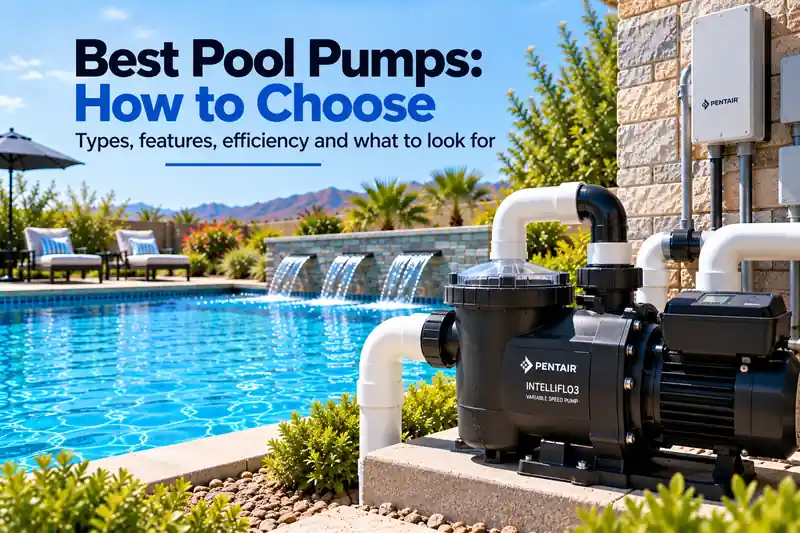
An above-ground pool pump needs enough flow to circulate and filter the water effectively, but simply buying the highest-horsepower pump available is not the answer. The pump must work with the pool's volume, filter, plumbing, and other equipment.
This guide explains what to compare when choosing an above-ground pool pump, including flow rate, horsepower, single-speed versus variable-speed operation, filter compatibility, plumbing size, energy use, and installation requirements.
Quick Answer: How Do You Choose an Above-Ground Pool Pump?
Choose an above-ground pool pump based on your pool's volume, required circulation flow, filter capacity, plumbing and electrical requirements. Compare actual pump performance rather than selecting a pump by horsepower alone.
A variable-speed pump can provide additional control over circulation and electricity use, while a single-speed pump operates at one fixed motor speed. Whichever type you choose, the pump must be compatible with the complete circulation system.
Above-Ground Pool Pump Buying Guide at a Glance
| Factor | What to Check | Why It Matters |
|---|---|---|
| Pool volume | Total gallons | Starting point for estimating circulation |
| Pump flow | GPM at the expected system resistance | Determines actual circulation performance |
| Filter compatibility | Filter's rated maximum flow | Prevents excessive flow through the filter |
| Pump speed | Single-speed or variable-speed | Affects operating flexibility and electricity use |
| Plumbing | Pipe diameter, fittings and connection sizes | Affects resistance and installation compatibility |
| Installation | Pump location and priming requirements | Determines whether the pump suits the equipment layout |
| Electrical supply | Voltage, circuit and protection requirements | Must meet manufacturer and applicable electrical requirements |
What Does an Above-Ground Pool Pump Do?
The pool pump moves water through the circulation system.
Water is drawn from the pool, passes through the pump and filter, and returns to the pool. Depending on the installation, the circulation system may also support heaters, sanitation equipment and other accessories.
The pump and filter therefore need to work together as a system.
Start With Pool Volume
Knowing approximately how much water the pool contains gives you a starting point for estimating circulation requirements.
Pool volume depends on shape, dimensions and average water depth.
If you do not already know your pool's volume, use our Pool Volume Calculator.
Flow Rate Matters More Than Horsepower Alone
Pool pumps are often marketed by horsepower, but horsepower alone does not tell you how much water a pump will move through a particular plumbing system.
Flow rate is generally expressed in gallons per minute (GPM).
Actual flow depends on the pump's performance curve and the resistance created by plumbing, the filter, fittings and other equipment.
How to Estimate the Flow Your Pool Needs
A simple circulation estimate can be made from pool volume and a selected turnover period.
Estimated Flow (GPM) = Pool Volume (Gallons) ÷ Turnover Time (Minutes)
Example: A 12,000-Gallon Above-Ground Pool
Suppose you have a 12,000-gallon above-ground pool and want to calculate the theoretical average flow needed to circulate one pool volume over eight hours.
| Measurement | Value |
|---|---|
| Pool volume | 12,000 gallons |
| Example turnover period | 8 hours |
| Total minutes | 480 |
| Theoretical average flow | 25 GPM |
12,000 ÷ 480 = 25 GPM
This is a theoretical circulation estimate, not a universal flow requirement or a complete pump-sizing calculation.
Actual operating flow must account for the filter, plumbing resistance and any connected equipment that requires a particular minimum flow.
Use our Pool Pump Sizing Calculator to estimate circulation requirements.
Do Not Oversize the Pump
A larger pump is not automatically better.
An unnecessarily large pump can create excessive flow through the filter and plumbing, increase noise and consume more electricity when operated at unnecessarily high speeds.
The goal is enough flow to support filtration and other equipment without substantially exceeding what the system requires.
The Filter Must Handle the Pump's Flow
The pump and filter should be selected together.
A filter has a maximum recommended or rated flow. The pump should not force more water through the filter than the filter is designed to handle.
If you are also selecting a filter, use our Pool Filter Sizing Calculator.
Single-Speed vs. Variable-Speed Above-Ground Pool Pumps
| Feature | Single-Speed | Variable-Speed |
|---|---|---|
| Motor speed | One fixed operating speed | Multiple adjustable speeds |
| Circulation control | Primarily adjusted through runtime | Adjusted through speed and runtime |
| Energy use | Depends on fixed power draw and runtime | Can reduce power demand at lower speeds |
| Equipment functions | One operating speed for supported functions | Can use different speeds for different functions |
| Programming | Generally simpler | May provide advanced scheduling and speed settings |
| Purchase cost | Depends on model and availability | Depends on model and control features |
Single-Speed Pool Pumps
A single-speed pump operates at one motor speed whenever it is running.
The design is simple, but the pump cannot reduce speed during periods when the pool only needs lower circulation.
This can result in unnecessary energy consumption compared with a properly programmed variable-speed pump.
Check current efficiency requirements and product availability for your application before purchasing.
Variable-Speed Pool Pumps
A variable-speed pump can operate at different motor speeds for different pool functions.
Lower speeds can be used for routine filtration, while higher speeds can be programmed when additional flow is required.
That flexibility can substantially reduce pump energy consumption because reducing pump speed can significantly reduce power demand.
See Variable-Speed vs. Single-Speed Pool Pumps for a complete comparison.
Are Variable-Speed Pumps Worth It for Above-Ground Pools?
They can be, particularly when the pool operates for long periods each day or electricity rates are high.
Potential savings depend on pump size, operating speed, daily runtime, electricity rate and required filtration flow.
The purchase price should be evaluated alongside expected operating costs rather than considered in isolation.
You can estimate electricity costs with our Pool Pump Operating Cost Calculator.
Example: Comparing Pump Electricity Costs
Consider two hypothetical operating schedules using an electricity rate of $0.18 per kWh.
| Example | Average Power | Daily Runtime | Daily Energy | Daily Cost |
|---|---|---|---|---|
| Higher-power operation | 1,500 watts | 8 hours | 12 kWh | $2.16 |
| Lower-power operation | 300 watts | 12 hours | 3.6 kWh | $0.65 |
Electricity Cost = (Watts ÷ 1,000) × Hours × Electricity Rate
In this illustration, the lower-power schedule uses less electricity despite operating for more hours.
These are hypothetical power figures, not measured results for specific pumps. The two schedules are not necessarily hydraulically equivalent. Actual savings depend on the flow required and the pump's measured power consumption at each operating speed.
Variable-Speed Pumps Must Be Programmed Correctly
Installing a variable-speed pump and operating it at maximum speed all day defeats much of its potential efficiency advantage.
The goal is generally to determine the lowest speed that still provides necessary circulation and allows connected equipment to operate correctly.
See What RPM Should I Run My Variable-Speed Pool Pump?.
How Long Should an Above-Ground Pool Pump Run?
There is no universal daily runtime that applies to every pool.
Required runtime depends on:
- Pool volume.
- Actual pump flow.
- Water temperature.
- Sanitation method.
- Swimmer load.
- Debris conditions.
- Operating speed.
A variable-speed pump may operate longer at a low speed while still using less electricity than a shorter high-speed cycle.
See How Long Should You Run a Variable-Speed Pool Pump Each Day?.
Horsepower Still Matters
Horsepower remains an important pump specification, but it should be considered alongside the pump's performance curve and the plumbing system.
Two pumps with similar horsepower ratings can have different hydraulic performance.
For a typical above-ground pool, choosing a pump solely because it has a larger horsepower number can result in more pump than the system needs.
Above-Ground Pumps vs. Inground Pumps
Above-ground pool pumps are often designed for installations where the equipment sits near the pool and water can flow toward the pump by gravity.
Many inground pool pumps are designed to self-prime and lift water from plumbing located below the equipment pad.
Because hydraulic requirements can differ, use a pump intended for your type of installation unless the manufacturer specifically approves another configuration.
Check Whether the Pump Is Self-Priming
A self-priming pump is designed to evacuate air from suction plumbing and establish water flow when installed within the manufacturer's priming limitations.
Not every above-ground pump is designed for the same installation height or suction conditions.
Check the installation manual before positioning the pump above the pool's normal water level.
Plumbing Size Matters
Above-ground pools commonly use flexible hose or PVC plumbing in sizes such as 1.5 inches, although installations vary.
The pump's inlet and outlet connections should be compatible with the plumbing or properly adapted.
Restrictive plumbing can limit actual flow even when the pump itself is capable of moving considerably more water.
More Flow Is Not Always Better
Increasing flow also increases resistance through the circulation system.
High flow can create additional pressure across the filter and increase water velocity through plumbing and fittings.
A properly sized system balances adequate circulation with appropriate water velocity and filter performance.
Check the Pump Performance Curve
Manufacturers publish performance curves showing the relationship between flow and total dynamic head.
As system resistance increases, pump flow generally decreases.
This is why the maximum advertised flow number should not be treated as the flow the pump will automatically produce after installation.
How to Compare Two Pump Curves
When evaluating two pumps, use the same estimated system resistance for both.
For example, if the estimated operating condition is 30 feet of total dynamic head, compare the flow each pump produces at that point on its published performance curve.
Then check whether that flow satisfies your pool's circulation needs without exceeding the filter's limits.
For a variable-speed pump, compare the performance curves or manufacturer data for the operating speeds you expect to use.
Electrical Requirements
Verify the pump's electrical requirements before purchase.
Depending on the model, a pump may require:
- 115-volt power.
- 230-volt power.
- A specific circuit configuration.
- GFCI protection.
- Permanent wiring.
- A manufacturer-approved cord connection.
- Proper bonding and grounding.
Installation should follow the manufacturer's instructions and applicable electrical requirements. Use a qualified professional for electrical work where required.
Energy Efficiency
The pool pump can be one of the larger electrical loads associated with pool operation.
Energy use depends on both power draw and operating time.
Variable-speed technology makes it possible to operate at lower speeds when maximum flow is unnecessary.
Actual energy use should be estimated using the pump's published power data or measured operating consumption.
Look at Long-Term Operating Cost
The cheapest pump to purchase is not necessarily the cheapest pump to own.
Compare:
- Purchase price.
- Estimated electricity use.
- Expected daily runtime.
- Replacement parts.
- Warranty.
- Expected service life.
For pumps that operate many hours per day, electricity can become a significant portion of lifetime cost.
Noise Can Matter
Above-ground pool equipment is often installed close to patios, decks, neighboring properties or the pool itself.
Pump noise may therefore be more noticeable than on an equipment pad located farther from the swimming area.
Variable-speed pumps operating at lower speeds can generally operate more quietly than when running at high speed.
Pump Basket Size and Access
The pump's strainer basket catches larger debris before it reaches the impeller.
Look for easy lid removal, clear lid visibility, reasonable basket capacity and convenient cleaning access.
A basket that is difficult to access can make routine maintenance unnecessarily frustrating.
Common Above-Ground Pool Pump Problems
| Symptom | Possible Cause | Initial Check |
|---|---|---|
| Weak return flow | Dirty filter, blocked basket or plumbing restriction | Filter pressure, accessible baskets and pump settings |
| Pump loses prime | Low water level, suction-side air leak or obstruction | Water level, pump lid seal and accessible suction connections |
| Excessive noise | Air entering the system, vibration or mechanical wear | Water level, mounting and visible operating conditions |
| Unexpectedly high electricity use | High operating speed or excessive runtime | Programmed settings and actual power consumption |
| Connected equipment does not activate | Insufficient flow or incompatible control settings | Manufacturer-required flow and equipment status |
Turn off the pump and follow manufacturer instructions before opening equipment or performing maintenance. Electrical repairs should be performed by a qualified professional.
Winterization
In climates where pools are winterized, consider how easily the pump can be drained and protected from freezing.
Follow manufacturer instructions for draining, storage and freeze protection.
Portable or seasonal above-ground installations may have different winterization needs than permanently plumbed pools.
Replacement Parts and Service
Common pump service components include:
- Lid O-rings.
- Shaft seals.
- Drain plugs.
- Strainer baskets.
- Impellers.
- Motor or drive components.
Parts availability can make an established pump easier to maintain over its service life.
Compare Above-Ground Pool Pumps
When comparing pumps, focus on actual system requirements instead of horsepower alone.
Pool volume, required flow, filter capacity, plumbing, electrical supply, energy consumption, controls, warranty and replacement-parts support all matter.
Compare Above-Ground Pool Pumps on Amazon
Above-Ground Pool Pump Buying Checklist
- Pool volume.
- Required circulation flow.
- Filter maximum flow rate.
- Single-speed or variable-speed design.
- Pump performance curve.
- Horsepower.
- Plumbing connection size.
- Installation height.
- Self-priming requirements.
- Electrical voltage.
- Energy consumption.
- Controls and scheduling.
- Noise.
- Basket access.
- Winterization requirements.
- Replacement-parts availability.
- Warranty.
Frequently Asked Questions
What size pump do I need for an above-ground pool?
Start with pool volume and estimated circulation requirements. Then compare pump performance at the expected system resistance with the filter's maximum rated flow and the requirements of connected equipment.
Is a 1.5 HP pump too powerful for an above-ground pool?
Horsepower alone cannot answer that question. The pump's actual flow depends on its design and the plumbing system. Compare the manufacturer's performance curve with your filter and pool requirements.
Can I use a variable-speed pump on an above-ground pool?
Yes, when the pump is approved for the installation and compatible with the filter, plumbing and electrical supply. A variable-speed pump can provide adjustable flow and more flexible operating schedules.
How many hours a day should an above-ground pool pump run?
Runtime depends on pool volume, actual flow, water temperature, sanitation requirements, swimmer load and debris conditions. There is no universal schedule that applies to every pool.
Can I replace an above-ground pool pump with a larger pump?
Possibly, but first verify the replacement pump's flow against the filter's rated capacity, plumbing limits and other equipment requirements. A larger pump may require additional system changes.
Will a variable-speed pump lower my electricity bill?
It can reduce electricity use when programmed to operate at lower speeds while maintaining the required circulation. Actual savings depend on the previous pump, operating settings, runtime and electricity rate.
Does an above-ground pool pump need to be self-priming?
That depends on the equipment location and installation. Many above-ground pumps are designed for flooded-suction arrangements. Check the manufacturer's installation requirements before positioning a pump above the pool's water level.
Can I use an inground pool pump on an above-ground pool?
Only when the manufacturer approves the intended installation and the pump is compatible with the filter, plumbing and electrical system. The pump must also produce an appropriate operating flow.
Bottom Line
An above-ground pool pump should provide the required circulation without substantially exceeding the capabilities of the filter and plumbing system.
Start with pool volume and estimated flow requirements. Then compare pump performance, filter compatibility, plumbing, electrical requirements, single-speed versus variable-speed operation, energy consumption, maintenance and warranty.
Choosing the pump as part of the complete circulation system is more useful than simply selecting the largest horsepower rating available.
How We Research
Pool Equipment Lab evaluates pool equipment using manufacturer specifications, documentation, compatibility requirements, operating costs, warranty information, and owner feedback when relevant. We do not claim hands-on testing unless we actually performed it.