
How Long Should You Run a Variable-Speed Pool Pump Each Day?
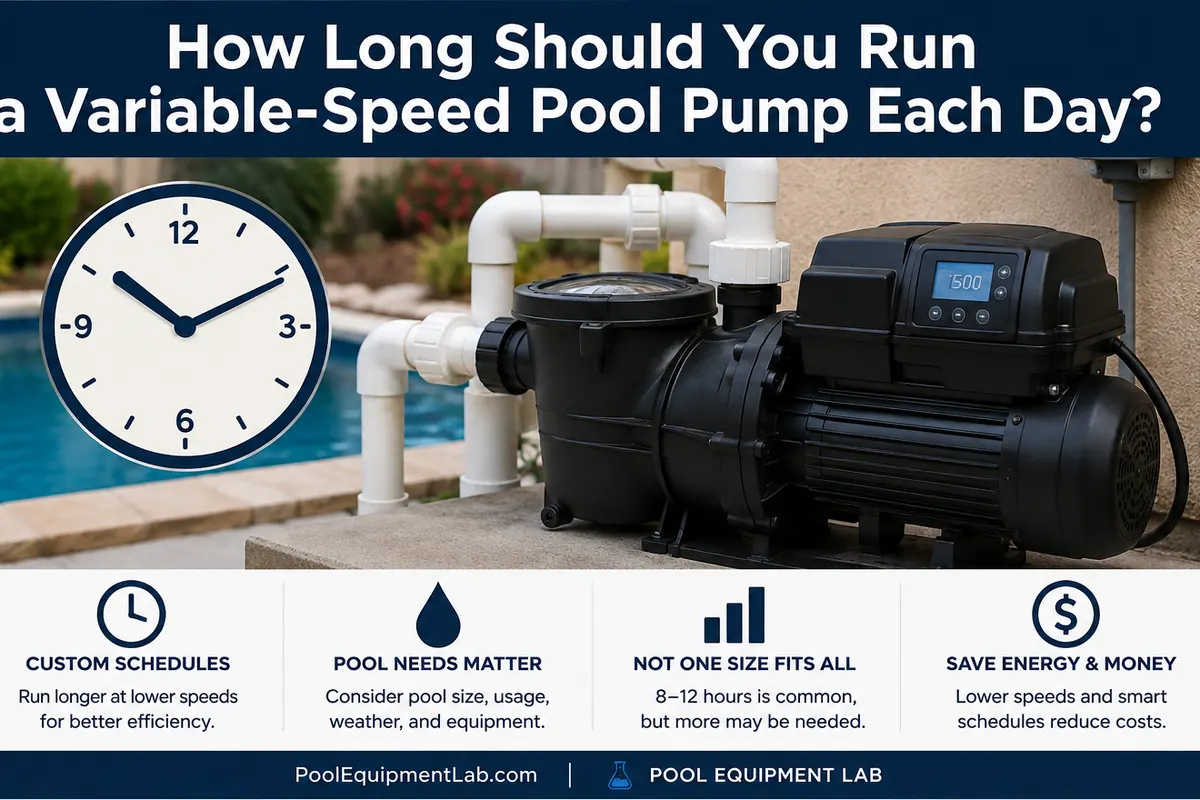
There is no single number of hours that every variable-speed pool pump should run each day. An 8-hour schedule may work for one pool while another pool may benefit from running 12, 16, or even more hours at lower speeds.
The better approach is to determine how much circulation and filtration your pool actually needs, then operate the pump at the lowest practical speeds for enough time to accomplish those jobs.
Quick Answer: How Long Should a Variable-Speed Pool Pump Run?
For many residential pools, 8 to 12 hours of daily operation can be a useful starting point for a variable-speed pool pump. However, there is no universal runtime that works for every pool. Some pools can operate effectively with shorter schedules, while others may benefit from 12 to 16 hours or longer at reduced speeds.
The appropriate schedule depends on pool volume, actual water flow, sanitation requirements, skimming performance, swimmer load and connected equipment.
Rather than running the pump at one speed all day, consider using lower-speed circulation for much of the schedule and higher speeds when additional flow is required for skimming, heating, cleaning or water features.
Variable-Speed Pool Pump Runtime at a Glance
| Factor | What to Consider | Effect on Your Schedule |
|---|---|---|
| Pool volume | Amount of water in the pool | Provides a starting point for circulation calculations |
| Actual GPM | Water flow at each programmed speed | Determines the theoretical volume circulated per hour |
| Low-speed filtration | Flow required for routine circulation | May allow longer operation with lower electrical consumption |
| Surface skimming | Flow needed to remove floating debris | May benefit from scheduled higher-speed periods |
| Salt chlorinator | Required flow and chlorine-production time | May establish minimum operating hours |
| Heater | Required flow and heating schedule | May extend pump runtime |
| Pool use and weather | Debris, temperature and swimmer load | May require seasonal schedule adjustments |
| Electricity rate | Energy price and time-of-use periods | Can influence when the pump operates |
For a broader explanation of variable-speed operation, flow, sizing and efficiency, see our Complete Guide to Pool Pumps.
Why Variable-Speed Pumps Can Run Longer
A variable-speed pump does not consume the same amount of electricity at every RPM. Reducing pump speed can substantially reduce the electrical power required to circulate water through the system.
As a result, a longer low-speed filtration cycle can sometimes consume less electricity than a much shorter high-speed cycle.
This flexibility allows pump speed and runtime to be adjusted independently.
Example: Comparing Two Operating Schedules
Consider two hypothetical pump schedules. The wattages below are illustrative and are not specifications for a particular pump.
| Schedule | Average Electrical Draw | Runtime | Daily Energy |
|---|---|---|---|
| Higher-speed schedule | 1,000 watts | 5 hours | 5 kWh |
| Lower-speed schedule | 300 watts | 12 hours | 3.6 kWh |
Electrical consumption is calculated using:
Power (kW) × Runtime (hours) = Energy (kWh)
At a hypothetical electricity rate of $0.18 per kWh:
- The higher-speed schedule costs approximately $0.90 per day.
- The lower-speed schedule costs approximately $0.65 per day.
The lower-speed schedule uses less electricity in this example despite running for more than twice as long.
However, the two schedules do not necessarily circulate the same amount of water. Flow and equipment requirements must also be evaluated before deciding whether either schedule is suitable.
Our Pool Pump Operating Cost Calculator can estimate electricity costs using pump wattage, runtime and your electricity rate.
Start With Your Pool's Circulation Requirements
Pool volume provides a useful starting point when establishing a pump schedule.
If you know the approximate flow rate at a particular pump speed, you can calculate the theoretical volume of water moved during the scheduled runtime.
Flow Rate (GPM) × 60 × Runtime (Hours) = Gallons Circulated
For example, suppose your pool system moves approximately 35 GPM.
Over eight hours:
35 × 60 × 8 = 16,800 gallons
Over twelve hours:
35 × 60 × 12 = 25,200 gallons
Actual flow depends on the pump, RPM, plumbing, filter condition, valve positions and other hydraulic restrictions. RPM alone does not establish GPM.
If you need to estimate pool capacity, use our Pool Volume Calculator. You can also use the Pool Pump Sizing Calculator to estimate circulation flow requirements.
How Runtime and Flow Work Together
Increasing runtime allows a pump to move more water at a given flow rate.
Alternatively, increasing flow allows the same theoretical volume to move through the system in less time.
Example: An 18,000-Gallon Pool
Consider three hypothetical operating schedules.
| Average Flow | Daily Runtime | Theoretical Volume Moved |
|---|---|---|
| 25 GPM | 12 hours | 18,000 gallons |
| 37.5 GPM | 8 hours | 18,000 gallons |
| 50 GPM | 6 hours | 18,000 gallons |
All three schedules mathematically move the same total volume.
However, they may not provide identical skimming, mixing, filtration or sanitation performance.
Their electricity consumption may also differ substantially.
Use circulation calculations as a starting point, then evaluate how the pool and its equipment actually perform.
Turnover Is Useful, but It Shouldn't Be the Only Goal
Pool owners often hear that all the water must pass through the filter once or twice every day.
Turnover calculations can help estimate circulation, but they should not be interpreted as proof that every gallon of pool water has literally passed through the filter.
Water continuously mixes. Some water may circulate through the equipment more than once while other areas receive less effective circulation.
The practical goal is adequate circulation, filtration, sanitation and water clarity—not simply reaching a theoretical turnover number.
Applicable circulation requirements, equipment specifications and the needs of the individual pool should determine the final schedule.
A Practical Variable-Speed Pump Schedule
A variable-speed pump can use several operating speeds throughout the day rather than running at one RPM for the entire filtration cycle.
Low-Speed Filtration
The longest portion of the schedule can often be devoted to lower-speed circulation.
This keeps water moving through the filter and sanitation system while taking advantage of reduced-speed operation.
The speed must still provide adequate circulation and meet the flow requirements of any equipment operating during that period.
Higher-Speed Skimming
A shorter period at higher speed may improve surface skimming and help move floating debris toward the skimmers.
The amount of additional flow required depends on the pool's skimmer design, plumbing and operating conditions.
Equipment-Specific Speeds
Heaters, salt chlorinators, cleaners, spas and water features may require more flow than basic filtration.
Program separate operating modes when the equipment and control system support them.
Return to Low Speed
After higher-flow equipment shuts off, the pump can return to its lower filtration setting for the remainder of the scheduled circulation period.
If you are deciding what speeds to use, see What RPM Should I Run My Variable-Speed Pool Pump?.
Example: A 12-Hour Variable-Speed Pump Schedule
The following is a hypothetical residential pool schedule intended to illustrate how different operating modes can be combined.
| Time | Operating Mode | Duration | Purpose |
|---|---|---|---|
| 8:00 AM–10:00 AM | Higher speed | 2 hours | Morning skimming and circulation |
| 10:00 AM–6:00 PM | Lower speed | 8 hours | Routine filtration and circulation |
| 6:00 PM–8:00 PM | Moderate speed | 2 hours | Additional circulation, heating or cleaning if needed |
| Total | Mixed-speed operation | 12 hours | Daily programmed runtime |
This schedule allows the pump to spend most of the day at a lower speed while providing higher-flow periods for other tasks.
It is not a recommended schedule for every pool. Actual RPM, GPM and runtime should be determined from your pool's equipment requirements and observed performance.
If you are comparing pumps for programmable operation, you can review available variable-speed models below.
Compare Variable-Speed Pool Pumps on Amazon
How to Calculate Runtime for Your Pool
Once you have a reliable flow measurement or estimate, you can calculate the time needed to move a theoretical volume equal to your pool's capacity.
Runtime (Hours) = Pool Volume ÷ (GPM × 60)
Example: A 20,000-Gallon Pool
Suppose your pump produces approximately 40 GPM at a particular operating speed.
20,000 ÷ (40 × 60) = 8.33 hours
At that flow, the pump would mathematically move 20,000 gallons in approximately 8 hours and 20 minutes.
If actual flow were 30 GPM instead:
20,000 ÷ (30 × 60) = 11.11 hours
That is approximately 11 hours and 7 minutes.
The calculation illustrates the relationship between flow and runtime. It does not establish the required daily turnover or guarantee that the entire pool is circulated uniformly.
When You May Need More Pump Runtime
Some operating conditions may require additional circulation or longer equipment operation.
Hot Weather
Higher water temperatures can increase chlorine demand and biological activity.
Additional circulation may help the filtration and sanitation systems operate effectively, but extending pump runtime does not replace testing and maintaining appropriate sanitizer levels.
Heavy Swimming
More swimmers introduce sunscreen, body oils, dirt and other contaminants.
Additional filtration after heavy use may help remove suspended debris and support water clarity.
After a Storm
Wind and rain can introduce leaves, dust, pollen and other debris.
Additional circulation and filtration may be useful until the pool is clean again.
Empty skimmer and pump baskets as needed, and monitor the filter for increased restriction.
Heating the Pool
A pool heater or heat pump requires adequate water flow while operating.
Long heating periods may therefore increase total pump runtime.
Confirm the heater's specified operating-flow range and coordinate the pump schedule with the heating controls.
Salt Chlorination
A salt chlorine generator generally produces chlorine only when sufficient water flows through the cell.
The chlorine output required by your pool can therefore affect how long the circulation system needs to operate.
For more information about salt cells, chlorine production, flow requirements and sizing, see our Complete Guide to Saltwater Pool Systems.
How Salt Chlorinator Output Can Affect Runtime
A salt chlorine generator's output depends on its rated production capacity, operating time and output setting.
For a simplified calculation:
Estimated Chlorine Production = Rated Daily Output × (Operating Hours ÷ 24) × Output Percentage
Suppose a hypothetical salt cell is rated to produce 1.2 pounds of chlorine over 24 hours at full output.
| Operating Time | Output Setting | Estimated Chlorine Production |
|---|---|---|
| 8 hours | 100% | 0.4 lb |
| 8 hours | 50% | 0.2 lb |
| 12 hours | 100% | 0.6 lb |
| 12 hours | 50% | 0.3 lb |
| 16 hours | 50% | 0.4 lb |
These are hypothetical calculations. Actual chlorine production depends on the cell, operating conditions and manufacturer specifications.
The example shows why reducing pump runtime without adjusting salt-system settings can reduce total chlorine production.
Use water testing and the chlorinator's instructions to establish appropriate operation.
When You May Be Able to Reduce Runtime
If the pool remains clear, water chemistry is stable, skimming is effective and all connected equipment receives adequate flow, you may be able to reduce unnecessary pump operation.
Make adjustments gradually rather than removing several hours from the schedule at once.
After changing the schedule, monitor:
- Water clarity.
- Free chlorine and other relevant water-chemistry measurements.
- Surface skimming.
- Filter pressure at a consistent pump speed.
- Debris accumulation.
- Salt-system operation.
- Heater and cleaner performance.
If water quality or equipment performance declines, reconsider the runtime, operating speed or other contributing factors.
Should You Run a Variable-Speed Pump 24 Hours a Day?
A variable-speed pump can be scheduled for continuous operation, and some pool owners choose to circulate water at relatively low speeds for much of the day.
However, 24-hour operation is not automatically necessary or more effective.
Consider whether the additional circulation provides a useful benefit relative to the electricity consumed and the requirements of the pool.
Example: Comparing 12-Hour and 24-Hour Operation
Suppose a pump draws a hypothetical average of 250 watts at a particular low-speed setting.
| Daily Runtime | Daily Energy | Daily Cost at $0.18/kWh | 30-Day Cost |
|---|---|---|---|
| 12 hours | 3 kWh | $0.54 | $16.20 |
| 16 hours | 4 kWh | $0.72 | $21.60 |
| 24 hours | 6 kWh | $1.08 | $32.40 |
These calculations assume the same electrical draw throughout each schedule and are not measurements for a particular pump.
Longer operation increases electricity consumption at a fixed wattage. Whether that additional runtime is worthwhile depends on circulation, sanitation and equipment requirements.
Should You Run the Pump During the Day or at Night?
Either can work, and many variable-speed schedules use both daytime and nighttime operation.
If your electric utility offers time-of-use pricing, shifting some filtration to lower-cost periods may reduce operating expenses.
However, other equipment can affect the schedule.
- Solar heating may require circulation during periods of useful sunlight.
- Salt chlorination may require sufficient pump runtime to meet chlorine demand.
- Pool cleaners may operate during scheduled cleaning periods.
- Water features may run when the pool is being used.
- Surface skimming may be more useful when debris is actively entering the pool.
Coordinate the pump schedule with these requirements rather than selecting operating hours based only on electricity rates.
Don't Choose Runtime Without Considering RPM and GPM
Asking how many hours a variable-speed pump should run is only part of the question.
A pump running for 12 hours at a low RPM can have a completely different electrical cost and hydraulic performance from the same pump running for 12 hours near maximum speed.
Runtime, RPM, actual flow and electricity consumption should be considered together.
Our guide to how many GPM a variable-speed pool pump should run explains why RPM and actual water flow are related but not interchangeable.
A Practical Process for Adjusting Your Pump Schedule
- Record your current settings. Note the programmed speeds, runtimes and equipment operating during each period.
- Determine actual flow where possible. Use a suitable flow meter, compatible pump display or manufacturer performance information.
- Review equipment requirements. Check the filter, heater, salt system, cleaner and other connected equipment.
- Establish routine circulation. Select a schedule that provides appropriate circulation and sanitation.
- Add higher-flow periods when needed. Account for skimming, heating, cleaning and water features.
- Check energy consumption. Compare actual or estimated electrical draw and runtime.
- Make gradual adjustments. Change one part of the schedule at a time.
- Monitor pool performance. Check water clarity, chemistry, debris removal and equipment operation.
- Adjust seasonally. Revisit the schedule when weather, swimmer load or equipment use changes.
Common Variable-Speed Pump Scheduling Mistakes
| Mistake | Why It Matters | What to Do Instead |
|---|---|---|
| Copying another pool's schedule | Plumbing, equipment and pool use differ. | Establish settings for your own system. |
| Running at maximum speed unnecessarily | Can increase electricity consumption without providing a corresponding benefit. | Use flow appropriate for each operating mode. |
| Reducing runtime too aggressively | May affect circulation, sanitation or equipment operation. | Make gradual adjustments and monitor results. |
| Ignoring salt-system production | Less operating time may reduce daily chlorine output. | Coordinate the pump and chlorinator schedules. |
| Ignoring heater flow requirements | Insufficient flow may prevent proper heater operation. | Follow the heater manufacturer's operating requirements. |
| Assuming RPM equals a fixed GPM | Actual flow depends on hydraulic resistance. | Measure flow or use appropriate performance information. |
| Judging the schedule only by turnover | Turnover does not establish complete mixing or adequate sanitation. | Evaluate actual water quality and equipment performance. |
If you are replacing a single-speed pump or evaluating programmable operation, compare available variable-speed models and verify the manufacturer's specifications for any pump you are considering.
Compare Variable-Speed Pool Pumps on Amazon
Frequently Asked Questions
Is 8 hours enough for a variable-speed pool pump?
It may be enough for some pools, but the appropriate runtime depends on actual flow, circulation, sanitation, skimming and connected-equipment requirements.
Should I run my variable-speed pump for 12 hours?
A 12-hour schedule can be a useful starting point for some residential pools, particularly when much of the operation is at reduced speed. Adjust the schedule according to your pool's actual requirements.
Can I run a variable-speed pool pump 24 hours a day?
Yes, continuous operation is possible, but it is not automatically necessary. Evaluate the additional circulation benefit against electricity consumption and equipment requirements.
Is it cheaper to run a pool pump longer at a lower speed?
It can be. Reduced-speed operation may substantially lower electrical draw, but actual savings depend on pump performance, system resistance and runtime.
How many hours should I run my pump in summer?
Summer operation depends on water temperature, swimmer load, sanitation demand and equipment use. Monitor water chemistry and circulation performance, then adjust the schedule as needed.
Should I run my pool pump more after heavy swimming?
Additional circulation and filtration may help remove debris introduced during heavy use. Maintain appropriate sanitizer levels and adjust the schedule based on actual pool conditions.
Does a saltwater pool need longer pump runtime?
Salt chlorine generators produce chlorine while operating with adequate flow. The runtime needed depends on the cell's production capacity, output setting and the pool's chlorine demand.
Does a pool heater affect pump runtime?
Yes. The pump must provide adequate water flow while the heater operates, so longer heating periods may require additional circulation time.
Should I run my pool pump during the day or at night?
Either can work. Consider utility pricing, skimming, heating, sanitation and other equipment schedules when deciding when to operate the pump.
How do I know whether I can reduce pump runtime?
Make small changes while monitoring water clarity, chemistry, skimming and equipment performance. Do not reduce operation below applicable circulation or equipment requirements.
Bottom Line
There is no universal daily runtime for a variable-speed pool pump.
For many residential pools, roughly 8 to 12 hours can be a useful starting point, while longer low-speed schedules may also be appropriate. The correct schedule depends on pool volume, actual flow, filtration, sanitation, weather, swimmer load and connected equipment.
Start with a reasonable schedule, verify that every piece of equipment receives adequate flow, and adjust runtime and speed based on actual water quality, pool performance and electricity consumption.
How We Research
Pool Equipment Lab evaluates pool equipment using manufacturer specifications, documentation, compatibility requirements, operating costs, warranty information, and owner feedback when relevant. We do not claim hands-on testing unless we actually performed it.