
Pentair IntelliFlo3 vs. Jandy ePump: Which Variable-Speed Pump Is Better?
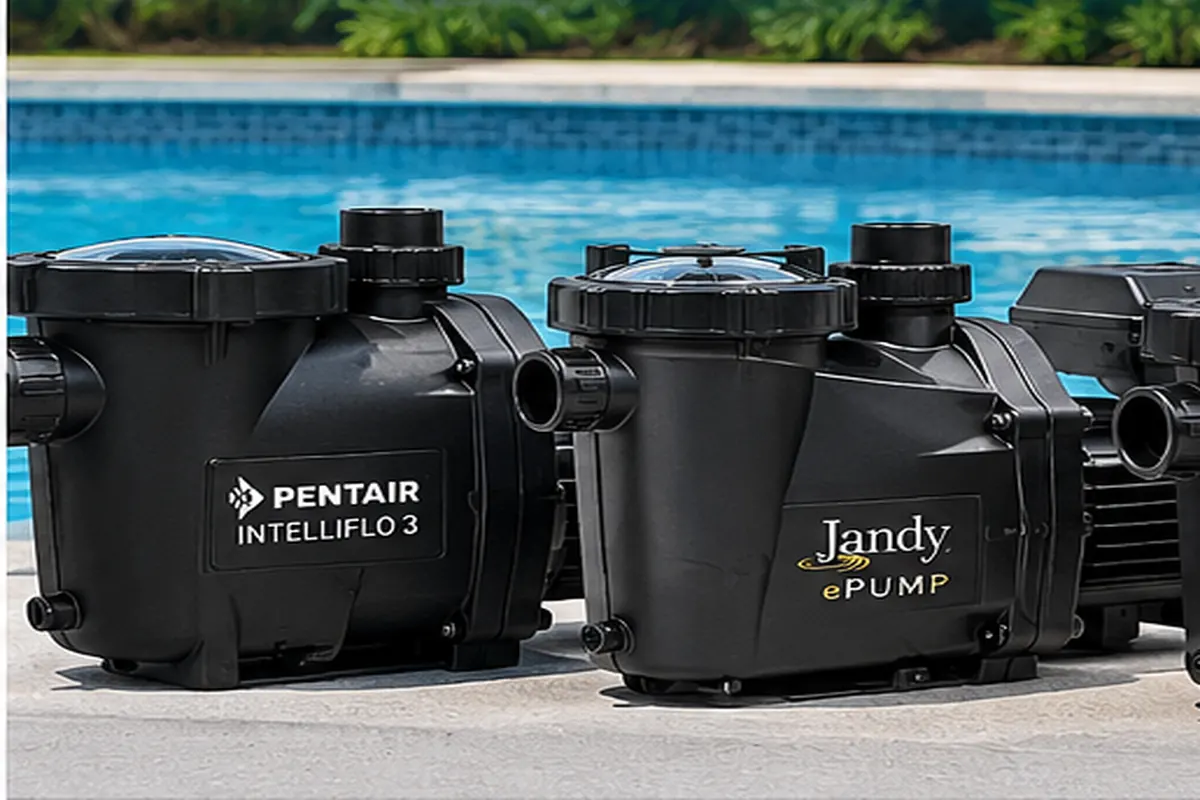
The Pentair IntelliFlo3 and Jandy ePump are both premium variable-speed pool pumps designed for efficient circulation and demanding pool systems, but they take different approaches to sizing, controls, automation, and installation. This comparison uses published manufacturer specifications and documentation to help determine which pump is the better fit for a particular pool rather than declaring one model universally better.
Quick Answer: Pentair IntelliFlo3 vs. Jandy ePump
The Pentair IntelliFlo3 and Jandy ePump are variable-speed pool pump families designed to serve a range of residential pool systems. The IntelliFlo3 offers variable-speed-and-flow (VSF) control, including sensorless flow regulation. The Jandy ePump offers variable-speed operation and control options designed for integration with Jandy equipment and automation.
Both manufacturers offer models for different hydraulic requirements. The appropriate pump depends on the flow your pool needs, the resistance of its plumbing, the electrical supply and the compatibility of your existing equipment.
For a replacement installation, automation compatibility and the cost of any necessary electrical or plumbing modifications can be just as important as the pump's published performance.
Pentair IntelliFlo3 vs. Jandy ePump at a Glance
| Feature | Pentair IntelliFlo3 | Jandy ePump |
|---|---|---|
| Models covered | 1.5 THP and 3.0 THP | 2.7 THP and 3.8 THP |
| Speed control | Variable speed | Variable speed |
| Flow-oriented control | Sensorless flow control | Check the exact model and controller for available functions |
| Automation ecosystem | Pentair Pool app and compatible Pentair automation | Jandy AquaLink and compatible Jandy controls |
| Smaller model voltage | 1.5 THP: 115 V or 208–230 V | Applicable 2.7 THP models: 115 V or 208–230 V |
| Larger model voltage | 3.0 THP: 208–230 V | 3.8 THP: 208–230 V |
| Published WEF figures used in this comparison | 1.5 THP: 9.4; 3.0 THP: 7.1 | 3.8 THP: 6.5; verify the exact 2.7 THP model |
| Auxiliary equipment control | Available on applicable configurations | Two auxiliary relays on applicable models |
| Installation considerations | Hydraulic performance, voltage, plumbing and control compatibility | Hydraulic performance, voltage, plumbing and control compatibility |
These specifications describe the models covered in this comparison. Confirm the manufacturer's documentation for the exact model number and configuration before purchasing.
For more about pump sizing, energy efficiency and variable-speed operation, see our Complete Guide to Pool Pumps.
1. Pentair IntelliFlo3 Overview
The Pentair IntelliFlo3 VSF family includes 1.5 and 3.0 total-horsepower models.
Its defining feature is the combination of variable-speed operation and sensorless flow control. Rather than relying exclusively on a programmed motor speed, compatible operating modes can regulate flow toward a selected target.
The IntelliFlo3 also supports connected control through the Pentair Pool app and can be incorporated into compatible Pentair automation systems.
IntelliFlo3 1.5 HP
The 1.5 THP model provides an option for residential pools whose hydraulic requirements fall within its performance range.
The specifications used for this comparison list a Weighted Energy Factor (WEF) of 9.4 and applicable configurations supporting 115-volt or 208–230-volt operation.
Dual-voltage capability can be useful during replacement installations, particularly where the existing electrical supply is 115 volts.
However, electrical compatibility does not establish hydraulic suitability. The pump must still provide the required flow at the pool's actual system resistance.
Shopping for the IntelliFlo3 1.5 HP? The Amazon listing below is for Pentair model 011065. Verify that the exact product matches your pool's electrical, plumbing, automation and hydraulic requirements before purchasing.
Check IntelliFlo3 1.5 HP Price on Amazon
IntelliFlo3 3.0 HP
The 3.0 THP IntelliFlo3 provides additional hydraulic capacity for systems with greater flow requirements.
The specifications used here list a WEF of 7.1 and 208–230-volt operation.
Applications worth evaluating include pools with attached spas, water features, longer plumbing runs and other equipment configurations that require additional hydraulic performance.
Whether the larger model is necessary depends on the required GPM at the system's total dynamic head (TDH).
2. Jandy ePump Overview
The Jandy ePump family provides variable-speed operation and integrates with compatible Jandy equipment and controls.
The models covered here include 2.7 THP and 3.8 THP configurations.
Jandy offers several control options, including AquaLink automation, iQPUMP01 and SpeedSet, depending on the exact pump and installation.
Jandy ePump 2.7 HP
Applicable 2.7 THP models support 115-volt or 208–230-volt operation.
This provides electrical installation flexibility for systems that need more available pump capacity than a smaller model can provide.
Compatible control configurations include Jandy AquaLink, iQPUMP01 and SpeedSet.
Applicable models also provide two auxiliary relays that can be used with compatible controls for additional equipment, such as a booster pump or salt chlorinator.
Confirm the specific model's voltage, controller and relay capabilities before ordering.
Jandy ePump 3.8 HP
The 3.8 THP ePump is designed for systems with substantial hydraulic requirements.
Jandy states that this model provides 24% more hydraulic performance than its 2.7 HP ePump. That is a manufacturer comparison between its own models, not a measured comparison with the Pentair IntelliFlo3.
The specifications used here list:
- 3.8 total horsepower.
- WEF of 6.5.
- 208–230-volt operation.
- Maximum power of 3,120 watts.
- 2.5-inch by 3-inch unions.
Applications to evaluate include large pools, spas, negative-edge systems, waterfalls and other high-flow installations.
Its suitability still depends on the manufacturer's performance curve and the system's actual hydraulic requirements.
3. Compare Hydraulic Performance Before Horsepower
Horsepower describes motor output capacity, but it does not tell you how much water a pump will move through your particular pool system.
Actual flow depends on the pump's performance characteristics and the resistance created by the complete circulation system.
That resistance includes:
- Pipe diameter and length.
- Elbows and other fittings.
- Valves.
- Pool filters.
- Heaters.
- Salt chlorinators.
- Other equipment and operating configurations.
The correct comparison is the flow each pump can deliver at the expected TDH.
Example: Two Pools With the Same Volume
Consider two hypothetical 20,000-gallon pools.
| Feature | Pool A | Pool B |
|---|---|---|
| Volume | 20,000 gallons | 20,000 gallons |
| Plumbing | Shorter, relatively simple runs | Longer runs with additional fittings |
| Attached spa | No | Yes |
| Water features | No | Multiple features |
| Peak-flow requirements | Primarily circulation and connected equipment | May include substantially greater spa and feature demands |
Pool B may need significantly more hydraulic capacity despite having the same water volume as Pool A.
This is why choosing a pump by pool gallons alone can produce an unsuitable installation.
4. Calculate the Flow Your Pool Actually Needs
Pool volume and the intended circulation period provide a starting estimate of average required flow.
Pool Volume ÷ Circulation Time in Minutes = Average Required GPM
For example, circulating 20,000 gallons over eight hours requires:
20,000 ÷ 480 = 41.7 GPM
This represents the theoretical average flow for one turnover over eight hours.
It does not establish the pump's required peak output or account for the actual resistance of the circulation system.
| Pool Volume | 8-Hour Circulation | 10-Hour Circulation |
|---|---|---|
| 10,000 gallons | 20.8 GPM | 16.7 GPM |
| 15,000 gallons | 31.3 GPM | 25 GPM |
| 20,000 gallons | 41.7 GPM | 33.3 GPM |
| 25,000 gallons | 52.1 GPM | 41.7 GPM |
| 30,000 gallons | 62.5 GPM | 50 GPM |
These are theoretical circulation calculations, not recommended flow settings for a particular pump.
Determine the flow requirements of connected equipment and any higher-demand operating modes before comparing pump curves.
5. How the Two Pumps Handle Speed and Flow Control
One of the differences between the pump families is their approach to controlling water movement.
Pentair IntelliFlo3: Variable-Speed-and-Flow Control
The IntelliFlo3 combines variable-speed operation with sensorless flow control.
In a compatible flow-control mode, the pump can adjust its operation toward a programmed flow target as system conditions change, within its operating limits.
This can be useful where maintaining a selected flow is important for connected equipment.
Jandy ePump: Variable-Speed Operation
The Jandy ePump provides programmable variable-speed operation through compatible control options.
Its available programming and control functions depend on the exact pump and controller.
Check the relevant Jandy documentation if your installation requires a particular flow-oriented function rather than conventional speed programming.
Example: What Happens When a Filter Becomes Dirty?
Suppose a pump is programmed to run at a fixed RPM while the pool filter gradually accumulates debris.
As resistance increases, the actual flow through the system may decrease even though the programmed RPM has not changed.
A compatible flow-control system can respond by adjusting pump operation toward the programmed flow target, provided the target remains within its operating limits.
That does not eliminate the need to clean the filter. The system still requires maintenance according to the filter manufacturer's instructions.
6. Compare Energy Efficiency Using WEF and Actual Operating Conditions
The Department of Energy uses Weighted Energy Factor (WEF) as an efficiency metric for covered dedicated-purpose pool pumps.
WEF describes the amount of water moved relative to electrical energy consumed under the applicable standardized test procedure.
A higher WEF indicates greater efficiency under that test procedure, but the number does not establish which pump will consume less electricity in every installation.
Published WEF Figures in This Comparison
| Pump Model | Published WEF Used Here |
|---|---|
| IntelliFlo3 1.5 THP | 9.4 |
| IntelliFlo3 3.0 THP | 7.1 |
| Jandy ePump 2.7 THP | Verify the exact model |
| Jandy ePump 3.8 THP | 6.5 |
These values describe the specified models under standardized test conditions. They should not be interpreted as a direct measurement of operating cost on your pool.
The models also have different hydraulic capabilities, so a higher WEF does not establish that a smaller pump can meet a larger system's requirements.
Example: Why Daily Energy Use Depends on Programming
Consider two hypothetical operating schedules. These are illustrative electrical measurements, not published performance figures for either pump family.
| Schedule | Average Electrical Draw | Runtime | Daily Energy |
|---|---|---|---|
| A | 350 watts | 12 hours | 4.2 kWh |
| B | 900 watts | 6 hours | 5.4 kWh |
Energy use is calculated as:
Power (kW) × Runtime (hours) = Energy (kWh)
At a hypothetical electricity price of $0.18 per kWh:
- Schedule A costs approximately $0.76 per day.
- Schedule B costs approximately $0.97 per day.
The example demonstrates why operating speed, electrical draw and runtime all matter.
It does not establish which pump is cheaper to operate on a particular pool. That requires comparable performance data under the same hydraulic conditions.
7. Automation Compatibility Can Affect Installation Cost
Existing automation should be one of the first things evaluated when comparing these pump families.
The IntelliFlo3 integrates with compatible Pentair controls, while the ePump supports compatible Jandy control systems.
Replacing a pump with a different brand may require additional compatibility checks, programming changes or equipment modifications.
Existing Pentair Automation
If your pool already uses Pentair automation, investigate the IntelliFlo3's compatibility with the installed controller and its software or firmware version.
Confirm the functions you want to use, including speed or flow programming, scheduling and any equipment-control capabilities.
Existing Jandy Automation
If your pool uses Jandy AquaLink, review the exact ePump model's compatibility with the installed automation system.
Applicable ePump configurations also provide auxiliary-relay capabilities that may be useful for controlling compatible additional equipment.
Changing Between Brands
Cross-brand installations may be possible, but do not assume every pump and automation combination supports the same control functions.
Before ordering, verify:
- The installed automation model.
- Its software or firmware version.
- The pump's exact model number.
- Supported communication and control methods.
- Available speed or flow programming.
- Any required interface or additional hardware.
Compatibility matters particularly when replacing a pump on an otherwise functioning equipment pad.
8. Compare Electrical Requirements
Electrical requirements can determine whether a pump is suitable for a straightforward replacement or whether additional electrical work is needed.
| Model | Voltage Listed for This Comparison |
|---|---|
| IntelliFlo3 1.5 THP | 115 V or 208–230 V |
| IntelliFlo3 3.0 THP | 208–230 V |
| Applicable Jandy ePump 2.7 THP models | 115 V or 208–230 V |
| Jandy ePump 3.8 THP | 208–230 V |
For a pool with an existing 115-volt pump circuit, the dual-voltage models are worth investigating if they also meet the hydraulic requirements.
However, voltage is only one part of electrical compatibility.
Verify circuit capacity, wiring, grounding, bonding and all other manufacturer requirements. Have electrical modifications performed by a qualified professional.
9. Plumbing and Physical Installation
A replacement pump must fit the existing equipment pad and connect appropriately to the pool's plumbing.
Check the following before purchasing:
- Suction and discharge port dimensions.
- Existing pipe diameter.
- Available equipment-pad space.
- Required service clearance.
- Electrical service.
- Automation connections.
- Required unions or plumbing modifications.
Jandy's 3.8 THP model, for example, is listed with 2.5-inch by 3-inch unions in the specifications used here.
That does not mean every pool connected to smaller existing plumbing will benefit from installing the larger pump.
The entire hydraulic system must be evaluated to determine whether its flow requirements can be met safely and efficiently.
Example: A Pump Replacement That Requires More Work
Suppose a pool has an existing 115-volt circuit, limited equipment-pad space and a compatible automation system already installed.
Replacing the pump with a model that requires 208–230 volts could introduce electrical work.
Changing to a pump with different connection dimensions could require plumbing modifications.
Switching automation ecosystems could create additional control or programming requirements.
These installation considerations can materially change the total cost of a pump replacement, even when two pumps have similar purchase prices.
10. Comparing the Pumps for a Basic Residential Pool
A straightforward residential pool without substantial water features or demanding spa equipment may have relatively modest peak-flow requirements.
For this type of installation, evaluate whether the IntelliFlo3 1.5 THP or an appropriate Jandy ePump configuration meets the required flow at the actual system resistance.
The Pentair model offers sensorless flow control and dual-voltage capability in applicable 1.5 THP configurations.
Jandy's 2.7 THP ePump offers additional available pump capacity, applicable dual-voltage configurations and integration with compatible Jandy controls.
Neither set of features replaces the need to compare pump performance curves.
11. Comparing the Pumps for Spas and Water Features
Attached spas, waterfalls, negative edges and other features can substantially increase peak-flow requirements.
The IntelliFlo3 3.0 THP and Jandy ePump 3.8 THP are both models to evaluate for more hydraulically demanding installations.
The appropriate selection depends on the required GPM at the expected TDH and the operating limits of the complete system.
Example: Filtration Versus Spa Operation
Consider a hypothetical pool-and-spa system with the following requirements:
| Operating Mode | Illustrative Flow Requirement |
|---|---|
| Normal pool filtration | 40 GPM |
| Spa operation | 90 GPM |
These are hypothetical requirements, not manufacturer performance figures or recommended spa-jet settings.
The example shows why sizing a pump solely for normal filtration can overlook much higher peak demands.
Determine the actual flow requirements of the installed equipment and compare both pumps' performance at the relevant operating conditions.
12. What About Pool Heaters and Salt Systems?
Heaters and salt chlorine generators have operating-flow requirements that must be considered when selecting a pump.
However, the presence of either device does not automatically establish a need for a higher-horsepower model.
Verify the connected equipment's minimum and maximum flow requirements, where specified, and determine whether the pump can satisfy them at the system's actual resistance.
For more about connected heating equipment, see our Complete Guide to Pool Heaters.
For salt-system operation and maintenance, see our Complete Guide to Saltwater Pool Systems.
13. Common Mistakes When Comparing IntelliFlo3 and ePump
| Mistake | Why It Matters | What to Check Instead |
|---|---|---|
| Choosing by horsepower alone | Horsepower does not establish flow at the pool's operating head. | Compare pump performance curves at the required TDH. |
| Choosing by pool gallons alone | Ignores plumbing resistance and peak equipment demands. | Calculate required flow for all relevant operating modes. |
| Comparing WEF without considering pump capacity | Models with different hydraulic capabilities may not serve the same application. | Evaluate efficiency alongside the required flow and head. |
| Assuming automation compatibility | Control functions can vary by controller and firmware. | Verify the exact pump and automation combination. |
| Ignoring electrical requirements | May require additional installation work. | Confirm voltage and circuit requirements. |
| Ignoring plumbing connections | May require modifications or introduce hydraulic limitations. | Review connection dimensions and the complete plumbing system. |
| Buying unused capacity | Additional horsepower does not automatically improve filtration or reduce energy costs. | Match pump capacity to actual operating requirements. |
14. A Practical Pump Comparison Checklist
- Calculate pool volume. Establish a starting circulation requirement.
- Determine required flow. Include filtration, heating, cleaning, spa and water-feature modes.
- Estimate total dynamic head. Consider the resistance of the complete circulation system.
- Compare performance curves. Confirm that each candidate pump can deliver the required GPM at the expected TDH.
- Review connected equipment limits. Verify filter, heater and other component requirements.
- Compare energy performance. Evaluate WEF alongside expected operating flow, electrical draw and runtime.
- Check automation compatibility. Confirm the exact controller, pump model and supported functions.
- Verify electrical requirements. Check voltage, circuit capacity and installation instructions.
- Review plumbing connections. Confirm physical fit and any required modifications.
- Estimate total installation cost. Include the pump, electrical work, plumbing changes and automation requirements.
Frequently Asked Questions
What is the main difference between the Pentair IntelliFlo3 and Jandy ePump?
The IntelliFlo3 combines variable-speed operation with sensorless flow control. The Jandy ePump provides variable-speed operation and integrates with compatible Jandy control systems. Both families include models with different hydraulic capabilities.
Does the IntelliFlo3 have flow control?
Yes. Its VSF platform includes sensorless flow control, allowing compatible operating modes to regulate toward a selected flow target within the pump's operating limits.
Can the Jandy ePump connect to AquaLink?
Applicable ePump models support compatible Jandy AquaLink systems. Confirm the exact pump model, installed controller and software or firmware requirements.
Can an IntelliFlo3 connect to Pentair automation?
Yes, with compatible Pentair automation. Verify the exact controller and the functions supported by the specific pump configuration.
Which models support 115-volt operation?
The specifications used here list dual-voltage capability for applicable IntelliFlo3 1.5 THP and Jandy ePump 2.7 THP models. Confirm the exact model and electrical requirements before ordering.
Does a larger horsepower rating guarantee more flow?
No. Actual flow depends on the pump's performance characteristics and the resistance of the circulation system. Compare manufacturer performance curves at the expected TDH.
Can either pump be used with a salt chlorine generator?
Potentially. Verify that the pump can provide the salt system's required flow and that any desired control integration is compatible.
Does an attached spa require a larger pump?
Not automatically. Calculate the spa's actual flow requirements and compare them with the pump's performance at the system's expected operating head.
Can I switch from Pentair to Jandy or from Jandy to Pentair?
A brand change may be possible, but verify automation compatibility, electrical requirements, plumbing connections and any additional installation work before purchasing.
How should I compare operating costs?
Use comparable operating conditions: required flow, system head, electrical draw, runtime and local electricity price. WEF is useful standardized information, but it does not replace a site-specific energy estimate.
Bottom Line
The Pentair IntelliFlo3 and Jandy ePump offer different combinations of hydraulic capacity, control functions, electrical configurations and automation integration.
For an existing equipment pad, verify compatibility with the installed automation, electrical service and plumbing before comparing purchase prices.
For a new installation, calculate the required flow and system resistance, then compare the manufacturer's performance data for the exact models under consideration.
If the IntelliFlo3 1.5 HP meets your system's requirements, the Amazon listing below is for Pentair model 011065. Confirm the exact model and installation specifications before ordering.
How We Research
Pool Equipment Lab evaluates pool equipment using manufacturer specifications, documentation, compatibility requirements, operating costs, warranty information, and owner feedback when relevant. We do not claim hands-on testing unless we actually performed it.