
The Complete Guide to Swimming Pool Equipment
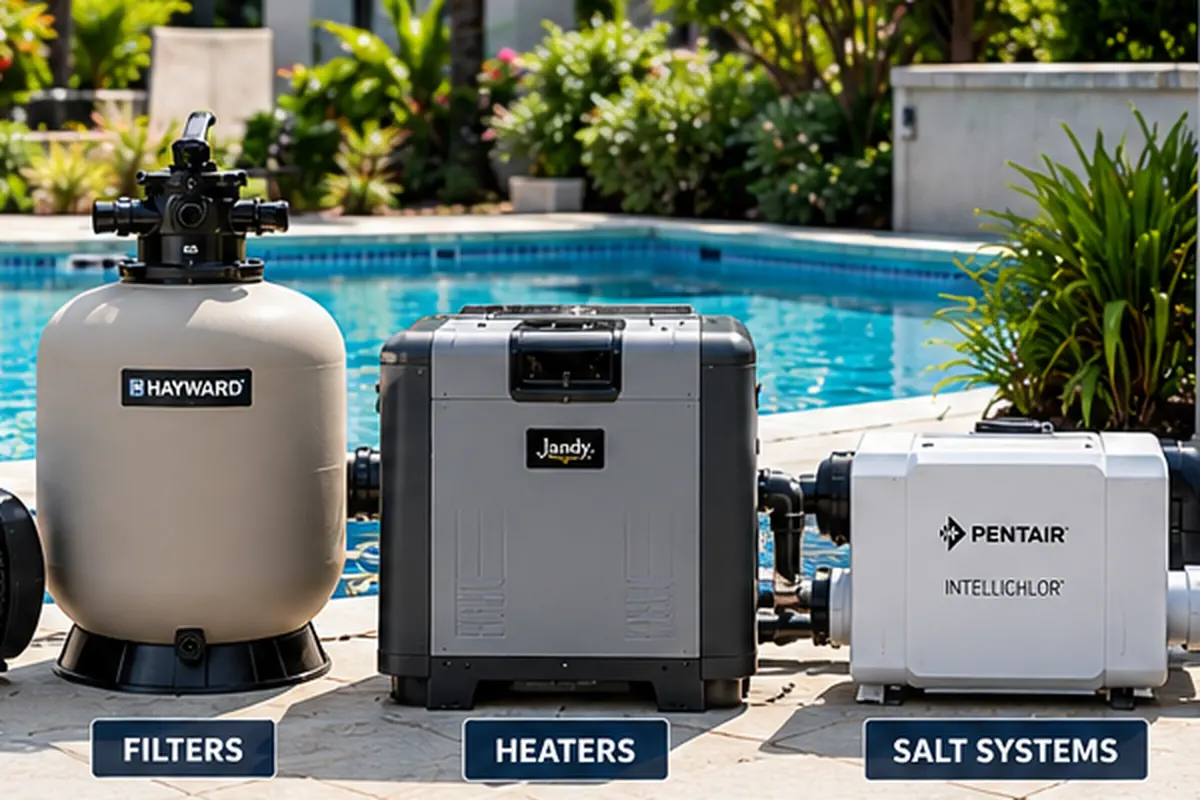
A swimming pool is a complete water-circulation and treatment system. The pump moves the water, the filter removes suspended debris, the heater can control temperature, and sanitation equipment helps keep the water safe for swimming.
Understanding how these components work together makes it much easier to choose, operate, maintain, and troubleshoot pool equipment.
Quick Answer: What Equipment Does a Swimming Pool Need?
Most residential swimming pools need a pump to circulate water, a filter to remove suspended debris and a sanitation system to maintain safe water conditions. Depending on the pool, additional equipment may include a heater or heat pump, an automatic cleaner and an automation controller.
These components should be planned together. Pump flow affects filtration and the operation of heaters and salt chlorine generators. Plumbing, electrical requirements and automation compatibility also influence which equipment can work together.
Swimming Pool Equipment at a Glance
| Equipment | Main Function | Important Selection Factor |
|---|---|---|
| Pool pump | Circulates water through the system | Required flow at the system's total dynamic head |
| Pool filter | Removes suspended particles | Rated flow, filtration area and maintenance requirements |
| Heater or heat pump | Raises and maintains water temperature | Heating capacity, climate and operating cost |
| Sanitation system | Provides a means of maintaining disinfectant levels | Pool demand, output capacity and water chemistry |
| Automatic cleaner | Removes debris from pool surfaces | Pool design, debris load and operating requirements |
| Automation controller | Coordinates equipment schedules and functions | Compatibility with installed equipment |
How Swimming Pool Equipment Works Together
Although individual equipment configurations vary, a residential pool generally operates as a circulation loop.
The pump draws water from the pool through suction plumbing and pushes it through the equipment system. This circulation allows filtration, heating, sanitation and other water-treatment equipment to function.
Every major component affects the rest of the system. That is why pool equipment should be selected as a coordinated system rather than as unrelated products.
The Pool Pump: The Heart of the Circulation System
The pool pump creates the water movement that allows the rest of the equipment to operate. Water is drawn through skimmers and other suction points, enters the pump and is pushed through filtration and treatment equipment.
Single-Speed vs. Variable-Speed Pumps
A single-speed pump operates at one motor speed whenever it is running.
A variable-speed pump allows the motor speed to be adjusted for different jobs. Lower speeds can often provide routine circulation efficiently, while higher speeds can be used when additional flow is required.
The U.S. Department of Energy has established efficiency standards for dedicated-purpose pool pumps, making energy performance an important consideration when selecting modern equipment.
For a deeper explanation of pump types, flow, RPM, sizing and operating costs, see our Complete Guide to Pool Pumps.
Pool Pump Sizing
A pump should not be selected simply by choosing the highest horsepower available. The goal is to provide the flow required by the pool while accounting for plumbing resistance and the operating limits of connected equipment.
Important factors include:
- Pool volume and circulation requirements.
- Plumbing diameter and length.
- System resistance, expressed as total dynamic head (TDH).
- Filter flow capacity.
- Heater flow requirements.
- Water features and spa operation.
- Salt-system requirements.
Use our Pool Volume Calculator to estimate water volume and our Pool Pump Sizing Calculator to estimate a starting circulation flow.
The Pool Filter
The filter removes suspended particles and debris from circulating pool water. The three primary residential filter types are cartridge, sand and diatomaceous earth (DE).
Cartridge Filters
Cartridge filters pass water through pleated filter elements. The cartridges are periodically removed and cleaned. They do not normally require routine backwashing, which can reduce water loss compared with systems that depend on backwashing for cleaning.
Sand Filters
Sand filters pass water through a bed of filtration media. Dirt becomes trapped within the media, and the filter is periodically backwashed to remove accumulated debris. They are widely used because of their relatively straightforward operation and maintenance.
DE Filters
DE filters use grids coated with diatomaceous earth or approved filtration media. They can provide very fine filtration but require specific cleaning and media-handling procedures.
Comparing the Three Filter Types
| Filter Type | Cleaning Method | Considerations |
|---|---|---|
| Cartridge | Remove and clean cartridges | No routine backwashing; replacement cartridges are a recurring expense |
| Sand | Backwash according to manufacturer instructions | Relatively straightforward maintenance; backwashing uses water |
| DE | Backwash or clean grids as specified and replenish media | Fine filtration; additional media-handling requirements |
Our Complete Guide to Pool Filters explains each type in more detail. The Pool Filter Sizing Calculator can help estimate a starting flow-capacity target.
Pool Heaters and Heat Pumps
Pool heating equipment extends the swimming season and allows owners to maintain a preferred water temperature. Two common choices are gas pool heaters and electric pool heat pumps.
Gas Pool Heaters
Gas heaters burn natural gas or propane and transfer heat to circulating pool water through a heat exchanger. Their relatively high heating output makes them useful when rapid heating is important.
Pool Heat Pumps
A heat pump uses electricity to capture heat from the surrounding air and transfer it into the pool. Because it moves existing heat rather than producing all of its heat through electrical resistance, it can provide efficient heating under suitable conditions.
Heat-pump performance varies with outdoor temperature and humidity. Heating time and operating cost also depend on pool size, water temperature, weather and whether a pool cover is used.
See our Complete Guide to Pool Heaters for a deeper comparison. You can also use the Pool Heater Sizing Calculator for a preliminary heating estimate.
Pool Sanitation Equipment
Filtration removes suspended particles, but a pool also requires an effective sanitation system. Chlorine remains one of the most common residential pool sanitizers.
Traditional Chlorination
Chlorine can be introduced through liquid products, granular products, tablets, feeders or other approved methods. Regardless of the delivery method, the pool still requires regular water testing and appropriate chemistry management.
Salt Chlorine Generators
A salt chlorine generator uses electrolysis to produce chlorine from dissolved salt in pool water. A saltwater pool is therefore still a chlorine pool. The main difference is how the chlorine is supplied.
Salt systems must be selected with consideration for pool volume, chlorine demand, manufacturer-rated output and required water flow.
Our Complete Guide to Saltwater Pool Systems explains salt cells, sizing, maintenance and common problems. The Salt Cell Sizing Calculator provides a preliminary capacity estimate.
Automatic Pool Cleaners
Automatic cleaners help remove debris from pool surfaces. The major categories are robotic, suction-side and pressure-side cleaners.
| Cleaner Type | How It Operates | System Considerations |
|---|---|---|
| Robotic | Uses its own powered drive and debris collection system | Electrical supply, pool shape and cleaning coverage |
| Suction-side | Uses suction from the pool's circulation system | Available suction flow and plumbing configuration |
| Pressure-side | Uses pressurized water; some models require a booster pump | Return-side plumbing and manufacturer flow requirements |
The appropriate choice depends on pool design, debris load, plumbing, energy use and the amount of cleaning automation desired.
See our Complete Guide to Pool Cleaners for a more detailed comparison.
Pool Automation
Automation systems coordinate multiple pieces of equipment from a central controller. Depending on the system, automation may control:
- Pump schedules and speeds.
- Pool and spa modes.
- Heating.
- Valves.
- Lighting.
- Water features.
- Compatible sanitation equipment.
Some systems also provide remote monitoring and control through mobile applications.
Compatibility matters. Not every controller supports every pump, heater, salt system or accessory, even when the equipment performs similar functions.
Our Complete Guide to Pool Automation explains controllers, scheduling, compatibility and remote access.
How Water Moves Through the Equipment
A simplified circulation sequence is:
- Water leaves the pool through skimmers and other suction points.
- The pump moves the water into the equipment system.
- The filter removes suspended debris.
- Heating and treatment equipment condition the water as required.
- Water returns to the pool through the return plumbing.
This is a simplified illustration, not an installation diagram. Actual equipment order, check valves, bypasses and other installation details must follow manufacturer requirements and applicable codes.
Practical Example: Planning Equipment for a 20,000-Gallon Pool
Consider a hypothetical 20,000-gallon residential pool with a variable-speed pump, cartridge filter, gas heater and salt chlorine generator.
If an eight-hour turnover target is used for an initial calculation, the average flow estimate is:
20,000 gallons ÷ (8 hours × 60 minutes) = 41.7 GPM
That estimate helps begin the equipment-planning process, but it does not establish the final pump or filter size.
| Component | What to Verify | Why |
|---|---|---|
| Variable-speed pump | Performance curve at the system's estimated TDH | Confirms whether the pump can deliver the required flow |
| Cartridge filter | Manufacturer's rated flow and filtration area | Helps prevent operation beyond the filter's limits |
| Gas heater | Minimum and maximum flow requirements | Supports proper heater operation |
| Salt chlorine generator | Chlorine production capacity and flow requirements | Helps ensure the cell can operate and meet chlorine demand |
| Automation | Supported equipment models and control functions | Prevents compatibility problems |
For example, the pump may be able to produce the calculated 41.7 GPM during routine circulation, but the heater or another accessory may require a different operating flow. A variable-speed schedule may therefore need separate settings for routine filtration and heating.
The eight-hour turnover used here is an illustrative calculation, not a universal daily requirement. Actual circulation schedules depend on water quality, sanitation, pool use and equipment specifications.
Why Equipment Compatibility Matters
A high-performance component does not automatically create a high-performance pool system. Every component must operate within the flow, pressure, electrical, plumbing and control requirements of the complete system.
Equipment Compatibility Checklist
- Flow: Check the minimum and maximum flow requirements of each connected component.
- Pressure: Confirm that plumbing and equipment are suitable for expected operating pressures.
- Connections: Verify plumbing sizes and required adapters.
- Electrical: Confirm voltage, circuit capacity and installation requirements with a qualified professional.
- Automation: Check the manufacturer's compatibility documentation for exact equipment models.
- Service access: Allow sufficient clearance for cleaning, maintenance and replacement.
- Installation sequence: Follow the manufacturer's instructions for component placement and any required check valves or bypasses.
Excessive pump flow can create unnecessary pressure or exceed the rated flow of another component. Insufficient flow can prevent heaters or salt generators from operating correctly.
Energy Efficiency
The pump can be one of the major electrical loads associated with pool operation. Variable-speed technology allows owners to match motor speed more closely to the task instead of operating at maximum speed for every circulation period.
Estimate electricity usage and cost for different pump settings with our Pool Pump Operating Cost Calculator.
Heating efficiency also matters because maintaining warm water can represent a substantial operating expense. Our Pool Heater Operating Cost Calculator can help estimate heating expenses.
Maintaining the Equipment System
A practical equipment-maintenance routine includes:
- Emptying pump and skimmer baskets.
- Monitoring filter pressure.
- Cleaning the filter when appropriate.
- Inspecting equipment for leaks.
- Maintaining proper water chemistry.
- Inspecting salt cells where applicable.
- Checking for adequate water flow.
- Following heater maintenance requirements.
- Keeping equipment areas clear and properly ventilated.
Follow the maintenance intervals and safety procedures in each manufacturer's instructions. Electrical repairs and unfamiliar equipment work should be handled by qualified professionals.
How to Choose Pool Equipment
Start with the pool's requirements rather than a particular equipment brand. Consider pool volume, plumbing configuration, flow requirements, climate, heating goals, sanitation preferences, energy prices, automation goals, maintenance requirements and replacement-part availability.
Document the requirements of each component before buying. This makes it easier to identify incompatible equipment or a system that cannot deliver the intended performance.
Frequently Asked Questions
What are the three essential pieces of pool equipment?
A pump, filter and effective sanitation system form the core of many residential pool equipment setups. Other equipment depends on the pool's design and intended use.
Does a pool need a heater?
Not every pool requires a heater. The decision depends on climate, desired water temperature, swimming season and operating budget.
Can I use equipment from different manufacturers?
Often, yes, but compatibility must be verified. Check plumbing, electrical, flow and control requirements, particularly when integrating automation.
Does a larger pool pump improve filtration?
Not necessarily. The pump must deliver suitable flow without exceeding the filter's rated operating limits. Higher flow alone does not guarantee better water quality.
Is a saltwater pool chlorine-free?
No. A salt chlorine generator produces chlorine from dissolved salt. Water chemistry and disinfectant levels still require monitoring.
Do I need automation for a variable-speed pump?
Not necessarily. Many variable-speed pumps have built-in scheduling controls. External automation may be useful when coordinating compatible pumps, heaters, valves and other equipment.
Bottom Line
A well-planned pool equipment system is one in which circulation, filtration, heating, sanitation, cleaning and controls work together within their intended operating limits.
Start with pool requirements, estimate the necessary flow, check manufacturer specifications and verify compatibility before selecting individual components.
How We Research
Pool Equipment Lab evaluates pool equipment using manufacturer specifications, documentation, compatibility requirements, operating costs, warranty information, and owner feedback when relevant. We do not claim hands-on testing unless we actually performed it.